Volvo vs Polestar 1?

Volvo vs Polestar 1?
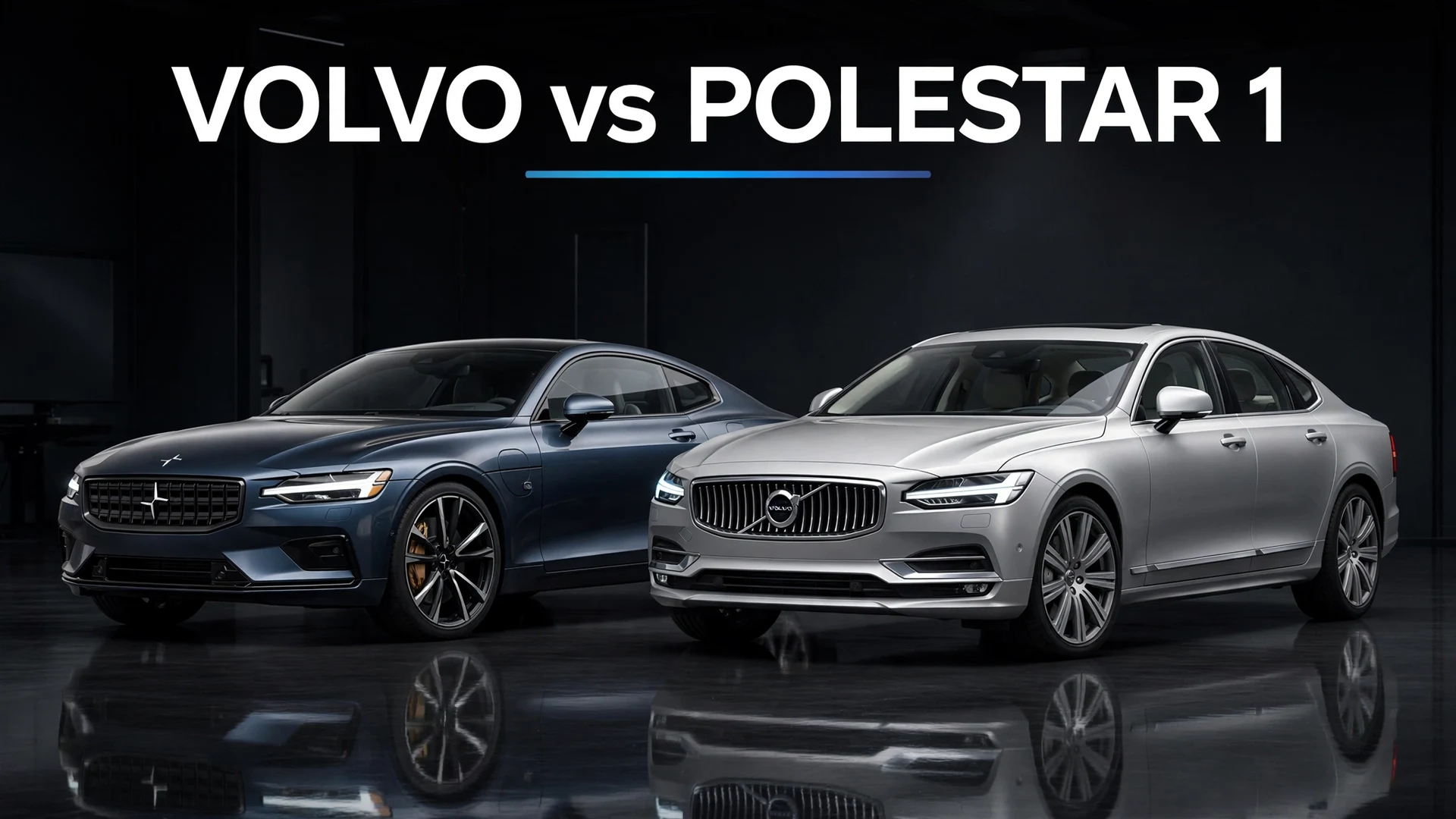
The Polestar 1 is a plug-in hybrid grand tourer that shares its powertrain formula with the Volvo XC90 T8 — but it was a limited run of just 1,500 cars, built from 2019 to 2021, with a carbon-fiber body and a starting price of $155,000. A comparable Volvo XC90 T8 gives you the same twincharged 2.0-liter hybrid hardware for roughly a third of the money, while the Polestar 1 offers exotic rarity, sharper handling, and genuine collector status. If you want the technology, buy the Volvo. If you want a future classic, hunt down the Polestar 1.
- The Polestar 1 ran from 2019 to 2021 with total production capped at 1,500 units — about 450 of them destined for the U.S.
- Its powertrain combines a twincharged (turbocharged and supercharged) 2.0-liter four-cylinder with two rear electric motors for 619 hp and 738 lb-ft.
- The Volvo XC90 T8 plug-in hybrid uses the same engine formula at roughly a third of the Polestar 1’s $155,000 base price.
- Carbon-fiber body, Öhlins dampers, and Akebono brakes make the Polestar 1 a true halo car, not just a rebadged Volvo.
- Used Polestar 1 values are holding firm on scarcity — it behaves more like a collector car than a depreciating used EV.
Volvo and Polestar: How Closely Are They Related?
Polestar began life as Volvo’s racing team in the Swedish Touring Car Championship in the mid-1990s and evolved into the factory performance arm — think of it as Volvo’s equivalent of what AMG once was to Mercedes. Volvo bought the Polestar performance division outright in July 2015. Then, in June 2017, Volvo’s parent company Geely spun Polestar off as a standalone global brand for high-performance electrified vehicles, with Volvo design chief Thomas Ingenlath installed as its CEO.
The relationship has since loosened further. In February 2024, Volvo stopped funding Polestar and distributed most of its stake, retaining about 18 percent, while Geely increased its control. Polestar today is a separate automaker headquartered in Gothenburg that still shares platforms and components with Volvo — the Polestar 3 SUV, for example, is built alongside the Volvo EX90 in Ridgeville, South Carolina.
The Polestar 1 was the brand’s launch vehicle: a statement car whose design traces back to Volvo’s 2013 Concept Coupe. It rides on a shortened version of Volvo’s SPA platform (the architecture under the S90 sedan), and its plug-in hybrid system is derived from the XC90 T8’s. So when people say the Polestar 1 is “a Volvo underneath,” they are broadly right — but the carbon-fiber body, bespoke chassis tuning, and hand-finished assembly in Chengdu, China, put meaningful distance between it and anything with a Volvo badge.
Specs at a Glance
| Specification | Polestar 1 (2019–2021) | Volvo XC90 T8 Recharge (current) |
|---|---|---|
| Powertrain | 2.0L twincharged I4 + ISG + 2 rear e-motors (PHEV) | 2.0L twincharged I4 + electric motor (PHEV) |
| Combined output | 619 hp / 738 lb-ft | 455 hp / 523 lb-ft |
| Battery | 34 kWh | 18.8 kWh |
| Electric range (EPA) | 52 miles | 33 miles |
| 0–60 mph | 4.2 seconds | ~5.1 seconds |
| Body | Carbon-fiber 2+2 coupe | Steel 7-seat SUV |
| Production | 1,500 units, 2019–2021 | Mass production, ongoing |
| Base price when new | $155,000 | ~$72,000 |
| Drivetrain trick | Torque vectoring via twin rear motors | Single rear motor, no torque vectoring |
Combined system output: Polestar 1 vs Volvo XC90 T8
Where the Polestar 1 Pulls Ahead
The headline numbers only tell part of the story. The Polestar 1’s twin rear electric motors — one per rear wheel — enable genuine torque vectoring, something no Volvo T8 can do. That, plus manually adjustable Öhlins dampers at all four corners, Akebono brakes, and a carbon-fiber body that keeps weight in check for a plug-in hybrid, makes the 1 a legitimate driver’s car rather than a fast cruiser. MotorWeek’s first drive praised its composure on twisty roads, noting it stayed nimble and planted where heavier-feeling luxury cars would wallow.
Then there is the exclusivity math. With 1,500 cars built over three model years and only about 450 allocated to the United States, the Polestar 1 is rarer than a Ferrari F40 (1,315 built). It was also the first — and, since Polestar is now EV-only, the last — hybrid the brand will ever make. Halo cars from new brands with that kind of production cap have a strong historical record of holding value, and early used-market data suggests the 1 is behaving like a collector car rather than a depreciating used plug-in.
Practicality is not entirely absent, either. The 34 kWh battery delivers 52 miles of EPA-rated electric range and 58 MPGe — the longest electric range of any plug-in hybrid on sale at the time. For a grand tourer, it is genuinely usable as a daily driver: silent electric commuting during the week, 619 hp on demand for the weekend.
Where a Volvo T8 Makes More Sense
Here is the uncomfortable truth for Polestar fans: the Volvo XC90 T8 Recharge delivers the same fundamental hybrid technology — twincharged 2.0-liter, electric assistance, all-wheel drive — in a package that seats seven, tows, carries a family, and costs less than half as much. The current XC90 T8 makes 455 hp with 33 miles of electric range, which covers the average American commute. It also comes with a full Volvo dealer service network, standard warranty support, and parts availability that a 1,500-unit halo car can never match.
Servicing is a real consideration. Polestar 1 owners rely on a small network of Polestar and Volvo service points, and carbon-fiber body repairs are specialist work. Insurance, tire, and brake costs all run at exotic-car levels. The XC90 T8, by contrast, is a mainstream luxury SUV with mainstream running costs.
Depreciation risk also favors the Volvo in the short term. The Polestar 1’s collector case is strong but unproven over a full market cycle; the XC90 T8 is a known quantity with established residuals. If your goal is economical electrified motoring rather than owning a piece of automotive history, the Volvo wins decisively.
Which Buyer Are You?
Buy the Polestar 1. 1,500 units, first-and-last hybrid from a new brand, carbon body, $155k launch price — this is the profile of a future classic. Prioritize documented service history and original paint; carbon repairs are expensive. Expect values to be volatile but supported by scarcity.
It depends how you drive. If your “driving” means weekend back roads, the Polestar 1’s torque vectoring and Öhlins dampers are genuinely special. If it means daily commuting with occasional fun, a used Polestar 1 at a discount — or a Volvo T8 — delivers 90% of the experience for far less money and hassle.
Buy the Volvo T8. Same engine family, same plug-in philosophy, seven seats, a real dealer network, and a price that leaves six figures in your pocket. The Polestar 1 is a beautiful detour; the XC90 T8 is the car you can actually live with.
Alternatives Worth Considering
If the Polestar 1’s price or rarity puts you off but you want the flavor, consider these: a used BMW i8 (similar carbon-intensive plug-in halo, also appreciating), a Porsche Panamera 4 E-Hybrid (four doors, similar money when new, easier to service), or the current Volvo S60/V60 Polestar Engineered models — the actual descendants of the Polestar tuning arm, with 455 hp plug-in powertrains and Öhlins suspension at a fraction of the 1’s price. For pure electric grand touring, the used market for early Porsche Taycans now overlaps Polestar 1 pricing.
The Verdict
The Polestar 1 is the better car in almost every objective performance measure — more power, more torque, more electric range, better handling hardware, and a body made of carbon fiber. The Volvo XC90 T8 is the better purchase for almost every real-world buyer — similar technology, genuine practicality, dealer support, and a price that is less than half. Buy the Polestar 1 with your heart and your investment thesis; buy the Volvo T8 with your head. Neither choice is wrong, but only one of them seats seven.
FAQ
How many Polestar 1 cars were built?
Polestar planned and built 1,500 units total, produced from 2019 to 2021 at its Chengdu, China facility. Roughly 450 of those were allocated to the United States, with about 125 arriving in the final 2021 batch.
Is the Polestar 1 just a rebadged Volvo?
No. It uses Volvo’s SPA platform and a powertrain derived from the XC90 T8, but it has a carbon-fiber body, bespoke chassis with Öhlins dampers and Akebono brakes, twin rear motors for torque vectoring, and was hand-finished as a limited-run halo car. The mechanical relationship is real, but the execution is distinct.
What is the electric range of the Polestar 1?
The EPA rated the Polestar 1 at 52 miles of electric-only range from its 34 kWh battery, with 58 MPGe combined. Polestar itself claimed up to 60 miles in its own communications. On gasoline alone it is rated at 26 mpg combined.
How much did the Polestar 1 cost new?
Pricing started at $155,000 in the U.S. for the Launch Edition (later listed at $156,500), with a First Edition trim at $160,000. For comparison, a current Volvo XC90 T8 starts around $72,000 — less than half.
Is the Polestar 1 a good investment?
It has the right ingredients — 1,500 units, first and last hybrid from the brand, carbon body — and early used values have held up well on scarcity. But collector markets are cyclical, and servicing a limited-run carbon car is expensive. Treat it as an enthusiast purchase with investment potential, not a guaranteed asset.
Can you still buy a new Polestar 1?
No. Production ended in 2021 and the car was never replaced — Polestar is now an EV-only brand. You can only buy used, and with 1,500 cars in existence worldwide, clean examples are scarce.
Sources
- GoodCarBadCar — Polestar 1 sales figures and specifications
- The Drive — Polestar 1 production ends in 2021
- MotorWeek — 2021 Polestar 1 first drive review
- Engadget — Polestar to cease production of its hybrid at end of 2021
- Green Car Reports — Volvo cuts Polestar funding, February 2024
- Jalopnik — Who owns Polestar and where its cars are made