Volvo P2 vs P3?

Volvo P2 vs P3?
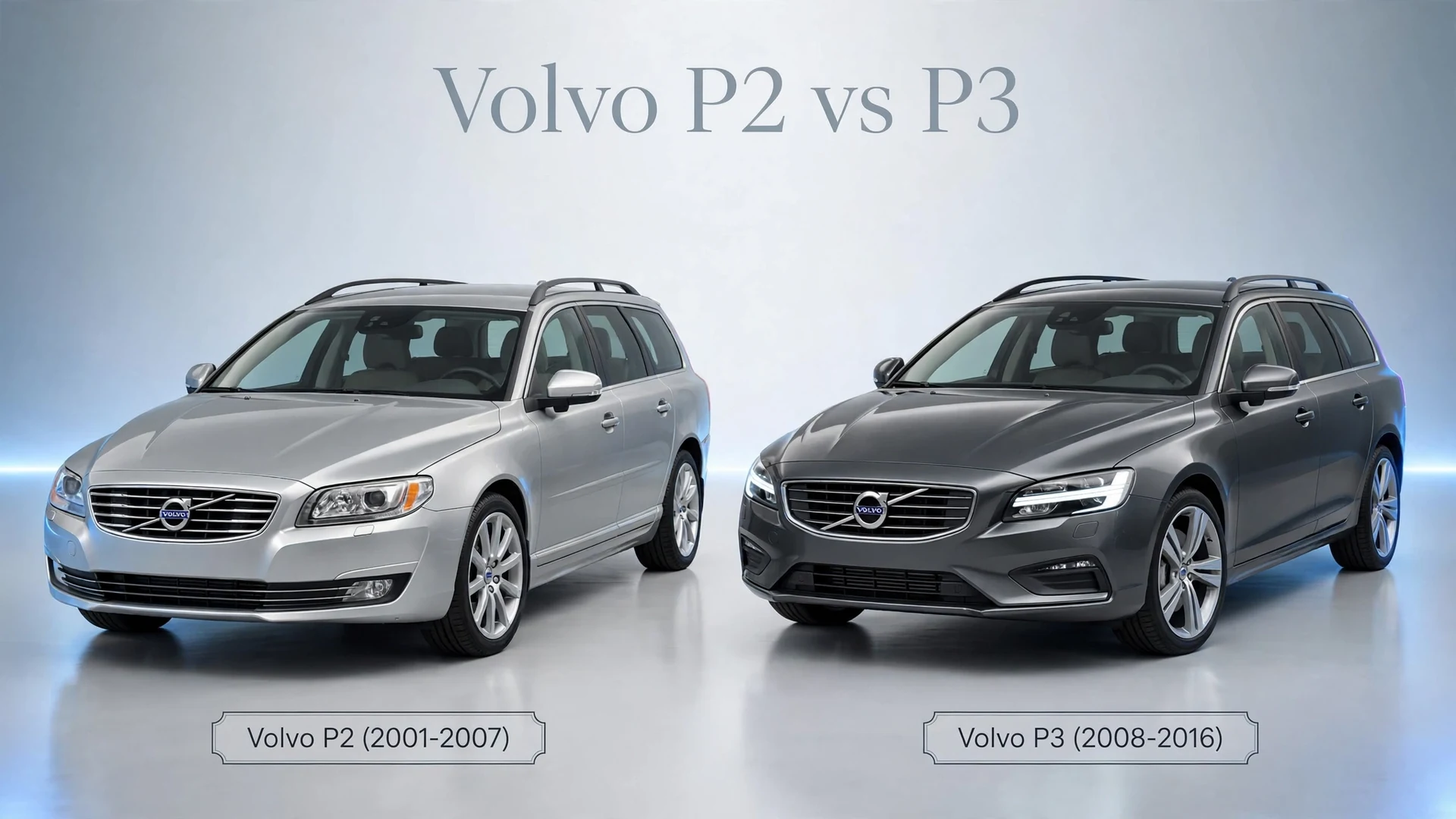
Volvo’s P2 platform (1999–2014: S80, S60, V70, XC70, XC90) and P3 platform (2007–2018: S80 II, S60 II, V70 III, XC70 III, XC60, V60) are the two architectures behind nearly every used Volvo you’ll encounter from the 2000s and 2010s. The short answer: P3 cars are the more refined, safer, better-equipped generation — quieter cabins, stronger structures, and more modern powertrains — while P2 cars are simpler, cheaper to buy and fix, and supported by an enormous DIY community. P3 wins for most buyers; P2 wins for the budget-conscious tinkerer. Here’s the complete engineering, reliability, and buying comparison.
- P2 (1999–2014): S80 I, S60 I, V70 II, XC70 II, XC90 I. Volvo’s own architecture; 5-cylinder white-block engines; simpler electrics.
- P3 (2007–2018): S80 II, S60 II, V70 III, XC70 III, XC60 I, V60. Ford EUCD-derived; SI6 3.2/T6 sixes, later Drive-E 4-cylinders.
- P2 weak spots: ETM throttle (1999–2002), AW55-50 valve body (2001–2002), PCV clogging, AWD angle-gear sleeve, timing-belt 5-cylinders.
- P3 weak spots: PCV breather box, AC compressors, electric parking brake sticking, early Drive-E oil consumption.
- Costs: P2 parts are cheaper and DIY support is vast; P3 suspension work is more complex but components last longer.
- Verdict: P3 for the daily driver; P2 for the budget project or second car.
The Two Platforms in 60 Seconds
P2 was Volvo’s first fully in-house large-car architecture of the modern era, debuting under the 1999 S80 and spreading to the S60, V70, XC70, and the original XC90 — which stayed in production an astonishing 12 years (2003–2014). Its heart is the modular “white block” engine family: 5-cylinder gasoline and diesel engines (2.4, 2.5T, T5, D5) plus the 2.9/3.2 sixes and the Yamaha V8 in the XC90. Transmissions were 5-speed manuals or the Aisin AW55-50 5-speed automatic (with the GM 4T65 in early T6 models). P2 electrics are simpler than what followed — fewer modules, less CAN-bus complexity.
P3 arrived with the 2007 S80 and is derived from Ford’s EUCD architecture (developed during Ford’s ownership of Volvo — the same bones underpin contemporary Mondeos). It brought a stiffer structure, more refined multilink rear suspension, and a new engine strategy: the transverse SI6 3.2-liter inline-6 and turbocharged T6 (3.0L), with the 5-cylinder soldiering on in base trims until the Drive-E (VEA) 2.0-liter direct-injection 4-cylinders arrived from 2014–2015. The Aisin TF-80SC 6-speed automatic became the standard slushbox. Interiors, safety systems (City Safety, pedestrian detection), and infotainment all leapt a generation forward.
Which Cars Are Which
| Model | P2 (years) | P3 (years) |
|---|---|---|
| S80 | 1999–2006 | 2007–2016 |
| S60 | 2001–2009 | 2011–2018 |
| V70 | 2001–2007 | 2008–2010 (US; longer in Europe) |
| XC70 | 2001–2007 | 2008–2016 |
| XC90 | 2003–2014 | — (replaced by SPA XC90, 2016–) |
| XC60 | — | 2010–2018 |
| V60 | — | 2015–2018 (US; 2011– in Europe) |
Note the overlap years: both platforms were on sale simultaneously around 2007–2009 (P2 S60 and XC90 continued while P3 S80, V70, and XC70 launched), so always verify by model year, not by badge. Also note the naming reshuffle that confuses everyone: on P2, the S60 and V70 were sister cars; on P3, the V70 grew to S80 size while the S60 shrank and spawned its own V60 wagon.
Engineering Differences That Matter
Structure and safety. P3 bodies are stiffer and protect better — Volvo’s safety development never stood still, and a decade of progress shows in crash performance and driver-assistance tech (City Safety auto-braking, blind-spot systems, pedestrian detection arrived on P3). P2 cars were class-leading in their day and remain structurally sound, but they’re a generation behind.
Engines. P2’s 5-cylinders are the beloved workhorses: timing-belt driven (replacement every ~10 years/120k miles — non-negotiable), tolerant of neglect, and cheap to rebuild. P3’s SI6 3.2 is chain-driven and generally robust (watch the PCV breather box and aux-belt tensioner at ~10 years/150k miles); the T6 adds strong turbo performance with more heat and complexity; late Drive-E 4-cylinders bring direct injection and supercharging/turbocharging — efficient but with early oil-consumption issues on some units and more expensive failures.
Transmissions. P2’s AW55-50 5-speed is infamous for early valve-body failures (especially 2001–2002; $3,500–$4,000 dealer repairs were common), though later units with fluid changes are durable. The GM 4T65 in early T6 models is the one to avoid. P3’s TF-80SC 6-speed is a markedly better gearbox — smoother, stronger, and longer-lived with fluid services.
AWD. Both use Haldex-based AWD with an angle gear (bevel gear) transferring power rearward. The angle gear’s splined sleeve is a known wear item on P2 AWD cars (XC70, V70R, S60R) — a $1,000+ job when it strips. P3 AWD is a more developed system with fewer chronic complaints, though no AWD system is maintenance-free.
Electrics. P2’s simpler architecture means fewer modules to fail — but the CEM (central electronic module) and DIM (driver information module, with its failing solder joints/dash pixels) are known issues. P3 added modules and complexity; the electric parking brake’s sticking calipers (wearing rear pads prematurely) are the signature annoyance.
Common Faults Compared
| System | P2 (typical faults) | P3 (typical faults) |
|---|---|---|
| Engine breathing | PCV system clogs → oil leaks, seal failures (service ~every 100k mi) | PCV breather box on top of engine fails; easy 5-minute swap |
| Transmission | AW55-50 valve body (2001–02); B4 servo cover; fluid changes essential | TF-80SC 6-speed — robust with fluid services |
| Throttle | ETM electronic throttle (1999–2002) — the famous one | Resolved; no chronic throttle issues |
| AWD | Angle-gear splined sleeve strips; Haldex servicing needed | Improved; fewer chronic complaints |
| Suspension | Control-arm bushings, strut mounts, sway-bar links wear | Holds up better; but more complex/expensive to work on |
| Electrics | DIM pixel/solder failures; CEM issues; alarm siren module | Electric parking brake sticking; more modules overall |
| Climate | Blower resistor; AC compressor clutch | AC compressor solenoid (“lazy” cooling); blower motor |
| Timing | Belt-driven 5-cyl — belt service critical | Chain-driven 6-cyl and Drive-E — no belt service |
Running Costs: Purchase, Parts, and DIY
Purchase prices heavily favor P2: a decent S60 or V70 can be found for a few thousand dollars, while comparable P3 cars command roughly double. The XC90 is the P2 bargain of the century — or its money pit, depending on maintenance history (avoid the early T6’s GM transmission; the 2.5T and later 3.2/V8 cars are the ones to buy).
Parts and DIY also favor P2, and this is where the platform’s age becomes an asset: two decades of forum knowledge, abundant used parts, and straightforward mechanical layouts make P2 Volvos among the most DIY-friendly modern cars. P3 parts cost more, some jobs (suspension, blower motor) are more labor-intensive, and diagnostic work increasingly needs Volvo-specific software. That said, P3 components generally last longer between replacements — you pay more per job but do fewer jobs.
Fuel and insurance are roughly a wash within equivalent segments; the late P3 Drive-E cars are the efficiency standouts (mid-30s mpg highway in an S60), while P2 T5/R models and the XC90 V8 drink accordingly. Insurance favors older, cheaper P2 cars.
Which Should You Buy?
Verdict: P3 Is the Better Car; P2 Is the Better Bargain
There’s no upset here: the P3 platform is the superior engineering achievement — stiffer, safer, more refined, with better gearboxes and chain-driven engines. For a daily driver you’ll keep for years, a well-chosen P3 (2012+ S60, XC60, or XC70) is the rational buy and worth the premium. But the P2’s case is stronger than the spec sheet suggests: unmatched parts availability, vast DIY knowledge, simpler systems, and purchase prices so low the math forgives a lot of maintenance. Buy the P3 with your head; buy the P2 with your heart and your toolbox.
Whatever platform you choose, buy the car, not the badge. On both P2 and P3 cars of this age, get underneath: rear wheel arches, subframes, and brake lines tell the truth about a car’s life, and southern or garaged cars are worth traveling for. Service history beats mileage — a 150,000-mile car with a documented PCV service, timing belt, and transmission fluid changes is a better buy than a 90,000-mile car with nothing. And join the owner’s forum before you buy, not after: the model-specific buyer’s guides on the big Volvo communities will tell you exactly which questions to ask the seller.
Sources
- NHTSA Technical Service Bulletin MC-10231934-9999 (Volvo, 2023) — official P1/P2/P3/P5/P6 platform-to-model-year mapping.
- FCP Euro Volvo P3 Owners Hub — P3 model history, SI6 and Drive-E engine introduction, XC60/V60 notes.
- Matthews Volvo Site — P2 parts-failure poll (V70/S60/XC70 2001–2007): control-arm bushings, PCV, ETM, strut mounts, sway-bar links.
- Matthews Volvo Site — P2 reliability discussion: AW55-50 valve-body failures ($3,500–$4,000), B4 servo cover, ETM 1999–2002.
- TurboBricks (Volvo technician) — P3 3.2 buying guide: PCV breather box, AC compressor solenoid, blower motor, aux-belt tensioner intervals.
- Volvo Owners Club Forum — P2 vs P3 owner debate: size/positioning shifts, weight, comfort and equipment comparisons.
Frequently Asked Questions
What years are Volvo P2 and P3?
P2 spans roughly 1999–2014 (S80 1999–2006, S60 2001–2009, V70/XC70 2001–2007, XC90 2003–2014). P3 spans roughly 2007–2018 (S80 2007–2016, XC70 2008–2016, XC60 2010–2018, S60 2011–2018, V60 2015–2018). The platforms overlapped in 2007–2009.
Is P3 more reliable than P2?
Generally yes for powertrain and structure: P3 resolved the ETM and early AW55 valve-body issues, added the robust TF-80SC 6-speed, and uses chain-driven engines. But P3s have their own faults (PCV breather box, AC compressor, electric parking brake), and P2s are cheaper and simpler to fix.
What are the worst P2 problems to check when buying?
Electronic throttle module (1999–2002), AW55-50 automatic valve-body failures (especially 2001–2002), clogged PCV systems, AWD angle-gear sleeve wear, and overdue timing belts on the 5-cylinder engines. Also check the DIM dashboard display and front suspension bushings.
What goes wrong on P3 Volvos?
The most reported issues are the PCV breather box (easy fix), “lazy” AC compressors (solenoid failure), blower motors, sticking electric parking-brake calipers, and oil consumption on some early Drive-E 4-cylinder engines. Aux-belt tensioners should be serviced around 10 years/150k miles.
Which is cheaper to own, P2 or P3?
P2: lower purchase prices, cheaper parts, and vast DIY support make it the budget champion — but expect more frequent age-related jobs. P3: higher buy-in and pricier parts/labor, but components generally last longer and the cars are more fuel-efficient (especially Drive-E models).
Should I buy a P2 XC90 or a P3 XC60?
The P2 XC90 (2003–2014) offers 7 seats and bargain prices — choose the 2.5T or later 3.2/V8 and avoid early T6 models. The P3 XC60 (2010–2018) is the more modern, refined, and reliable vehicle with better safety tech, but costs significantly more. For family duty, the XC60 is the safer recommendation.