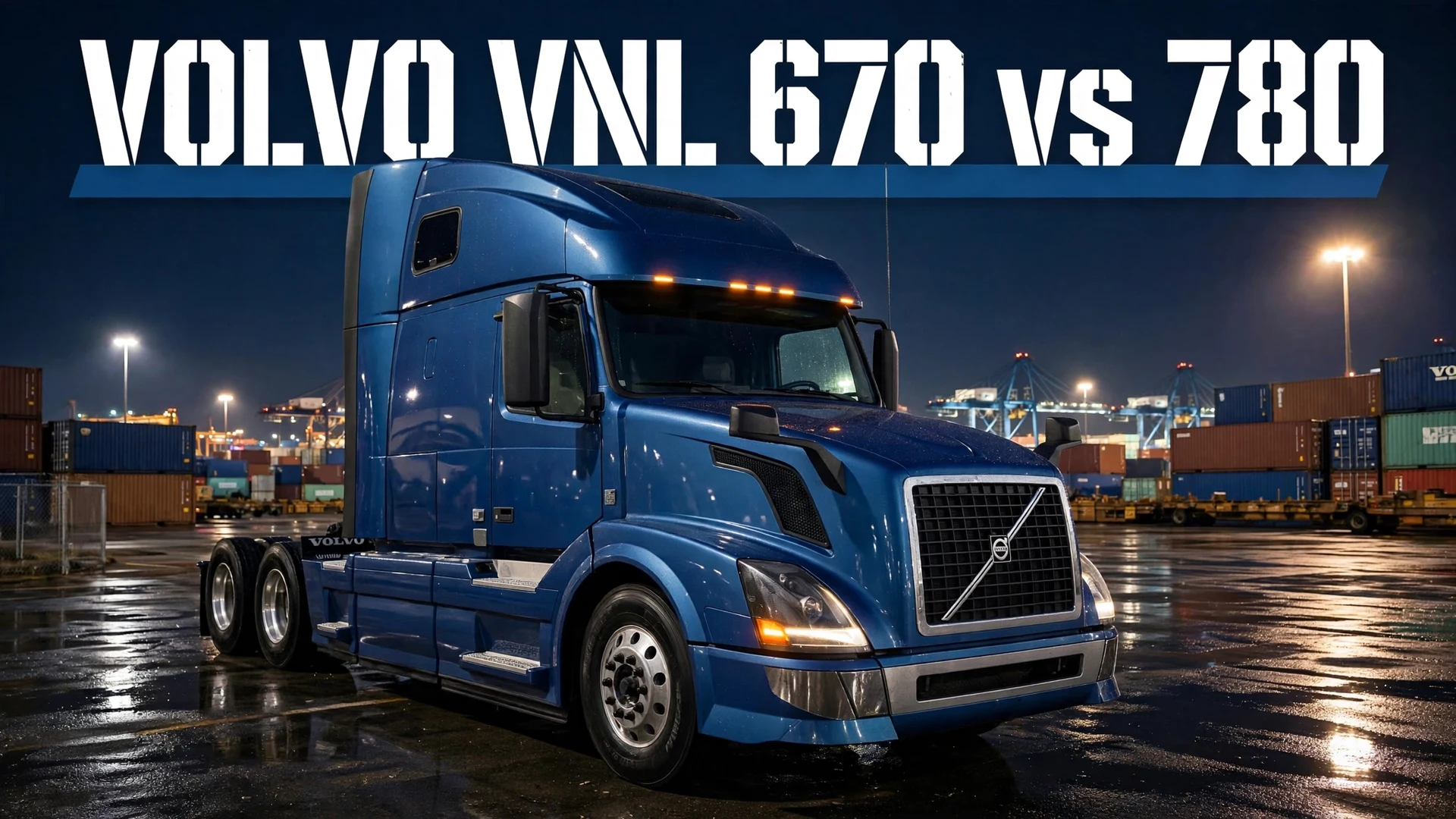
Volvo VNL 670 vs 780 Weight: Tare Weight, Payload & Which Sleeper Pays Better

If you are choosing between a Volvo VNL 670 and a Volvo VNL 780, the headline number is simple: the 780’s 77-inch condo sleeper makes it roughly 2,000 pounds heavier than the 670’s 61-inch mid-roof sleeper. A typical road-ready VNL 670 scales around 17,500–18,500 lbs with fuel and gear aboard; a comparably equipped VNL 780 scales around 19,500–21,700 lbs. Under the federal 80,000-lb gross combination limit, that difference comes straight out of your legal payload.
Key Takeaways
- The VNL 670 carries a 61-inch high-roof sleeper; the VNL 780 carries a 77-inch high-roof condo sleeper with a convertible dinette workstation.
- Dry curb weight typically runs 16,000–17,000 lbs (670) vs 18,000–19,000 lbs (780); road-ready with fuel, APU, and gear, the gap stays near 2,000 lbs.
- A published owner-operator scale ticket shows a loaded 780 at 21,680 lbs (steer 12,200 / drives 9,480) — too heavy to scale 45,000-lb reefer loads.
- At the 80,000-lb federal limit, the 670 hauls roughly 2,000 lbs more paying freight than the 780 on identical trailers.
- Volvo replaced the 670 with the VNL 760 (70″ sleeper) and the 780 with the VNL 860; the all-new 2024 VNL generation continues the 860 as flagship.
The Numbers, Head to Head
Both trucks share the same DNA — Volvo D13 power, I-Shift automated transmission, and Class 8 ratings — but the sleeper choice changes the weight slip. Figures below are realistic bands compiled from dealer listings, auction spec sheets, and published owner scale tickets; exact numbers move with tanks, fairings, APUs, and wheelbase.
| Specification | Volvo VNL 670 | Volvo VNL 780 | Why It Matters |
|---|---|---|---|
| Sleeper size & type | 61-inch high-roof | 77-inch high-roof condo | The 780’s extra 16 inches of sleeper is the root of the weight gap |
| Standing interior height | ~64 inches | 100+ inches | Full stand-up room anywhere in the 780’s living space |
| Dry curb weight (typical) | 16,000 – 17,000 lbs | 18,000 – 19,000 lbs | Factory weight before fuel, driver, and gear |
| Road-ready scale weight | 17,500 – 18,500 lbs | 19,500 – 21,700 lbs | Full tanks, APU, DEF, driver, and personal gear aboard |
| Engine | Volvo D13 12.8L, 375 – 500 hp / 1,450 – 1,850 lb-ft (D16 and Cummins ISX15 on older 670s) | Same powertrain family; weight gap is cab/chassis, not engine | |
| Transmission | Volvo I-Shift 12-speed automated (ATO2612D) | ~712-lb unit; identical on both models | |
| Front axle rating | 12,000 – 12,500 lbs | 12,500 – 13,200 lbs | The 780’s steer axle runs heavy — spec tires accordingly |
| Typical wheelbase | 210 – 230 in | 225 – 240 in | Longer frame rails and swing clearance add steel weight |
| Fuel capacity (typical) | Dual 100 – 125 gal | Dual 125 – 150 gal | 300 gal of diesel ≈ 2,160 lbs — tanks are a weight strategy |
| Max legal combination weight | 80,000 lbs (federal: 12,000 steer / 34,000 drives / 34,000 trailer tandems) | The fixed ceiling both trucks share | |
| Replaced by | VNL 740 / 760 | VNL 860 | 2018 generation; all-new VNL arrived for 2024 |
Tare Weight, Visualized
“Dry curb” is the factory truck with empty tanks; “road-ready” is what a CAT scale shows with full fuel, DEF, APU, driver, and gear. The gap barely moves between the two states — the sleeper shell is always there.
Scale: 0 – 22,000 lbs. 670 figures are typical bands from dealer/auction listings; the 780 road-ready figure is a published owner-operator scale ticket (300 gal fuel, APU, full DEF, gear aboard). Always scale your own truck.
Where the 780’s Extra ~2,000 Lbs Actually Lives
The weight does not come from one big thing. It comes from a dozen medium things, all downstream of one decision: a condo sleeper you can stand up and live in.
Illustrative side profiles (not to scale). The 780’s taller roof, longer sleeper, and residential interior are where the weight penalty originates.
- Sleeper shell and framing (largest share). Sixteen extra inches of high-roof sleeper means more stamped steel, glass, roof fairings, insulation, and trim — well over half the total delta.
- The dinette workstation. The 780’s signature convertible dinette — steel-framed table, two booth seats that fold into a bed — plus upper bunk, ladder, refrigerator, microwave prep cabinet, and overhead cupboards add several hundred pounds over the 670’s fixed bunk.
- Wheelbase and chassis. The 780 typically rides a 225–240-inch wheelbase (vs 210–230 for the 670) to keep swing clearance for 53-foot trailers. Longer frame rails are heavier frame rails.
- Tanks and fairings. 780s are commonly spec’d with dual 125–150-gallon aluminum tanks and full chassis fairings. Three hundred gallons of diesel weighs about 2,160 lbs — fuel strategy alone can swing the scale by a ton.
- APU and hotel loads. Owner-operators who live in the truck add auxiliary power units (~400 lbs), inverters, tools, and supplies. A published 780 owner ticket shows 21,680 lbs with APU, 300 gallons of fuel, full DEF, and gear aboard.
The 80,000-Lb Math: Why Every Pound Is Money
Federal law caps the combination at 80,000 lbs gross — 12,000 on the steer axle, 34,000 on the drive tandems, 34,000 on the trailer tandems. Payload is what’s left after truck, trailer, fuel, and driver:
Legal payload = 80,000 − (tractor tare + trailer tare + fuel + driver/gear)
Run that arithmetic with typical numbers. A road-ready 670 at 18,500 lbs pulling a 13,500-lb dry van with 1,500 lbs of fuel and driver leaves 46,500 lbs for freight. Behind a 21,680-lb 780, the same load leaves 43,320 lbs — a 3,180-lb swing in this fully-loaded comparison. On weight-sensitive freight — beverages, paper, canned goods, produce — brokers pay by the pound, and 2,000 lbs of denied payload is revenue you watch drive away.
There is also an axle-distribution wrinkle. That owner ticket showed the 780’s steer axle at 12,200 lbs — past the 12,000-lb federal steer figure — with the drives at only 9,480. The 780’s mass sits forward, so owners need 13,200-lb-rated steer tires and careful fifth-wheel placement to stay legal, especially on full tanks.
Scale-Check: Three Freight Scenarios
Pick the freight you actually haul. Each tab runs the empty-weight arithmetic for both trucks against the 80,000-lb ceiling so you can see exactly where each one lands.
Weight, Fuel, and the Ton-Mile Reality
Heavier trucks burn more fuel — but less than most people assume. At a steady 65 mph on flat highway, an extra 2,000 lbs of tare adds only a small rolling-resistance penalty; the cost grows on grades and in stop-and-go traffic, where every acceleration drags the extra ton back up to speed.
The sharper question is revenue per trip, not MPG. If the 670 lets you accept 2,000 lbs more paying freight on every weight-sensitive load, that revenue dwarfs a small fuel difference. Conversely, if your freight never approaches the ceiling, the 780’s weight costs almost nothing while its living space keeps drivers in the seat — and driver turnover is the most expensive line item in trucking.
What Replaced the 670 and 780
Volvo retired the 670/780 numbering with the 2018 VNL generation. The 61-inch 670 was succeeded by the VNL 760 with a 70-inch high-roof sleeper (the 740 covers the mid-roof slot), and the 780 was supplanted by the VNL 860 flagship condo. The all-new 2024 VNL generation continues the 860 as the premium long-haul model with a redesigned 74-inch sleeper. The same physics applies: the bigger the house, the heavier the tare.
Frequently Asked Questions
What is the tare weight of a Volvo VNL 780?
How much heavier is the VNL 780 than the VNL 670?
Can a Volvo VNL 780 legally haul 45,000 lbs?
What replaced the Volvo VNL 670 and 780?
Does the 780’s extra weight hurt fuel economy?
Bottom line: this is a business-model debate. If your freight is heavy and margins live at the scale house, the 670’s ~2,000-lb advantage is pure revenue. If your freight is light, your runs are long, and the cab is home, the 780’s condo is the most productive office-with-a-bedroom in trucking. Scale your truck, know your freight, and pick the sleeper that pays.