Gemini Generated Image nvhtt6nvhtt6nvht scaled

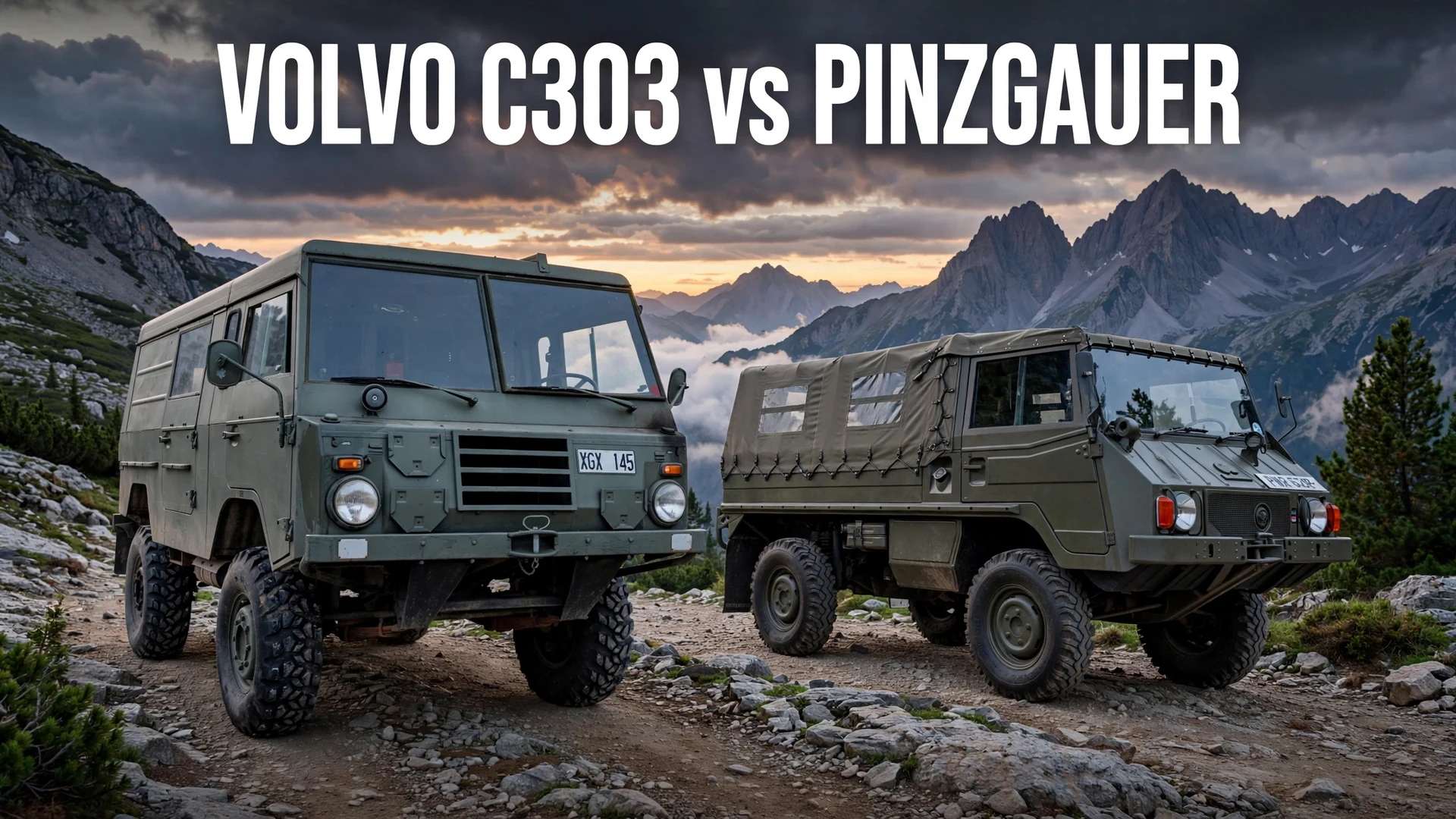
Volvo C303 vs Pinzgauer?

Volvo C303 vs Pinzgauer: Which Surplus Military 4×4 Should You Actually Buy?

Neither of these trucks was ever sold new in a US showroom, and that single fact trips up almost everyone who starts shopping for one. The Volvo C303 and the Steyr-Puch Pinzgauer are both Cold War–era military haulers — one Swedish, one Austrian — that only reach American driveways today as grey-market imports once they clear the 25-year rule. If you’re cross-shopping them, you’re not picking a trim level. You’re picking a whole ownership culture.

I’ve spent years covering Volvo’s model history for readers trying to separate collector hype from mechanical reality, and this comparison leans on production records, military procurement data, and current classic-vehicle market pricing (as of July 2026).

TL;DR

  • The Volvo C303 runs a 3.0L Volvo B30 inline-six gas engine shared with the Volvo 164 sedan — easy parts, easier to work on, gas-station-friendly torque
  • The Pinzgauer uses a 2.5L air-cooled flat-four (or later turbodiesel six) and a unique central-tube chassis that’s more sophisticated but pricier to service
  • Both are 25-year-rule imports in the US — neither was ever factory-sold here new
  • Average asking prices land close: roughly $29,000 for a C303, similar or slightly lower for a Pinzgauer 712, though clean US-based 710/712 listings often start around $29,500
  • The Pinzgauer had a far longer production run (1971–2007) and much wider global service, which means better parts networks outside Scandinavia

What Are These Vehicles, Actually?

The Volvo C303 — officially Terrängbil 11, or “Tgb 11″ in Swedish service — is a 4×4 troop and utility carrier <cite index=”2-1″>developed in the late 1960s based on the successful L3314 series, going into production in 1974</cite>. <cite index=”4-1″>It was Volvo’s answer to a late-1960s Swedish Defense Administration request for a vehicle that could replace an aging fleet in brutal Nordic terrain</cite>. <cite index=”2-1”>A total of 8,718 vehicles across the whole C3 series (C303, C304, C306) were built between 1974 and 1984, with roughly 75% going into military service</cite>.

The Steyr-Puch Pinzgauer is its Austrian rival, <cite index=”12-1″>developed by Steyr-Daimler-Puch as a successor to the smaller Haflinger 4×4, with prototypes appearing in the late 1960s</cite>. <cite index=”11-1″>Production began in 1971 and, remarkably, continued at various facilities until 2007</cite> — nearly three decades longer than the C303’s run. <cite index=”12-1″>More than 20,000 units were built across both generations and sold to over 30 militaries worldwide</cite>.

Pull quote: “The C303 is a Volvo 164 engine wearing combat boots — the Pinzgauer is a purpose-built off-road system with no civilian parts bin to raid.”

Core Question, Answered Fast

If you want maximum parts simplicity and a familiar gas engine, the C303 wins. If you want a vehicle with a longer global support network, better factory documentation, and a more sophisticated chassis, the Pinzgauer wins. Neither is a daily-driver proposition, and both demand a buyer who enjoys wrenching.

Engine and Drivetrain: Different Philosophies

The C303’s heart is <cite index=”4-1″>a version of the Volvo B30 petrol engine — an inline-six with overhead valves, 3.0-liter displacement, and 125 hp with 162 lb-ft of torque</cite>. <cite index=”7-1″>That engine started life powering the Volvo 164 luxury sedan</cite>, which is the whole appeal: Volvo enthusiasts already know this motor, and parts networks for it are mature even decades later.

The Pinzgauer takes a stranger, more specialized route. <cite index=”14-1″>First-generation models used a 2.5-liter air-cooled inline-four making about 87 bhp (105 hp SAE) with 133 lb-ft of torque, fed by dual Zenith carburetors</cite>. <cite index=”16-1″>The air-cooled design eliminates radiator freeze-ups and damage in the field, and the engine is happy running on low-octane fuel</cite>. Later second-generation 716/718 models moved to water-cooled turbodiesel sixes for more power and better fuel efficiency.

Quick Tip: If you’ve never rebuilt an air-cooled flat-four, budget time to learn — Pinzgauer engine parts are excellent but you won’t find a shop on every corner the way you might for Volvo six-cylinder work.

Chassis and Off-Road Hardware

This is where the two trucks diverge philosophically. <cite index=”4-1″>The C303 uses a body-on-chassis design with live axles and leaf springs front and back, plus portal axles that create roughly 15 inches of ground clearance under the differentials</cite>. It’s mechanically straightforward — closer to a lifted truck than a piece of engineering art.

The Pinzgauer is built around <cite index=”13-1″>a central tube chassis that houses the entire drivetrain — the transfer case sits inside the tube, and prop shafts without U-joints run through it to drive the axles</cite>. <cite index=”13-1″>Independent suspension uses solid beam half-axles that pivot around differentials mounted inside that tube, each with an electrically operated hydraulic differential lock</cite>. It’s a genuinely clever system — and one that’s harder to fabricate a replacement for if something breaks in the field.

Expert Insight: Portal axles on both trucks mean the differentials sit above wheel-center height, which is why both can wade, climb, and shrug off deep snow that would strand a stock pickup. The tradeoff is a taller center of gravity, so don’t expect sports-car cornering from either one.

Comparison Table

SpecVolvo C303 (Tgb 11)Steyr-Puch Pinzgauer 710/712
OriginSweden (Volvo, 1974–1984)Austria (Steyr-Daimler-Puch, 1971–2000; UK-built to 2007)
Total production<cite index=”2-1″>8,718 units (whole C3 series)</cite><cite index=”12-1″>Over 20,000 units (both generations)</cite>
Engine<cite index=”4-1″>3.0L Volvo B30 inline-six, gas, 125 hp / 162 lb-ft</cite><cite index=”14-1″>2.5L air-cooled inline-four, gas, ~87 bhp / 133 lb-ft (Gen 1)</cite>
Ground clearance<cite index=”4-1″>~15 in (380mm) under differentials</cite><cite index=”18-1″>13.2 in (335mm) fully loaded</cite>
Top speed<cite index=”7-1″>62 mph (100 km/h)</cite><cite index=”18-1″>68 mph (110 km/h) for 4×4, 62 mph (100 km/h) for 6×6</cite>
Towing (on-road)Not commonly published<cite index=”18-1″>5,000 kg (11,023 lb)</cite>
Typical asking price~$18,000–$38,500, average $29,062~$29,500 for clean US 710/712; wide range abroad
US factory availabilityNever sold new; import onlyNever sold new; import only

Pros and Cons by Buyer Type

The overland expedition builder

  • ✅ C303: Familiar six-cylinder engine simplifies a diesel-swap-free build; flat glass is field-replaceable anywhere
  • ✅ Pinzgauer: Longer wheelbase 6×6 (712) variants and stronger factory payload ratings suit heavier camper conversions
  • ❌ Both: Parts sourcing means planning ahead — neither has a nationwide dealer network

The military vehicle collector

  • ✅ Pinzgauer: <cite index=”11-1″>Documented service history across 29+ countries</cite>, including <cite index=”11-1″>US Army Delta Force use in the 1991 Gulf War and 2003 Iraq War</cite>, gives it deeper provenance appeal
  • ✅ C303: <cite index=”2-1″>A 1983 Paris-Dakar class win</cite> gives it a genuine motorsport story most Cold War trucks can’t claim
  • ❌ Both: Right-hand-drive and non-US-spec electrical systems complicate registration in some states

The backyard off-road hobbyist

  • ✅ C303: Simple body-on-frame design is approachable for a first heavy-truck restoration
  • ❌ Pinzgauer: The central-tube chassis is elegant engineering but intimidating for a first-timer to service
  • ✅ Both: Portal axle ground clearance outperforms almost anything else at this price point

Real-World Scenario

A Michigan-based overlander recently converted a 1973 Pinzgauer 712 into a full expedition camper — solar panels, a diesel heater, a rebuilt engine and clutch — and listed it around $60,000 once finished, illustrating how far build costs can climb above the base purchase price. Compare that to a bone-stock 1974 C303 that changed hands for $18,995 as a “clean solid driver” with no camper conversion — the delta between a stock truck and a fully-built one is enormous on either platform.

Expert Insight: The Parts Reality Check

Expert Insight: Both trucks share the same underlying constraint — you’re not buying into a Ford or Toyota parts ecosystem. Forum threads from both owner communities repeat the same advice: budget extra time, not just money, for sourcing parts, and join an owners’ forum before you buy, not after.

Alternatives to Consider

Choose a Unimog 404/416 if: you want an even more industrial-grade parts and support network — Mercedes-Benz’s military Unimogs share the “portal axle off-roader” DNA but with a larger global restoration community.

Choose a Land Rover Series III if: you want lighter weight, simpler mechanicals, and a much larger North American parts supply than either the C303 or Pinzgauer can offer.

FAQ

Can I buy a Volvo C303 or Pinzgauer new in the US? No. Neither was ever factory-sold in the US as a civilian vehicle. Every unit on US roads today is a surplus military import that has cleared the 25-year federal import exemption.

Which one is cheaper to maintain? Generally the C303, since its Volvo B30 inline-six shares parts with civilian Volvo sedans of the era. The Pinzgauer’s air-cooled flat-four and central-tube chassis require more specialized sourcing.

Are these legal to register and drive on US roads? Most states allow registration once a vehicle clears the 25-year import rule, but requirements vary — check your state DMV before buying, especially for right-hand-drive examples.

What’s a fair price to pay in 2026? Based on current listings, budget $18,000–$30,000 for a solid driver-condition C303 and roughly $25,000–$35,000 for a comparable Pinzgauer 710/712, with well-documented or fully restored examples commanding more.

Which is better for overlanding builds? The Pinzgauer’s 6×6 variants and higher payload capacity edge it out for heavy camper conversions; the C303’s simpler drivetrain favors builders who want to do their own wrenching.

Key Takeaways

  • Both trucks are 25-year-rule imports — never sold new in the US, so there’s no “MSRP” comparison to make
  • The C303 leans on a familiar Volvo inline-six; the Pinzgauer leans on a more specialized, longer-lived engineering platform
  • Average asking prices for both currently sit in the high-$20,000s to low-$30,000s range, with wide variance by condition
  • The Pinzgauer’s longer production run and wider military adoption mean a larger global parts and owner-support network
  • Neither is a casual purchase — budget for a support community and a learning curve on either platform

Next step: Before buying either truck, join a dedicated owners’ forum (C303 or Pinzgauer-specific) and get a pre-purchase inspection from someone who’s worked on the platform — sourcing surprises are far more common than mechanical ones.

Similar Posts