Volvo VNL 780 vs Freightliner Cascadia?

Volvo VNL 780 vs Freightliner Cascadia?
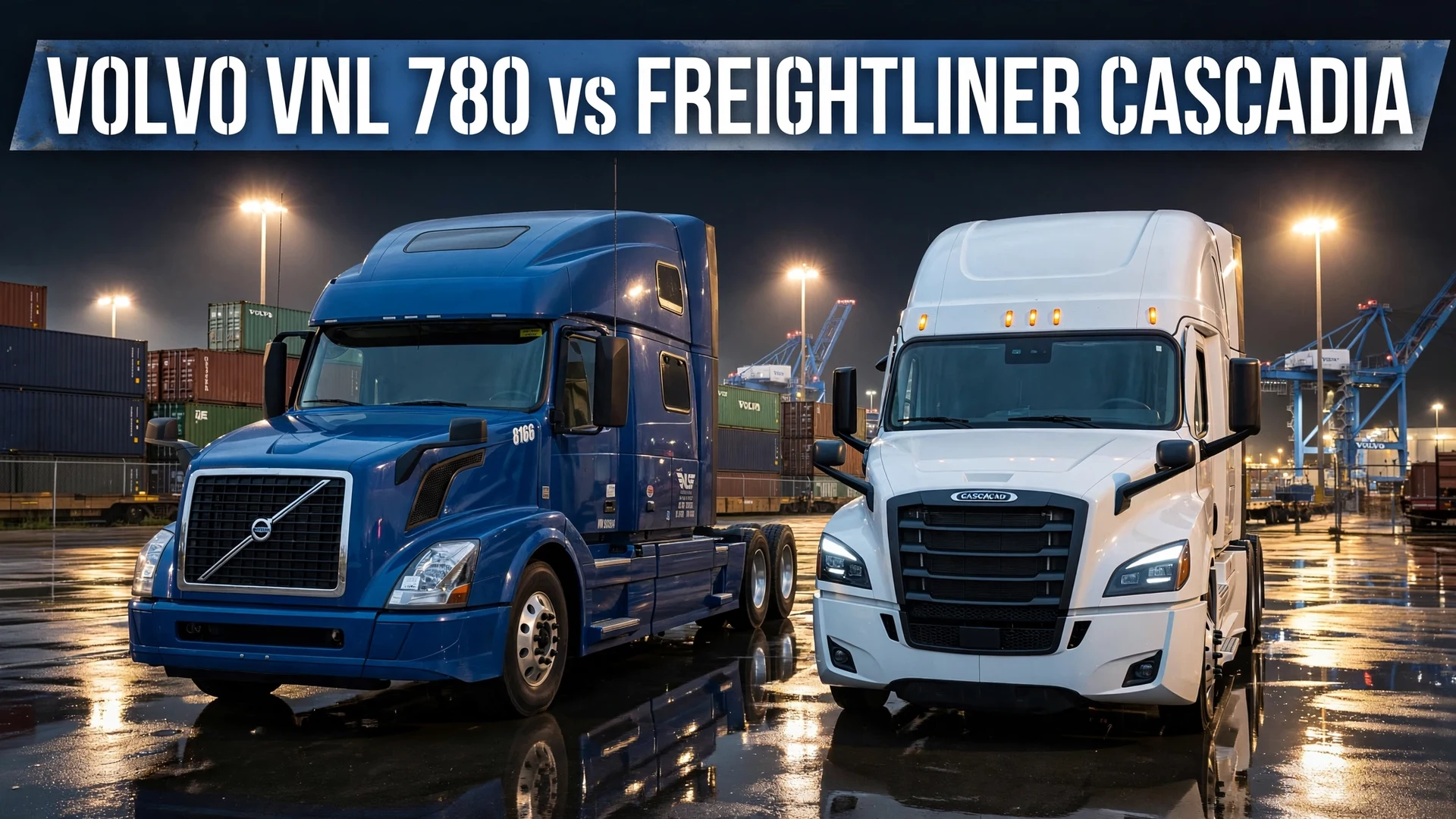
The Volvo VNL 780 and the Freightliner Cascadia are the two best-selling premium long-haul tractors in North America, and the choice between them is the most common “which truck” question in trucking. The Cascadia is the fleet favorite: America’s best-selling Class 8 truck, with a reputation for the lowest total cost of ownership, the biggest dealer network, and consistently strong fuel economy from its Detroit integrated powertrain.
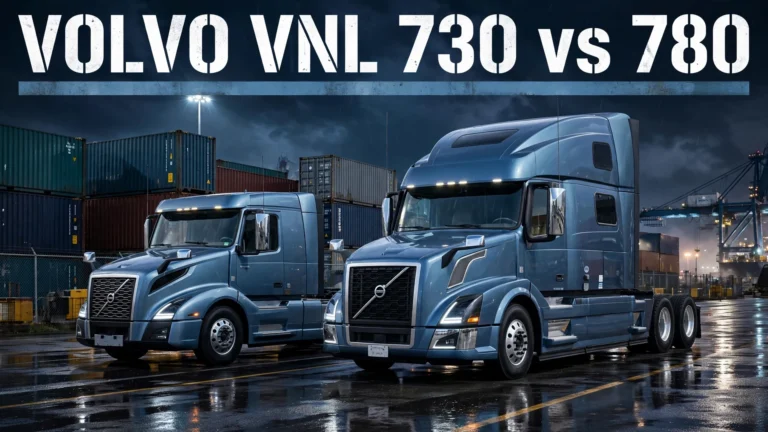
The VNL 780 is the driver’s favorite: a 77-inch high-roof sleeper built around Volvo’s D13 engine and I-Shift transmission, widely regarded as the most comfortable and safety-focused cab in the business. If your decision is driven by cost per mile and uptime, the Cascadia usually wins. If it is driven by driver comfort, safety, and retention, the Volvo usually wins. This comparison breaks down the numbers behind both reputations.
- The Cascadia runs the Detroit DD15 14.8L (455–505 hp) with the DT12 automated transmission; the VNL 780 runs Volvo’s D13 12.8L (425–500 hp) with the I-Shift 12-speed.
- The Cascadia has the industry’s largest dealer network and a long record of strong resale and low parts costs.
- The VNL 780’s 77-inch high-roof sleeper (42″x79″ lower bunk) is roomier than the typical 72-inch Cascadia condo, and Volvo’s safety equipment is more comprehensive as standard.
- Driver-reported fuel economy favors the Cascadia slightly, though Volvo claims up to 10% improvement for its newest VNL generation.
- Large fleets buy roughly 70% Freightliner by some industry estimates — a total-cost-of-ownership vote that is hard to ignore.
- Verdict: fleets and cost-per-mile owner-operators should buy the Cascadia; drivers who prioritize comfort and safety should buy the VNL 780.
Powertrains: Detroit Integration vs. Volvo Integration
Both trucks are sold as integrated powertrains — engine, transmission, and axles engineered to work together — which is the modern formula for fuel economy. The Cascadia’s headline combination is the Detroit DD15: a 14.8-liter inline-six rated from 455 to 505 horsepower with up to 1,750 lb-ft of torque, paired with the Detroit DT12 12-speed automated manual. Every DD15 is dyno-tested at the Detroit factory before it ships, a quality-control step Freightliner markets heavily.
The VNL 780’s combination is the Volvo D13: a 12.8-liter inline-six rated from 425 to 500 horsepower with up to 1,750 lb-ft, paired with the Volvo I-Shift 12-speed. The I-Shift has one of the best reputations in the industry for shift smoothness and low-speed control, and because Volvo designs the engine, transmission, and rear axles as a single system, the integration is arguably tighter than Detroit’s.
In practice, both powertrains are proven over millions of fleet miles. The DD15’s larger displacement gives it a slight edge in heavy-haul and mountainous applications; the D13’s smaller displacement and lighter weight help it in fuel-sensitive linehaul work. Typical fleet specs for both cluster around 455–475 hp.
Fuel Economy: The Cascadia’s Reputation Is Earned
Fuel economy is the Cascadia’s strongest card. Driver reports consistently put well-spec’d Cascadias at 8+ mpg in linehaul service, with some drivers reporting 8.5 mpg averages over full years. The Detroit integrated powertrain, full aero packages, and the truck’s relatively light weight all contribute. One widely cited owner test reported 9.1 mpg on a round trip at near-full gross weight — an exceptional figure that shows what the platform can do when spec’d right.
VNL drivers typically report 7–8 mpg in comparable service — competitive, but a few tenths behind the best Cascadia numbers. Volvo’s response is its all-new VNL generation, for which the company claims up to 10% better fuel efficiency than the previous truck. That is a manufacturer claim and should be read as a best-case figure, but it signals that Volvo knows exactly where the battle is fought. For now, on the trucks actually on the road today, the Cascadia holds the economy edge.
Sleeper and Cab: The Volvo Is the Nicer Place to Live
This is where the VNL 780 earns its loyal following. The 77-inch high-roof sleeper offers stand-up room, a 42″x79″ lower bunk and 39″x79″ upper bunk, generous cabinet storage, and an available workstation. Drivers consistently praise the VNL’s driving position, mirror visibility, low noise levels, and the quality of the ride on Volvo’s air-ride cab suspension.
The Cascadia’s sleeper (most commonly the 72-inch raised-roof condo) is well designed but a step down in sheer space: bunks are typically 40 inches wide, and headroom is less generous. Freightliner has closed the gap with recent interior updates, and the Cascadia’s dash ergonomics are excellent, but the Volvo remains the comfort benchmark. If you team-drive or simply value your living space, the VNL 780’s extra inches matter every single day.
Safety: Volvo Leads, Freightliner Is Well Equipped
Volvo’s safety reputation extends to its trucks. The VNL cab is built to the Swedish cab-impact standard, and Volvo made electronic stability control, forward collision warning with emergency braking, and lane-departure warning standard equipment years before they were common. The VNL 780 spec sheets read like a safety catalog: driver airbag, energy-absorbing steering column, and pretrip diagnostic systems.
The Cascadia counters with Detroit Assurance — a comprehensive suite including adaptive cruise, active brake assist, lane-departure warning, and optional Side Guard Assist. It is a thoroughly modern safety package. The difference is philosophical: Volvo treats safety as the brand’s core identity and standardizes more of it, while Freightliner offers excellent systems that are more often tied to option packages.
Dealer Network, Parts, and Total Cost of Ownership
The Cascadia’s trump card is scale. Freightliner has the largest dealer and service network in North America, parts are available nearly everywhere, and common repairs turn around faster — a consistent theme in driver forums. Industry watchers estimate large fleets buy roughly 70% Freightliner, and that fleet preference is itself a total-cost-of-ownership signal: big fleets measure everything, and they keep buying Cascadias.
The VNL’s network is strong but smaller, and Volvo’s proprietary systems can mean longer waits for certain parts — the most common complaint about Volvo ownership. On the other hand, VNL resale values have historically been solid, and the truck’s comfort reputation helps with driver recruitment and retention, which is a real (if hard to quantify) cost saving. For pure dollars-and-cents TCO, the Cascadia’s case is stronger; for driver-centric operations, the Volvo’s softer costs deserve weight.
Head-to-Head Spec Table
| Specification | Volvo VNL 780 | Freightliner Cascadia |
|---|---|---|
| Engine | Volvo D13 12.8L I6 | Detroit DD15 14.8L I6 |
| Max horsepower | 500 hp | 505 hp |
| Max torque | 1,750 lb-ft | 1,750 lb-ft |
| Transmission | Volvo I-Shift 12-spd AMT | Detroit DT12 12-spd AMT |
| Sleeper | 77-in high-roof; 42″x79″ bunks | 72-in raised-roof condo; ~40″ bunks |
| Typical fuel economy (driver-reported) | 7–8 mpg | 8+ mpg achievable |
| Dealer network | Strong, smaller footprint | Largest in North America |
| Safety equipment standard | Most comprehensive standard | Excellent, often optional |
| Driver comfort reputation | Best in class | Very good |
| Fleet market share signal | Strong #2 | ~70% of large-fleet buys (est.) |
Verdict: Which Truck Should You Buy?
Buy the Freightliner Cascadia if you think in cost per mile. It has the best fuel-economy record, the biggest service network, the cheapest parts, and the strongest resale — the complete total-cost-of-ownership package. That is why most large fleets buy it, and their accountants are not sentimental.
Buy the Volvo VNL 780 if you think in driver terms. It is the most comfortable, quietest, and safety-focused long-haul cab you can buy, and in a market where keeping good drivers is half the battle, that has real economic value. Owner-operators who live in their trucks overwhelmingly prefer the Volvo driving experience.
Either way, spec the truck properly: full aerodynamics, low-rolling-resistance tires, and an axle ratio matched to your cruise speed will save more fuel than any brand choice. And test-drive both — an hour in each cab tells you more than any comparison article.
Sources
- VNL 780 specs (D13 425–500 hp, I-Shift, 77-in sleeper, 42″x79″/39″x79″ bunks) — Volvo Trucks America’s Road Team spec sheet; Ritchie Bros. auction listings.
- Cascadia specs (DD15 14.8L 455–505 hp, DT12, 72-in sleeper) — Comvoy and dealer listings; ClassicCarsDepot.
- Driver-reported fuel economy (Cascadia 8–9.1 mpg, VNL 7–8 mpg) — TheTruckersReport forums; ExpeditersOnline.
- Cascadia TCO/dealer-network reputation and ~70% large-fleet share estimate — TheTruckersReport; ShareRig VNL vs Cascadia comparison.
- Volvo new-VNL “up to 10% fuel efficiency” manufacturer claim — FreightWaves Truck Tech via Castbox.
Frequently Asked Questions
Which gets better fuel mileage, the Volvo VNL 780 or Freightliner Cascadia?
The Cascadia has the stronger real-world record, with drivers regularly reporting 8+ mpg and exceptional tests above 9 mpg. VNL drivers typically report 7–8 mpg. Volvo claims up to 10% improvement for its newest VNL generation, but that is a manufacturer figure awaiting fleet verification.
What engine is in the Volvo VNL 780?
The Volvo D13, a 12.8-liter inline-six diesel rated from 425 to 500 horsepower, paired with the Volvo I-Shift 12-speed automated transmission.
What engine is in the Freightliner Cascadia?
The Detroit DD15, a 14.8-liter inline-six diesel rated from 455 to 505 horsepower, paired with the Detroit DT12 12-speed automated transmission.
Which has the bigger sleeper, VNL 780 or Cascadia?
The VNL 780, with a 77-inch high-roof sleeper and 42″x79″ lower bunk. The Cascadia’s most common sleeper is the 72-inch raised-roof condo with narrower bunks.
Which is cheaper to maintain, Volvo or Freightliner?
The Freightliner Cascadia, generally. It has the largest dealer network in North America, widely available parts, and faster turnaround on common repairs. Volvo parts can take longer to source and cost more.
Why do so many fleets buy Freightliner Cascadias?
Total cost of ownership. Large fleets measure fuel, maintenance, downtime, and resale obsessively, and industry estimates suggest they buy roughly 70% Freightliner — a data-driven endorsement of the Cascadia’s economics.