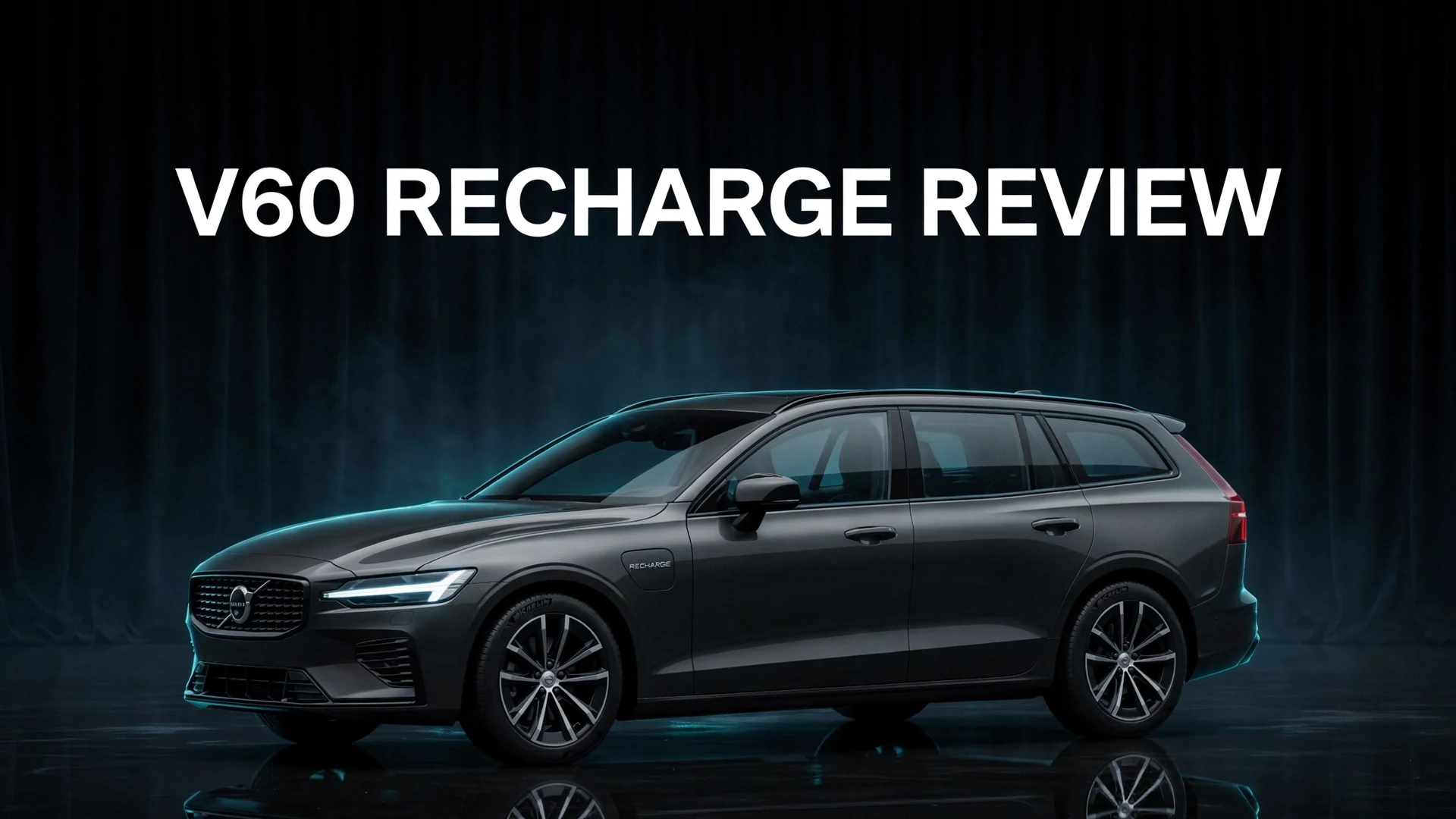
Volvo V60 Recharge Review (2026): The 455-HP Wagon You Can Only Buy Used

Volvo has always been the wagon company. So it stung, a little, when the brand confirmed in early 2025 that the V60 Recharge Polestar Engineered — the only true wagon it sold in America — would no longer be available as a new vehicle in the United States. Then, in December 2025, came the second blow: the lifted V60 Cross Country, the last wagon in Volvo’s American lineup, ends production in April 2026. After that, Volvo USA is an SUV-only brand.
Which makes the V60 Recharge something rare in the car world: an obituary you can still buy. This was a 455-horsepower plug-in hybrid wagon that hit 60 mph in 4.3 seconds — within shouting distance of a base BMW M3 — while offering 41 miles of EPA-rated electric driving and a cargo hold that swallows a family vacation. You cannot order a new one anymore. But on the used market, the V60 Recharge may be the smartest enthusiast purchase Volvo ever left behind.
- The V60 Recharge was discontinued in the US after the 2025 model year. New cars are gone; used and Certified by Volvo examples are the only path in.
- Buy a 2023-or-newer car: 455 hp, 523 lb-ft, 18.8 kWh battery, 41-mile EPA electric range, 0–60 in 4.3 seconds.
- Earlier 2020–2022 cars use the original 11.6 kWh pack: 415 hp and roughly 22 miles of EPA electric range. Same wagon, meaningfully less of everything.
- The 2025 sticker was $71,250 plus $1,195 destination — and the car holds value unusually well, with recent low-mile 2024s asking roughly $68,000 to $77,000.
- Federal clean-vehicle credits ended for vehicles acquired after September 30, 2025. Price this as a straight used-car purchase.
The last wagon standing
Context matters here. By the time Volvo pulled the plug, the V60 Recharge Polestar Engineered was an endangered species twice over: a wagon in an SUV market, and a plug-in hybrid performance car in a lineup pivoting to pure electrics. It was also, by most enthusiast accounts, the best-driving Volvo of its generation.
The formula was gloriously over the top for a family wagon. A 2.0-liter four-cylinder, both turbocharged and supercharged, drives the front wheels while an electric motor drives the rear. Polestar’s engineers added Öhlins adjustable dampers, Brembo brakes, and those signature gold seatbelts — and the result looked like a sensible Swedish estate while accelerating like something with a much angrier badge.
And now it’s a used car. That changes the review math completely — in the buyer’s favor. Depreciation has already done its work on the early cars, while the newest examples hold value so well they sometimes ask near their original sticker.
Specs: the numbers that matter
These are the figures for the extended-range cars — model years 2023 through 2025, the version you want. (Pre-2023 cars are covered in the buying guide below.)
| Specification | V60 Recharge Polestar Engineered (2023–2025) |
|---|---|
| Powertrain | T8 Twin Engine plug-in hybrid: 2.0L turbo + supercharged I4 (front) + electric motor (rear) |
| Combined output | 455 hp / 523 lb-ft of torque |
| Transmission | 8-speed automatic |
| Drivetrain | All-wheel drive (electric rear axle) |
| 0–60 mph | 4.3 seconds |
| Top speed | 112 mph (electronically limited) |
| Battery | 18.8 kWh lithium-ion |
| EPA electric range | 41 miles |
| Fuel economy | 74 MPGe combined / 31 mpg combined (gas) |
| Fuel tank / total range | 15.9 gallons (premium) / approx. 530 miles |
| Cargo volume | 23.2 cu ft behind rear seats / 50.9 cu ft max |
| Towing | 2,000 lb |
| Curb weight | 4,495 lb |
| Warranty | 4 yr / 50,000 mi basic; 8 yr / 100,000 mi hybrid components |
| 2025 MSRP | $71,250 plus $1,195 destination |
Two numbers deserve a pause. First, 41 miles of electric range covers the average American’s daily driving without burning a drop of premium. Second, 4.3 seconds to 60 mph in a wagon that can do the school run in silence is a combination nothing else at this price offered.
How it stacks up: power and cargo against the survivors
The V60 Recharge’s natural enemies are mostly extinct in America — the Audi A4 allroad is gone from US showrooms and the Mercedes E-Class wagon isn’t coming back. That leaves a short list of genuine alternatives you can actually cross-shop in 2026, and on paper the old Volvo still hits harder than all of them.
The chart tells the enthusiast story in one glance: nothing else in the segment pairs this much power with a plug. The A6 allroad counters with more space, a plusher ride, and a new-car warranty — the V60 Recharge buyer’s most logical alternative. The V60 Cross Country is the rational in-family fallback: same wagon virtues and a $52,300 starting price, but none of the fireworks.
Behind the wheel: five drive modes, one personality
Every Recharge model shares Volvo’s five-mode drive selector, sharpened in the Polestar Engineered car:
The five Recharge drive modes.
In practice, the Polestar Engineered chassis is the star: Öhlins dual-flow-valve dampers, strong progressive Brembos, and accurate steering. The trade-off, and every major review names it, is ride firmness — TrueCar calls the suspension jarring over broken pavement, and ConsumerGuide lists firm ride and road noise among the car’s few demerits. If your roads are rough, budget a long test drive before you commit.
Inside, it’s peak late-SPA Volvo: warm minimalist design, genuinely comfortable seats, a 9-inch Google Built-in touchscreen, a 12.3-inch digital cluster, and — standard on the Polestar Engineered — a 1,410-watt Bowers & Wilkins system with 15 speakers. Later cars also offer one-pedal driving, which suits the car’s silent-running character perfectly.
Trims and pricing: a used buyer’s market
New-car pricing is history, but it sets the baseline: the 2025 V60 Recharge came in a single, fully loaded Polestar Engineered trim at $71,250 plus $1,195 destination. Across 2020–2025, original stickers spanned roughly $67,300 to $71,250. The used market breaks down by model year — the single most important thing to get right:
| Model years | Battery / output | EPA electric range | Trims sold | What to pay (observed asking) |
|---|---|---|---|---|
| 2020–2022 | 11.6 kWh / 415 hp | ~22 miles | R-Design, Inscription, Polestar Engineered | High $40ks–low $60ks; e.g. a 2022 with ~19k miles asked $56,999 |
| 2023–2024 | 18.8 kWh / 455 hp | 41 miles | Polestar Engineered only | High $60ks–mid $70ks; 2024 CPO cars with 15k–43k miles asked $67,888–$77,030 |
| 2025 | 18.8 kWh / 455 hp | 41 miles | Polestar Engineered only (final year) | At or near original $71,250 sticker while clean examples last |
The value story here is remarkable for a European plug-in: these cars are not falling off a cliff. Enthusiast demand plus genuine scarcity keeps residuals strong. The 2023 model year is the sweet spot for most buyers: the extended-range powertrain at a meaningful discount to a 2025, with most of the factory warranty clock still ahead of you.
One caution on 2022s: the battery upgrade phased in during that model year’s production run in some markets. If you’re shopping a 2022, verify the window sticker or have the dealer confirm the 18.8 kWh pack and 455 hp rating before you assume you’re getting the extended-range car.
What it costs to own
Run the commuter math and the plug-in case makes itself. A full charge takes roughly five hours on a 240V home setup, and 41 miles of range covers the typical round-trip commute — many owners burn no gasoline on weekdays at all. On longer trips the 15.9-gallon tank and 31 mpg combined gas rating deliver around 530 miles of total range, and yes, it requires premium.
Maintenance is standard modern-Volvo fare: no exotic service schedule, longer-lasting brakes thanks to regenerative braking, and an 8-year/100,000-mile warranty on the hybrid components. Tires are the running-cost gotcha — the Polestar Engineered’s low-profile performance rubber is pricey and wears faster than the all-seasons on a Cross Country.
A brief word on tax credits: the federal new-vehicle (30D), used-vehicle (25E), and commercial (45W) clean-vehicle credits all ended for vehicles acquired after September 30, 2025. In 2026 there is no federal credit available on this car — price it as a straight used purchase and don’t let a seller pad the ask with a credit that no longer exists.
Which used V60 Recharge should you buy?
Three kinds of buyers show up for this car:
Frequently asked questions
Can you still buy a new Volvo V60 Recharge in the US?
No. Volvo confirmed in early 2025 that the V60 Recharge Polestar Engineered was no longer available as a new vehicle in the US, and the 2025 model year was its last. Your only options now are used or Certified by Volvo examples.
Which used V60 Recharge model year is the best to buy?
Buy a 2023 or newer: 18.8 kWh battery, 455 hp, 41 miles of EPA-rated electric range. The 2020–2022 cars use the original 11.6 kWh pack with 415 hp and about 22 miles of range — still good cars, but they should cost meaningfully less.
What is the real-world electric range of the V60 Recharge?
The EPA rates the extended-range cars at 41 miles. Like every plug-in hybrid, expect less in cold weather or at sustained highway speeds, and more in gentle city driving. Pre-conditioning the cabin while plugged in helps preserve range on cold mornings.
Does the V60 Recharge qualify for a federal tax credit in 2026?
No. The federal new-vehicle (30D), used-vehicle (25E), and commercial (45W) clean-vehicle credits all ended for vehicles acquired after September 30, 2025. There is no federal credit available on a V60 Recharge purchased in 2026.
Is the Polestar Engineered suspension too stiff for daily driving?
It is firm — reviewers consistently name ride comfort as the car’s main trade-off, especially over broken pavement. The Öhlins dampers are manually adjustable, which helps. If your daily route is rough, take an extended test drive before committing.
The verdict
The V60 Recharge was revolutionary in the way the original headline promised — just not how anyone expected. It didn’t revolutionize the market; the market barely noticed it. Instead it perfected a formula nobody else bothered with: genuine sports-sedan pace, genuine electric commuting, and genuine wagon practicality, in the most understated body in the segment. Volvo’s retreat from wagons in America makes this car a time capsule — the last of a species, built at its peak.
If you’ve ever wanted a fast wagon, there will never be a better moment than right now, while clean extended-range cars are still findable. The SUVs won. The enthusiasts get the last laugh.