Volvo D5 vs T5?

Diesel Muscle or Petrol Ease? The Volvo Engine Choice That Still Trips Up Buyers
You’re staring at two Volvo listings — same model, same year, similar mileage — and the only real difference is a badge on the back: D5 or T5. One drinks diesel, one drinks petrol, and the price gap between them can be surprisingly small. Pick wrong and you could be looking at pricier repairs or a car that feels sluggish for how you actually drive.
I’ve spent years digging through Volvo powertrain data, dealer spec sheets, and owner forums to separate marketing spin from what actually happens after 80,000 miles. Here’s the straight answer.
TL;DR
- D5 is Volvo’s five-cylinder turbodiesel — huge torque (up to 440 Nm), better fuel economy on long drives, but pricier maintenance and it was discontinued for new cars in 2017.
- T5 is a turbocharged 2.0-liter petrol four-cylinder making 250 hp and 258 lb-ft in most modern applications — smoother, cheaper to service, and simpler mechanically.
- Diesel (D5) wins for high-mileage motorway drivers; petrol (T5) wins for mixed city/highway use and lower long-term running costs.
- Both engines are now discontinued in favor of newer Volvo lineups, so most D5 and T5 cars on the market today are used.
- Neither is “bad” — the right pick depends entirely on your annual mileage and driving style.
Volvo’s D5 and T5 badges answer the same core question — which fuel and which turbocharging approach fits how you drive — and the short version is this: the D5 is a diesel five-cylinder built for towing and long-haul torque, while the T5 is a petrol turbo-four built for smoother everyday performance with simpler upkeep. If you drive mostly motorway miles or tow regularly, the D5’s torque and diesel efficiency pay off. If you’re doing mixed city and highway driving, the T5 is usually the easier, cheaper car to live with.
What Is the Volvo D5 Engine?
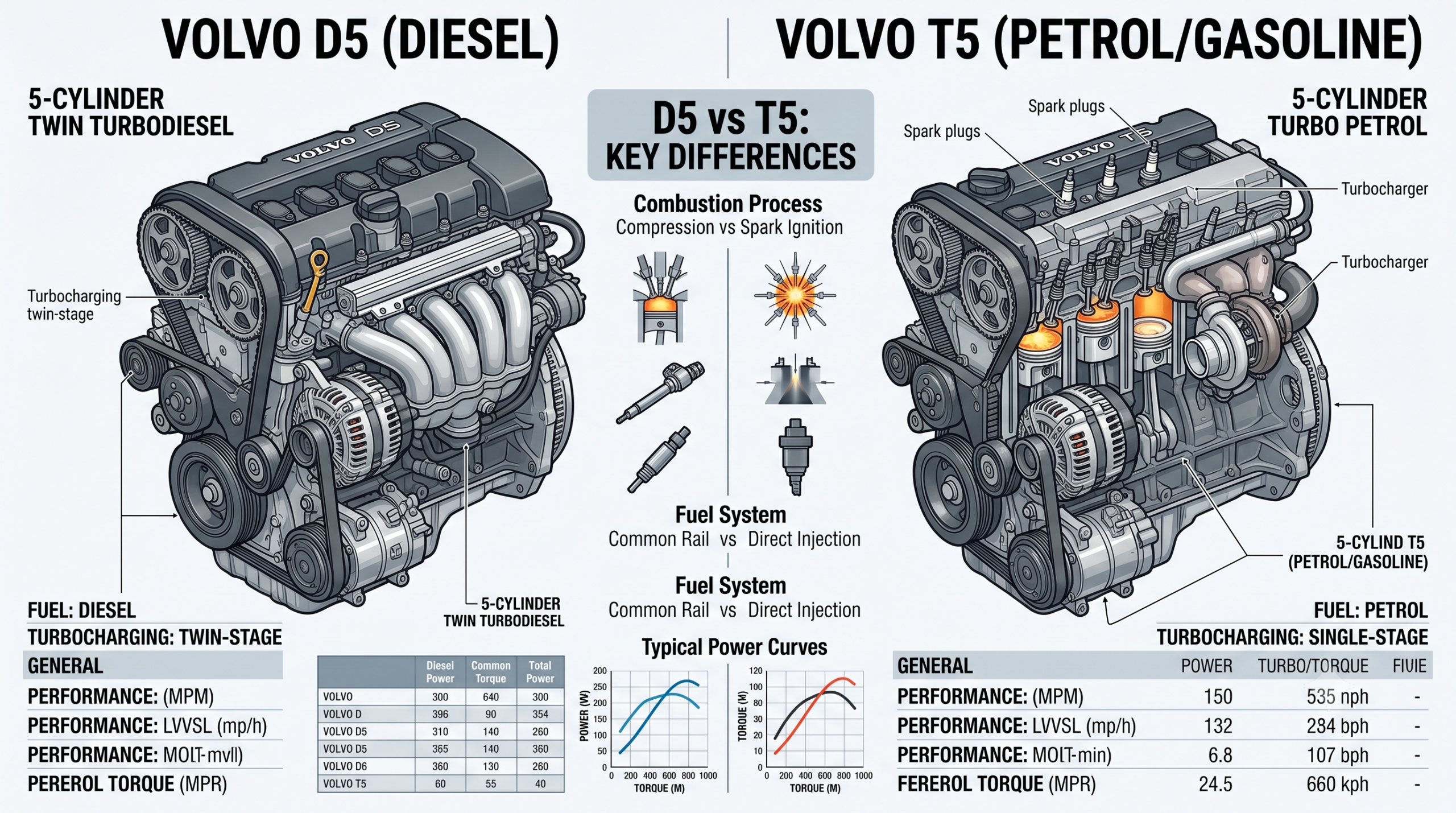
The D5 is Volvo’s in-house five-cylinder turbodiesel, known for outsized torque relative to its size. It first appeared in 2001 and went through three generations before Volvo phased it out.
The D5 is <cite index=”5-1″>an all-aluminium five-cylinder engine with 20 valves and double overhead camshafts</cite>, and it uses <cite index=”5-1″>a VGT turbocharger of the Variable Nozzle Turbine type, common rail direct injection, and cooled exhaust gas recirculation</cite>. That’s engineering-speak for: it spools up quickly and pulls hard from low RPM, which is exactly what you want when merging onto a motorway with a full car.
Later D5 versions pushed output even further. Volvo’s own engineers <cite index=”3-1″>boosted performance and torque from 205 hp/420 Nm to 215 hp and 440 Nm</cite> in one mid-life update — while simultaneously improving fuel economy. Depending on year and model, D5 output has ranged 163 hp to 220 hp, with torque between 400 Nm and 480 Nm, according to specification guides tracking the full production run.
Quick Tip: If you’re buying a used D5, check for the timing belt/chain service history first — this is the single biggest predictor of a trouble-free diesel Volvo.
Production of D5-type engines wound down as Volvo shifted to newer diesel architecture, and the badge was largely retired from new Volvo cars by 2017 as the brand’s focus moved toward petrol, hybrid, and electric powertrains.
What Is the Volvo T5 Engine?
The T5 is Volvo’s turbocharged 2.0-liter petrol inline-four, the mainstream performance option across most of the modern lineup before Volvo’s mild-hybrid B-series took over.
Most current-generation T5 units are rated at 250 horsepower and 258 lb-ft of torque, a figure that’s held remarkably consistent across the S60, XC60, V60, and XC90 for years. On the XC40, the same basic engine is tuned slightly differently — Volvo’s own documentation for that model lists <cite index=”13-1″>248 horsepower and 258 pound-feet of torque</cite> with standard all-wheel drive.
The T5 traces back to Volvo’s 850 T5R days of the early 1990s, when the badge described a 2.3-liter turbocharged five-cylinder. Volvo kept the “T5” name even after switching entirely to four-cylinder Drive-E engines in 2014, so today’s T5 shares a name — but little else — with its 1990s ancestor.
Volvo has since moved on here too: around 2020–2021, the T5 was gradually replaced by the B5 mild-hybrid engine, which adds a 48-volt electric assist system for slightly better efficiency at a small cost in peak horsepower.
Expert Insight: Torque peaks earlier on the T5 than on its B5 successor, which is why some owners say the older T5 actually feels a touch livelier off the line, even with marginally less horsepower on paper.
Volvo D5 vs T5: Side-by-Side Comparison
| Spec | Volvo D5 (Diesel) | Volvo T5 (Petrol) |
|---|---|---|
| Configuration | 5-cylinder turbodiesel (2.4L) | 4-cylinder turbo petrol (2.0L) |
| Horsepower | 163–220 hp (year-dependent) | 240–250 hp |
| Torque | 400–480 Nm (295–354 lb-ft) | 258 lb-ft (~350 Nm) |
| Best for | Motorway miles, towing, cold starts pulling loads | Mixed driving, smoother daily commute |
| Maintenance complexity | Higher — EGR, DPF, injectors | Lower — simpler turbo-petrol system |
| Availability today | Discontinued 2017, used market only | Discontinued ~2021–22, used market only |
| Typical buyer | High-mileage, motorway-heavy drivers | City/suburban drivers wanting balance |
Bottom line: torque wins the D5 the tug-of-war, horsepower wins the T5 the sprint. As Volvo’s own powertrain team put it years ago, <cite index=”3-1″>torque is of far greater interest than the number of horsepower when comparing modern diesel engines, because it’s the available torque that gives the diesel the kind of acceleration and driveability that many petrol engines can barely match</cite>. That’s the diesel case in a sentence — but it only matters if your daily drive rewards it.
Pros and Cons by Driver Type
The Long-Distance Commuter
- ✅ D5: Diesel fuel economy shines past 500 miles a week; low-RPM torque reduces fatigue on motorways.
- ❌ D5: DPF and EGR systems need highway heat cycles to stay clean — short trips clog them.
- ✅ T5: Smoother, quieter cabin experience for long stretches.
- ❌ T5: Worse fuel economy than diesel over very high mileage.
The City/Suburban Driver
- ✅ T5: Simpler maintenance, no DPF regeneration issues from short trips.
- ✅ T5: Peppier off-the-line feel in stop-and-go traffic.
- ❌ D5: Diesel particulate filter problems are common with mostly short urban journeys.
- ❌ D5: Diesel’s fuel-cost advantage shrinks fast at low annual mileage.
The Tower or Family Hauler
- ✅ D5: Higher torque figures make towing and hill climbs with a full load noticeably easier.
- ✅ D5: Historically used in Volvo’s wagon and SUV variants specifically for load-carrying jobs.
- ❌ T5: Still capable, but works harder (and drinks more) under sustained heavy loads.
- ❌ T5: No inherent low-end torque advantage over a diesel of similar output.
Real-World Scenario: The Same Commute, Two Different Engines
Picture two neighbors who both bought used Volvo V70s the same month — one a D5, one a T5. The D5 owner does a 45-minute motorway commute five days a week and refuels every ten days. The T5 owner does a stop-start 20-minute school run and errands mix, refueling almost twice as often — but has never had a single warning light related to emissions equipment.
Two years later, the D5 owner has spent more at the pump station overall but less per mile driven. The T5 owner has spent less on maintenance but more on fuel per mile. Neither owner would trade — because each engine fits the life it’s actually living.
Choose D5 If…
You regularly drive 15,000+ miles a year, mostly motorway, and value low-end pulling power for towing or a fully loaded car. Choose this if fuel economy over long distances matters more than upfront service simplicity.
Choose T5 If…
Your driving is a mix of city errands and occasional longer trips, and you’d rather avoid diesel-specific maintenance items like DPF regeneration and EGR cleaning. Choose this if smooth, low-maintenance ownership matters more than maximum torque.
A 2024 industry mechanical-reliability review found that <cite index=”15-1″>both the T5 and T6 powertrains are built with high-quality materials and are fine-tuned for durability</cite>, which is a reasonable proxy for why the petrol side of Volvo’s lineup has a reputation for being the lower-hassle choice.
FAQ
Is the Volvo D5 more powerful than the T5? Not necessarily in horsepower — the T5 usually wins there at 240–250 hp versus the D5’s 163–220 hp. The D5 wins decisively on torque, which is what you feel when accelerating from a stop or overtaking.
Can I still buy a new Volvo D5 or T5? No. Both engines have been discontinued from new-car production — the D5 by around 2017 and the T5 by roughly 2020–2022 — replaced by newer diesel units and the mild-hybrid B5, respectively. Today, both are used-market purchases only.
Which engine is cheaper to maintain, D5 or T5? The T5 is generally cheaper to maintain because it lacks diesel-specific components like the DPF (diesel particulate filter) and EGR system, which can require costly attention if the car is mostly driven on short trips.
Does the D5 or T5 get better fuel economy? The D5 typically returns better fuel economy on long motorway trips, thanks to diesel’s inherent efficiency advantage at steady highway speeds. The T5 can be more cost-effective overall for drivers with lower annual mileage, since diesel’s per-mile savings take time to offset diesel fuel’s higher price.
Is a used Volvo D5 or T5 the safer buy? Both are mechanically sound when properly maintained. The safer buy depends more on service history and how the specific car was driven than on the engine badge alone — a well-cared-for D5 with full DPF service records can easily outlast a neglected T5.
Key Takeaways
- D5 = diesel torque monster, best for high-mileage motorway or towing use.
- T5 = petrol all-rounder, best for mixed driving and lower maintenance complexity.
- Torque numbers (D5: up to 440–480 Nm) vastly outpace the T5’s roughly 258 lb-ft (~350 Nm), but horsepower favors the T5.
- Both engines are discontinued from new production, so buying either today means shopping the used market.
- Match the engine to your actual annual mileage and driving pattern — not to which one “sounds” more powerful.
- Service history matters more than engine choice for long-term reliability in either case.
Ready to Decide?
Before you commit, pull the full service history on any used D5 or T5 you’re considering — DPF and turbo service records tell you more about the car’s future than the engine badge ever will.