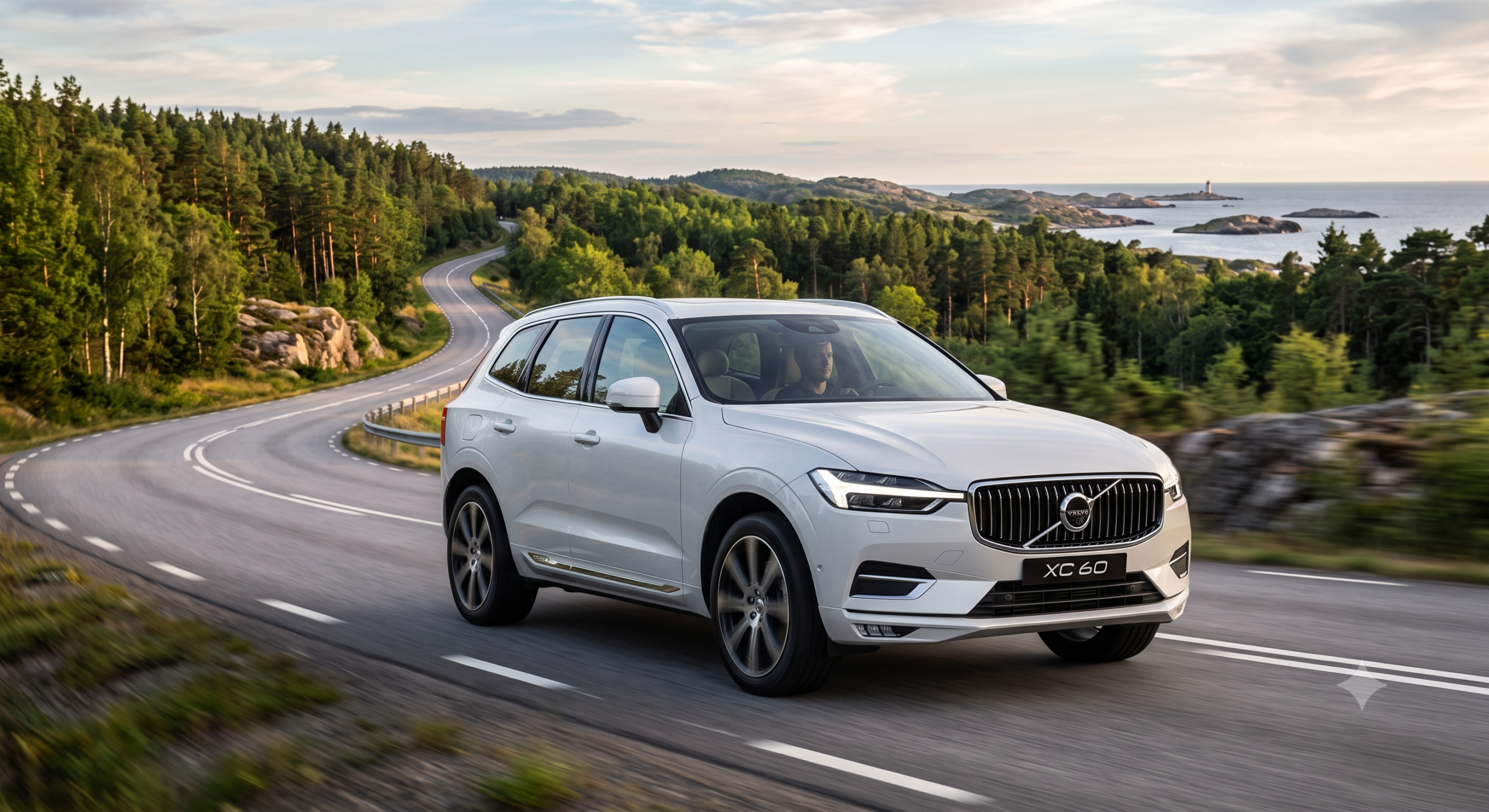
Who Makes the Volvo XC40?

Who Makes the Volvo XC40? Brand, Factory & Platform Explained
You’re about to spend $40,000 on a compact SUV and someone casually mentions that Volvo is “owned by China now.” Cue the second-guessing. Is the XC40 still a real Swedish car? Who actually builds it? And does any of this matter for quality?
It’s a fair set of questions — and the answers are more interesting than a simple yes or no.
TL;DR
- The Volvo XC40 is manufactured by Volvo Cars (Volvo Car AB), a Swedish company headquartered in Gothenburg, Sweden.
- Volvo Cars has been owned by Zhejiang Geely Holding of China since 2010 — but operates with significant independence, maintaining its Swedish design, engineering, and safety teams.
- US-market XC40s are assembled at Volvo’s plant in Ghent, Belgium — not Sweden and not China.
- The XC40 rides on the CMA platform, co-developed by Volvo and Geely, and debuted on the XC40 in 2017.
- The Ghent plant produced its one-millionth XC40/EX40 in 2024 — a milestone that underscores the model’s role as one of Volvo’s most important vehicles.
Who Makes the Volvo XC40?
Volvo Cars makes the Volvo XC40. The full corporate name is Volvo Car AB, trading as Volvo Cars, and it is a Swedish multinational luxury vehicle manufacturer headquartered in Torslanda, Gothenburg. Volvo Cars designs, engineers, and assembles the XC40 — the brand has been making cars since 1927.
What trips people up is the ownership layer. Volvo Cars is owned by Zhejiang Geely Holding Group, a Chinese multinational that acquired the brand from Ford Motor Company in August 2010 for $1.8 billion. Ford had purchased Volvo Cars in 1999 for $6.45 billion as part of its Premier Automotive Group strategy — alongside Jaguar and Land Rover — then sold it when the financial crisis forced a restructuring.
So to put it plainly: a Chinese company owns Volvo Cars, but a Swedish company makes the XC40. That distinction matters.
The XC40 is a Swedish-designed, Belgian-built car that rides a platform co-engineered between Sweden and China. It is one of the more internationally collaborative vehicles on the road today.
Who Owns Volvo Cars?
Zhejiang Geely Holding Group owns the majority of Volvo Cars. As of 2021, when Volvo Cars listed on the Nasdaq Stockholm exchange, Geely Holding holds approximately 86% of Volvo Cars’ shares, with the remainder publicly traded.
This sometimes causes confusion because Geely Automobile — Geely Holding’s publicly listed Chinese auto brand — makes affordable domestic vehicles. That’s a different entity. Volvo Cars operates independently, with its own board of directors, executive team, product development cycle, and global marketing. Li Shufu, Geely’s founder, framed the acquisition this way at closing: the goal was to help Volvo grow, not to absorb it.
Since 2010, the strategy has worked. Volvo Cars’ global sales grew from roughly 373,000 units in 2010 to a record 708,716 in 2023. The XC40 — launched in 2017 — has been among Volvo’s three best-selling models every year since its introduction.
A Quick Ownership Timeline
| Year | Event |
|---|---|
| 1927 | Volvo Cars founded in Gothenburg, Sweden |
| 1999 | Ford Motor Company acquires Volvo Cars for $6.45 billion |
| 2010 | Geely Holding acquires Volvo Cars from Ford for $1.8 billion |
| 2017 | XC40 launches; CMA platform debuts |
| 2021 | Volvo Cars lists on Nasdaq Stockholm (Geely retains ~86%) |
| 2024 | Ghent plant produces one-millionth XC40/EX40 |
Where Is the Volvo XC40 Made?
The answer depends on which market you’re buying in. Volvo follows a “build where you sell” strategy, which means production location tracks customer geography.
United States and Europe: Ghent, Belgium
US-market and European-market XC40s are assembled at Volvo Cars Ghent, in Ghent, Belgium. The plant began XC40 production in November 2017 and has never stopped — it is the original and primary production site for the model.
In October 2024, Volvo Cars announced that the one-millionth XC40/EX40 had rolled off the Ghent production line — a milestone plant manager Stefan Fesser called “very important in the history of Volvo Car Gent.” The Ghent facility is also being expanded to produce the fully electric EX30 from 2025 onward, cementing its role as Volvo’s European export hub.
If your XC40’s VIN begins with a character indicating Belgium (the 11th digit will typically be “2”), it was built in Ghent.
China, Australia, and Other Asian Markets: Luqiao, China
From 2019 onward, XC40s for the Chinese market and several other Asian markets have been assembled at the Luqiao plant in Taizhou, Zhejiang province — close to the port infrastructure around Shanghai. The Luqiao facility is owned by Geely and operated by Volvo Cars, and it also produces the Lynk & Co 01 and the Polestar 2 on the same CMA platform.
Canadian-market XC40s are also sourced from the Luqiao plant. If your VIN’s first character is “L,” the vehicle was built in China.
Quick Tip: You can decode your XC40’s production location in about 30 seconds. Go to Settings in the center display → System → System Information → Vehicle Identification Number. Then run that VIN through NHTSA’s free decoder at nhtsa.gov. The first character tells you the country of manufacture; “4” or “2” typically means Belgium; “L” means China.
What Platform Is the XC40 Built On?
The XC40 is the first Volvo model built on the CMA platform. CMA stands for Compact Modular Architecture, and it was co-developed by Volvo Cars and Geely Holding starting around 2012, with the first vehicle — the XC40 — debuting in 2017.
Geely specifically established a dedicated engineering company called China Europe Vehicle Technologies (CEVT) in Gothenburg — about 10 minutes from Volvo’s headquarters — and staffed it primarily with former Volvo and former Saab engineers to develop the CMA alongside Volvo’s teams. The result is a platform that is fundamentally European in its engineering DNA, despite being a joint Geely-Volvo creation.
The CMA platform was designed from the ground up to support petrol, diesel, plug-in hybrid, and pure-electric drivetrains — a design decision that made the XC40 Recharge (later renamed EX40) possible without engineering a separate architecture.
Other vehicles that share the CMA platform include the Lynk & Co 01, 02, 03, and 05; the Polestar 2; and Volvo’s own EC40 (formerly C40 Recharge). Volvo invested $1.2 billion in CMA development. By sharing that cost across multiple brands, Volvo was able to bring a fully electric compact SUV to market significantly faster than if it had funded the platform alone.
The CMA platform is what gives the XC40 its bones — and those bones were engineered in Gothenburg, not Shanghai.
Who Designed the Volvo XC40?
The XC40 was designed entirely within Volvo Cars’ Swedish design organization. The exterior concept was previewed by the “Concept 40.1,” unveiled in May 2016 and designed by Thomas Ingenlath, then Volvo’s Senior Vice President of Design and later CEO of Polestar. The initial sketch work involved British exterior designer Ian Kettle, working within Volvo’s Gothenburg studio.
Volvo maintains design centers in three locations — Gothenburg (primary), Shanghai, and Los Angeles — but the XC40’s core visual identity came from Gothenburg. The signature clamshell hood, upswept C-pillar with floating-roof effect, and vertical tail lamps were all established there.
The result was immediate validation: the XC40 won the European Car of the Year award at the 2018 Geneva Motor Show — the first Volvo in the brand’s 91-year history to receive that honor.
Expert Insight: The XC40’s design team deliberately made it the tallest and widest vehicle in its class, with the highest ground clearance among premium subcompact SUVs — a deliberate contrast to German competitors like the BMW X1 and Audi Q3, which trade true SUV proportions for a lower, sportier stance.
Does Geely’s Ownership Affect XC40 Quality?
No — and the data supports that. Since Geely acquired Volvo Cars, the brand has maintained its own safety testing at the Volvo Safety Centre in Gothenburg, one of the most advanced crash-testing facilities in the world. All XC40s undergo the same safety validation regardless of where they’re assembled.
The concern that Chinese ownership dilutes a European brand’s standards is understandable — but Volvo’s safety ratings and global sales trajectory since 2010 tell a different story. The XC40 launched with a 5-star NHTSA overall crash rating and IIHS Top Safety Pick+ status. Geely’s capital enabled the $1.2 billion CMA platform investment that gave the XC40 its fully electric capability — something the pre-Geely, Ford-era Volvo almost certainly couldn’t have funded.
A more accurate frame: Geely provided the financial runway; Volvo provided the engineering identity.
Expert Insight: Volvo Cars was publicly listed on the Nasdaq Stockholm exchange in 2021, adding an additional layer of independent governance and financial transparency on top of its operational autonomy from Geely. It is genuinely more independent than many people assume.
Volvo XC40 vs. Competitors: Who Makes What
| Vehicle | Manufacturer | Parent Owner | Primary Assembly |
|---|---|---|---|
| Volvo XC40 | Volvo Cars (Swedish) | Geely (China) | Ghent, Belgium |
| BMW X1 | BMW (German) | BMW AG | Regensburg, Germany |
| Audi Q3 | Audi (German) | Volkswagen Group | Martorell, Spain |
| Mercedes GLA | Mercedes-Benz (German) | Mercedes-Benz Group | Rastatt, Germany |
| Hyundai Kona | Hyundai (Korean) | Hyundai Motor Group | Ulsan, South Korea |
Every competitor on this list is assembled in Europe or Korea. The XC40’s Belgian production is, in that context, completely in line with the segment.
Buyer Persona Breakdown
The “Made in Sweden” Loyalist
Pros: The XC40 is genuinely a Swedish car at its core — designed in Gothenburg, engineered by Volvo’s own teams, and safety-tested in Sweden. The Ghent plant is a top-tier European facility, not an offshore cost-cutting move. Cons: Volvo Cars is not independently owned by Swedes — Geely holds the controlling stake. If corporate ownership purity matters to you, that’s a real factor.
The Practical Family Buyer
Pros: Production location is largely irrelevant to day-to-day ownership. The XC40 assembled in Belgium is the same vehicle safety-tested in Gothenburg. Geely’s capital funded the advanced platform and electrification roadmap that make this a future-proof buy. Cons: If you buy a Canadian-market used XC40 in the US, it may have been built in China — worth checking the VIN if provenance matters.
The Research-First Shopper
Pros: The CMA platform is a serious engineering achievement co-built between Swedish and Geely engineers headquartered in Gothenburg. The investment was $1.2 billion; it’s not a budget exercise. Cons: The Geely-shared platform means certain components are common across budget Chinese brands (Lynk & Co) and performance marques (Polestar). That’s either comfort in scale or a philosophical concern, depending on your perspective.
Quick Tip: If you’re buying a used XC40 and want to confirm it was assembled in Belgium (the market standard for US-sold vehicles), the 11th digit of the VIN should be “2” for the Ghent plant. A leading “L” in the VIN indicates Chinese assembly. Both meet Volvo’s quality standards — but it’s worth knowing.
Frequently Asked Questions
Is the Volvo XC40 made in China? US-market XC40s are not made in China. They are assembled in Ghent, Belgium. XC40s for the Chinese market and Canada are built at the Luqiao plant in Zhejiang, China. The assembly location is encoded in the VIN.
Is Volvo a Chinese company? No. Volvo Cars is a Swedish company headquartered in Gothenburg, Sweden. It is majority-owned by Zhejiang Geely Holding of China, but operates independently with its own Swedish management, design, and engineering teams.
Did Ford make the Volvo XC40? No. Ford sold Volvo Cars to Geely in 2010. The XC40 wasn’t unveiled until 2017 — seven years after Ford exited. The XC40 is entirely a post-Ford-era product developed under Geely ownership.
Where are Volvo XC40 engines made? Volvo manufactures engines in Skövde, Sweden, and Zhangjiakou, China. Body components are made in Olofström, Sweden. Final assembly for US-market vehicles happens in Ghent, Belgium.
Is the Volvo XC40 still Swedish? By design, engineering, and brand identity — yes. By corporate ownership — it’s a Swedish-operated company with a Chinese majority shareholder. The CMA platform was developed primarily in Gothenburg. It’s more accurate to call it a Swedish car with Chinese corporate backing than a Chinese car.
Key Takeaways
- Volvo Cars (Volvo Car AB) makes the XC40 — a Swedish brand founded in 1927, headquartered in Gothenburg.
- Zhejiang Geely Holding owns ~86% of Volvo Cars since 2010; Volvo operates with substantial independence.
- US-market XC40s are assembled in Ghent, Belgium at a plant that has produced over one million XC40/EX40 units.
- The XC40 rides on the CMA platform, co-engineered by Volvo and Geely — predominantly developed in Gothenburg by former Volvo and Saab engineers.
- The XC40 was designed in Sweden and won the European Car of the Year award in 2018 — the first Volvo ever to do so.
- Geely’s ownership funded the $1.2 billion CMA platform, making the XC40’s EV capability possible.
Next Step
Ready to dig deeper into XC40 ownership? Check out our guide to Volvo XC40 reliability by year — including which model years to target and which to avoid on the used market.
Volatile Data Flags:
- Geely’s ownership stake (86%) — may shift as Nasdaq shares trade; verify at publication
- Ghent one-millionth unit milestone — confirmed October 2024 per official Volvo release
- EX30 production starting at Ghent in early 2025 — verify status at publication
Accuracy Note — Ridgeville, SC: One third-party source (anusedcar.com) claimed the XC40 is assembled at Ridgeville, South Carolina. This is incorrect. Official Volvo press materials confirm Ridgeville builds the EX90 and S60, not the XC40. This claim was excluded from the article. Confirm with Volvo’s media site if the Ridgeville lineup has changed before publication.
Series Anchor Confirmations:
- Ghent, Belgium = confirmed XC40 (ICE/PHEV/mild hybrid) and EX40 (BEV) assembly for US and EU markets ✅
- Ridgeville, SC = EX90 and S60 only — NOT the XC40 ✅
- EX40 naming: the BEV version of the XC40 was renamed EX40 in 2024; this article correctly treats them as related but distinct nameplates ✅
- No federal EV tax credit discussion applicable to this article topic ✅