Volvo Cross Country vs Subaru Outback?

You want the ground clearance of an SUV without giving up the way a wagon drives, and now you’re staring at two very different answers to that same problem. One badge says Gothenburg, the other says Subaru of Indiana, and the price gap between them could buy a decent used car.
Quick context: this comparison is built from 2026 model-year pricing, EPA ratings, and manufacturer specs pulled from Volvo, Subaru, Edmunds, and Cars.com as of July 2026, since trims and pricing shift year to year.
TL;DR
- The Volvo V60 Cross Country starts around $52,300 with a standard 247-hp turbo mild-hybrid engine, 8.1 inches of clearance, and a genuinely upscale cabin.
- The Subaru Outback starts around $34,995, offers 6 trims up to a 260-hp turbo, and tops out at 9.5 inches of ground clearance.
- Subaru wins on price, off-road height, and long-term reliability reputation; Volvo wins on cabin materials, ride refinement, and highway quiet.
- Fuel economy is close: Outback’s base engine edges out the Volvo (up to 31 mpg highway vs. 31 mpg highway for Volvo, but Volvo’s real-world combined lands a bit lower at 26 mpg).
- If budget is the deciding factor, Outback wins easily. If you want the wagon to feel like a luxury car, the V60 Cross Country justifies the premium.
Both of these are “raised wagon” answers to the SUV question, but they’re built for different budgets and different priorities, and picking the wrong one means overpaying for luxury you don’t use or under-buying comfort you’ll regret on a five-hour drive. This guide compares 2026 pricing, powertrains, cargo, safety, and ownership costs side by side so you can match the car to your actual life, not the badge.
Volvo has spent decades building a reputation on safety and understated luxury, while Subaru built its name on go-anywhere reliability at a price regular families can afford. Those two identities show up in almost every spec on this page.
Price: The Gap Is Bigger Than You’d Think
The Outback starts about $17,000 cheaper than the V60 Cross Country, and that gap barely closes even at the top of each lineup. The 2026 Subaru Outback opens at an MSRP starting at $34,995, while the top Touring XT trim reaches $47,995. The 2026 Volvo V60 Cross Country’s base Plus trim carries an MSRP of $52,300, and Edmunds lists the upper Ultra trim starting at $57,600.
That means a loaded Outback Touring XT still costs less than a base V60 Cross Country. A 2025 industry pricing analysis found that raised-wagon shoppers cross-shop the Outback almost as often as compact luxury SUVs, largely because the price delta funds a lot of other purchases — a home charger, a trailer, a few years of gas.
| 2026 Volvo V60 Cross Country | 2026 Subaru Outback | |
|---|---|---|
| Starting MSRP | $52,300 | $34,995 |
| Top trim MSRP | $57,600 | $47,995 |
| Engine (base) | 2.0L turbo mild-hybrid I4, 247 hp | 2.5L flat-4, 180 hp |
| Engine (top) | Same 2.0L turbo, 247 hp | 2.4L turbo flat-4, 260 hp |
| EPA combined (base engine) | 26 mpg | 27 mpg |
| Ground clearance | 8.1 in | Up to 9.5 in |
| Towing capacity | Not a primary use case | Up to 3,500 lbs |
| Transmission | 8-speed automatic | CVT |
Quick Tip: If you’re financing, run the numbers on a mid-trim Outback Limited against the base V60 Cross Country. The Volvo’s higher MSRP often means a bigger loan even before options, and that difference compounds over a 5-6 year loan term.
Power and Driving Feel: Different Philosophies
The V60 Cross Country’s turbo four is quicker off the line, but the Outback’s optional turbo actually out-muscles it on paper. Volvo’s 2.0-liter mild-hybrid turbo four produces 247 horsepower and 258 lb-ft of torque paired with an 8-speed automatic, and Edmunds clocked 0-60 mph in about 7 seconds at their test track. That’s respectable, not thrilling — this is a car built for smooth highway cruising, not stoplight drag racing.
Subaru’s base engine is noticeably tamer: the 2.5-liter boxer four makes 180 horsepower and 178 lb-ft of torque, barely changed from the outgoing model. But step up to the Limited XT or Touring XT, and the 2.4-liter turbocharged boxer four bumps output to 260 horsepower, actually surpassing the Volvo on paper.
Where the two diverge most is refinement. A recent expert road test noted that the Outback counters with lower pricing and extra cargo height plus stronger bad-weather traction, but its cabin materials and highway hush aren’t as premium as the Volvo’s. If you’ve ever driven both back to back, that’s the tell: the Volvo feels like a luxury sedan that got tall, while the Outback feels like a very good, very practical SUV that happens to be shaped like a wagon.
Real-world scenario: Imagine a 400-mile road trip from Chicago to St. Louis. In the V60 Cross Country, wind and road noise stay low enough for normal conversation at 75 mph, and the cabin feels genuinely quiet. In the Outback, you’ll arrive just as safely and with more cargo room for the cooler and folding chairs, but you’ll notice more tire roar on coarse pavement by hour three.
Fuel Economy and Efficiency
These two are closer on fuel economy than the price tags suggest. The 2026 V60 Cross Country is EPA-rated at 23 mpg city, 31 mpg highway, and 26 mpg combined. The base Outback isn’t far off, rated at up to 31 mpg highway and 25 mpg city, though Cars.com notes the redesigned 2026 model actually lost about 1 mpg from most 2025 trims due to added weight and blockier styling.
Choose the turbo Outback trims if you want more power, but know you’ll pay for it: Limited XT and Touring XT trims drop to 29 mpg highway and 21 mpg city. Neither vehicle offers a hybrid or plug-in option for 2026, so if maximizing MPG is your top priority, this comparison is closer to a wash than the sticker prices imply.
Ground Clearance, Cargo, and All-Weather Capability
Subaru has the edge in raw off-road stats, but Volvo isn’t far behind for typical winter-driving needs. The Outback offers up to 9.5 inches of ground clearance and standard X-MODE traction control, plus up to 3,500 pounds of towing capacity for hauling small trailers or gear. The V60 Cross Country sits lower at 8.1 inches of ground clearance, which is still a meaningful lift over a standard sedan but not built for serious trail work.
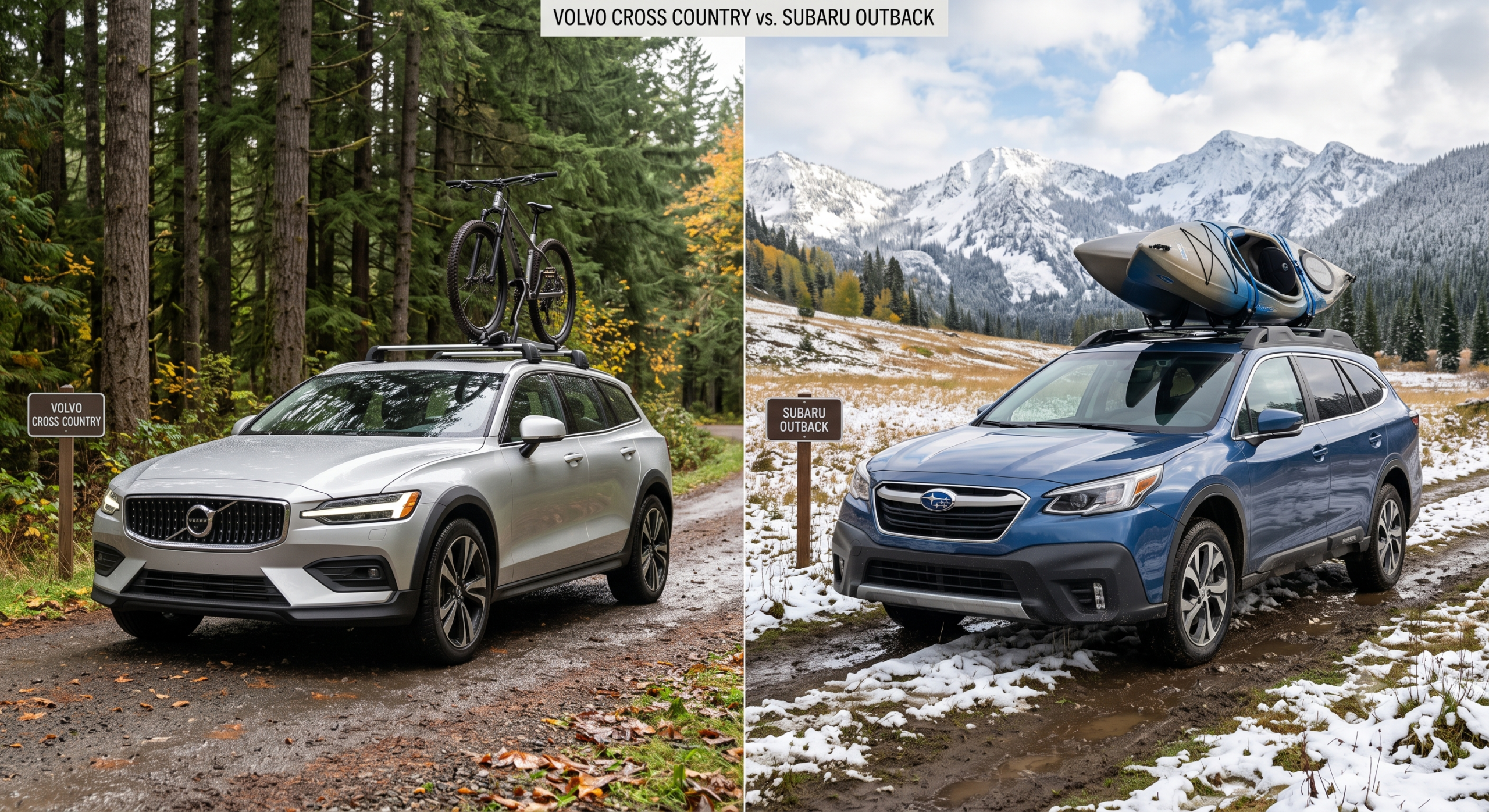
A 2026 comparison piece framed it well: the Volvo’s raised ride height gives it real bad-weather manners and low-effort highway comfort, but it doesn’t chase maximum cargo cubic feet the way a boxier SUV does. If you regularly haul a small camper, kayaks on a roof rack, or gear for backcountry trips, the Outback’s extra clearance and towing capacity matter more than they might sound on paper.
Expert Insight: Both vehicles come with standard all-wheel drive, so neither is a “weak in snow” option. The real differentiator is ground clearance for deep snow or rutted gravel roads — that’s where the Outback’s extra 1.4 inches actually shows up in daily use.
Reliability and Long-Term Ownership
Subaru’s reliability reputation is arguably its single strongest selling point. Subaru’s own data claims 96% of Outback vehicles sold in the last 10 years are still on the road today, a higher retention rate than the Toyota RAV4, Honda CR-V, Hyundai Santa Fe, or Toyota 4Runner. That’s a manufacturer-sourced stat, so treat it as directional rather than gospel, but it lines up with Subaru’s long-standing image as the car that just keeps running.
Volvo’s reliability story is more mixed. Edmunds notes the V60 Cross Country carries a reliability score of 7 out of 10 in their own rating system, solid but not class-leading. Volvo’s counterpoint is standard maintenance coverage: for 2026 model-year cars, Volvo covers recommended maintenance services for the first two years or 20,000 miles, which softens the ownership-cost gap somewhat.
Choose the Outback if you want the lowest long-term ownership risk and don’t mind a less plush interior. Choose the V60 Cross Country if you’re willing to trade a bit of reliability certainty for a noticeably nicer cabin and quieter ride, and you plan to lease or trade in before major maintenance bills hit.
Pros and Cons by Buyer Type
Family road-trippers:
- Volvo V60 Cross Country: ✅ Quiet cabin reduces trip fatigue, strong safety reputation. ❌ Less cargo height than a true SUV.
- Subaru Outback: ✅ More cargo room, lower price frees up trip budget. ❌ Noisier at highway speeds.
Budget-conscious first-time luxury buyers:
- Volvo V60 Cross Country: ✅ Genuine near-luxury materials and tech at a lower price than an SUV rival. ❌ Still a meaningful stretch versus mainstream competitors.
- Subaru Outback: ✅ Loaded trims still undercut the Volvo’s base price. ❌ Interior reads more “practical” than “premium,” even at the top.
Outdoor and towing enthusiasts:
- Volvo V60 Cross Country: ✅ Comfortable for long highway hauls to the trailhead. ❌ Limited towing capability compared to the Outback.
- Subaru Outback: ✅ Higher clearance and 3,500-lb towing rating. ❌ Ride quality softens on rough pavement compared to Volvo.
FAQ
Is the Volvo V60 Cross Country worth the extra money over a Subaru Outback? It depends on what you value. You’re paying roughly $17,000 more for a quieter cabin, nicer materials, and Volvo’s safety brand, not for more power or cargo room.
Which one is better in snow, the Cross Country or the Outback? Both come with standard all-wheel drive, but the Outback’s extra 1.4 inches of ground clearance gives it an edge in deep or unplowed snow.
Does the Subaru Outback get better gas mileage than the Volvo V60 Cross Country? They’re close. The base Outback and V60 Cross Country both reach 31 mpg highway, though the Outback’s base engine edges ahead slightly on combined mileage.
Can the Volvo V60 Cross Country tow a trailer? Volvo doesn’t market the V60 Cross Country as a towing vehicle the way Subaru promotes the Outback’s 3,500-pound rating, so it’s not the right pick if towing is a priority.
Which is more reliable long-term, Volvo or Subaru? Subaru’s reputation for longevity is one of the brand’s strongest selling points, while Volvo’s reliability scores are solid but not class-leading, according to Edmunds’ own ratings.
Key Takeaways
- The Subaru Outback starts nearly $17,000 cheaper than the Volvo V60 Cross Country, and that gap holds even between top trims.
- Volvo’s turbo mild-hybrid engine (247 hp) beats the Outback’s base engine, but Subaru’s optional turbo (260 hp) beats the Volvo.
- Fuel economy is nearly a wash, with both topping out around 31 mpg highway on their base engines.
- The Outback offers more ground clearance (9.5 in vs. 8.1 in) and real towing capacity (3,500 lbs).
- The V60 Cross Country wins on cabin quality, highway quiet, and overall refinement.
- Subaru holds a stronger reputation for long-term reliability, backed by its own 10-year retention data.
Ready to decide? If your budget is firm and you want maximum utility for the dollar, start your search with the Subaru Outback. If a quieter, more upscale cabin is worth the premium to you, book a test drive in the Volvo V60 Cross Country before you commit either way — the difference in feel is hard to judge from spec sheets alone.