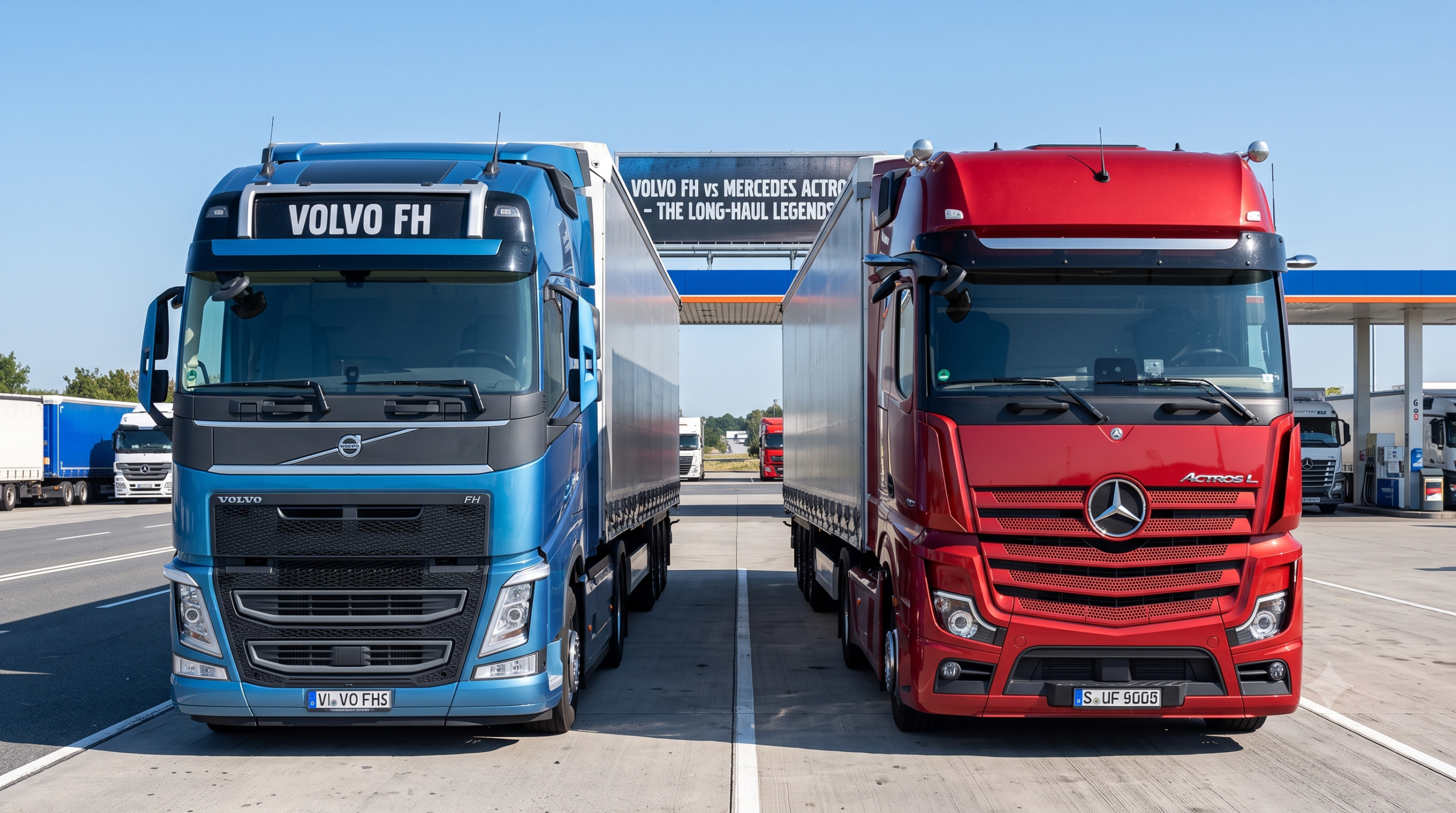
Volvo FH vs Mercedes Actros?

Two Flagship Trucks, One Decision That Affects Your Bottom Line for the Next Decade
Spec’ing a new tractor unit is one of the most expensive decisions a fleet manager or owner-operator makes, and the Volvo FH versus Mercedes-Benz Actros debate has been running for years without a clean winner. Both are engineering flagships from Europe’s biggest truck makers, and both will happily do 1,000,000+ kilometers if you look after them.
I’ve pulled together the latest published specs, independent 40-tonne comparison test data, and fleet feedback to give you a clear-eyed read on where each truck actually pulls ahead. No brand loyalty, just numbers.
TL;DR
- Volvo FH16 tops out around 650–750 hp with up to 3,150 Nm of torque in its 16.1-liter flagship engine.
- Mercedes Actros flagship (1863) delivers 625 hp and 3,000 Nm from its 15.6-liter OM 473 six-cylinder.
- Volvo’s engine delivers peak torque 150 rpm earlier, but Mercedes’ PPC GPS cruise control is rated more sophisticated by independent testers.
- Both brands now offer heavy electric tractors — the Mercedes eActros 600 and Volvo FH Aero Electric — with the eActros charging notably faster.
- Cab comfort is close: Volvo wins on storage space, Mercedes wins on flat-floor practicality.
The short answer: Volvo FH generally wins on raw power and low-end torque, especially in its 16-liter flagship trim, while the Mercedes Actros counters with a more refined automated cruise system and a flatter cab floor that many drivers prefer for two-up sleeping. Neither truck is a clear “better” choice — the right pick depends on your routes, your terrain, and what your drivers actually rate as comfortable.
Volvo FH: The Torque-First Flagship
The Volvo FH — especially the FH16 variant — is built around big-displacement power and early torque delivery. In independent 40-tonne comparison testing, the Volvo FH16/650 Globetrotter XL produced <cite index=”26-1″>650 PS and 3,150 Nm of torque from a 16.1-liter engine</cite>, putting it firmly in the “powertruck” category alongside Mercedes’ own top-spec Actros.
What stands out isn’t just the peak numbers — it’s when they arrive. Testers found the <cite index=”26-1″>Volvo engine delivers its maximum torque starting at 950 rpm, about 150 rpm earlier than the Actros drivetrain</cite>, and noted it runs notably smoothly with minimal vibration even at low revs. That earlier torque arrival matters most on hill starts and loaded pullaways — the moments where a truck either surges confidently or bogs down.
Quick Tip: If your routes include mountain passes or consistent hill starts fully loaded, Volvo’s earlier torque peak is the single biggest practical advantage to weigh.
Volvo’s gearbox strategy also earned praise in that same test — the FH16’s overdrive-coupled transmission downshifts early on climbs to stay in direct gear as much as possible, a subtle efficiency trick that adds up over long-haul routes.
Mercedes Actros: Refined Cruise Control and Cab Practicality
The Mercedes-Benz Actros counters with its OM 473 engine and what testers consistently call the more polished automated cruise system on the market.
In the same head-to-head, the flagship <cite index=”26-1″>Mercedes Actros 1863 BigSpace produced 625 PS and 3,000 Nm from its 15.6-liter OM 473 six-cylinder engine</cite> — slightly behind Volvo on paper, but the gap narrows considerably in real driving thanks to Mercedes’ Predictive Powertrain Control (PPC).
Testers were blunt about the difference here: <cite index=”26-1″>PPC is unmatched in its tuning, using every small rise in terrain to save fuel and even skipping a gear mid-climb when it makes sense</cite> — a level of GPS-based route anticipation that Volvo’s comparable I-See system doesn’t quite match, according to the same review.
Expert Insight: A more sophisticated cruise system isn’t just a comfort feature on long-haul routes — it directly affects fuel spend, which is often a fleet’s single largest operating cost.
Where the Actros also earns points is cab ergonomics. In a separate detailed cab comparison, testers found the Actros offers <cite index=”23-1″>a flatter cabin floor, making it easier to fit two full-size beds without compromise</cite> — a meaningful difference for teams running double-driver long-haul routes, even though it comes at the cost of a slightly harder step-up into the cab.
Volvo FH vs Mercedes Actros: Side-by-Side Comparison
| Spec | Volvo FH16 (Flagship) | Mercedes Actros 1863 |
|---|---|---|
| Engine displacement | 16.1L six-cylinder | 15.6L OM 473 six-cylinder |
| Peak power | Up to 650–750 hp | 625 hp |
| Peak torque | 3,150 Nm at 950–1,450 rpm | 3,000 Nm at 1,100 rpm |
| Cruise/route tech | I-See predictive cruise | PPC (Predictive Powertrain Control) |
| Cab floor | Small transmission tunnel | Fully flat |
| Cab storage | ~1,000 liters | Less than FH, per tester comparison |
| Electric flagship | FH Aero Electric | eActros 600 |
| Electric charging (DC) | ~2.5 hrs full charge at 250 kW | 20–80% in ~1 hour at up to 400 kW |
The pattern here is consistent: Volvo wins on mechanical grunt, Mercedes wins on software polish and cab practicality. Which one matters more to your operation depends heavily on your route profile and driver preferences.
Pros and Cons by Operator Type
The Long-Haul Fleet Manager
- ✅ Volvo: Earlier torque peak reduces strain on hilly or mountainous routes.
- ✅ Mercedes: PPC’s fuel-saving route anticipation can meaningfully cut per-km diesel spend across a large fleet.
- ❌ Volvo: I-See system rated slightly less sophisticated than PPC in direct testing.
- ❌ Mercedes: Slightly less peak torque than Volvo’s flagship 16-liter engine.
The Owner-Operator Doing Solo Long-Distance
- ✅ Volvo: Roughly 1,000 liters of in-cab storage, more than the Actros offers.
- ✅ Volvo: Smoother idle and low-RPM operation reported by testers.
- ❌ Mercedes: Flat floor is excellent for two drivers but less of an advantage solo.
- ❌ Mercedes: Standing air-conditioning unit takes up cab space Volvo relocates elsewhere.
The Team-Driver / Double-Crew Operation
- ✅ Mercedes: Flat cab floor makes fitting two full beds genuinely easier.
- ✅ Mercedes: Actros’ upper bunk is height-adjustable at the front for taller drivers.
- ❌ Volvo: Optional overhead cabinet system can make the upper bunk area tight.
- ❌ Volvo: Smaller step-up ladder design, though it doubles as a useful surface for quick tasks.
Real-World Scenario: Two Fleets, Two Priorities
A regional freight operator running mountain routes through the Alps chose the Volvo FH16 specifically for its earlier torque delivery — drivers reported noticeably less downshifting on sustained climbs compared to their previous fleet’s Actros units. Fuel consumption on those routes stayed roughly comparable once terrain was factored in.
Meanwhile, a long-haul operator running flat European motorway corridors between Rotterdam and Barcelona chose the Actros specifically for PPC’s fuel-saving cruise behavior on the mostly flat route — and for the flat cab floor, since many of their runs use two-driver rotation to keep the truck moving around the clock. Same industry, same budget range, genuinely different right answers.
Choose Volvo FH If…
Your routes involve significant elevation change, hill starts under load, or you simply want the highest available torque figure in class. Choose this if raw pulling power and cab storage matter more than the most advanced cruise-control software on the market.
Choose Mercedes Actros If…
You run mostly flat, long-distance motorway corridors where predictive cruise control can shine, or you regularly run two-driver teams needing a genuinely flat floor. Choose this if fuel-saving software sophistication and cab practicality for two people matter more than outright torque.
FAQ
Which is more powerful, the Volvo FH or the Mercedes Actros? The Volvo FH16 flagship generally out-torques the Mercedes Actros — in matched 40-tonne testing, the Volvo delivered 3,150 Nm versus the Actros’s 3,000 Nm, with Volvo also offering higher-output variants up to 750 hp in its range-topping configuration.
Does Mercedes or Volvo have better fuel economy? It depends heavily on terrain and route type. Mercedes’ PPC cruise system is rated by independent testers as more advanced at anticipating terrain to save fuel, particularly on rolling or flat motorway routes, while Volvo’s earlier torque delivery can reduce fuel-wasting downshifts on steep climbs.
Are there electric versions of the Volvo FH and Mercedes Actros? Yes. Mercedes offers the eActros 600 with battery capacity around 621 kWh usable and fast DC charging up to 400 kW, while Volvo offers the FH Aero Electric with battery capacity in the 360–540 kWh range and a slower roughly 2.5-hour full DC charge at 250 kW.
Which truck has a more comfortable cab, Volvo FH or Mercedes Actros? Both are excellent, but they win on different things — the Actros has a fully flat floor that’s better for two-driver sleeping setups, while the Volvo FH offers roughly 1,000 liters of storage space, more than the Actros provides.
Is the Volvo FH or Mercedes Actros better for mountain routes? The Volvo FH16 tends to perform better on sustained climbs because its torque peak arrives about 150 rpm earlier than the Actros, reducing the frequency of downshifts needed to maintain momentum under load.
Key Takeaways
- Volvo FH16 leads on raw torque (3,150 Nm) and delivers it earlier in the rev range — a real advantage on hilly or mountainous routes.
- Mercedes Actros counters with PPC, a GPS-based cruise system independent testers rate as the more sophisticated fuel-saving tool on the market.
- Cab comfort is close but different: Volvo offers more storage, Mercedes offers a flatter floor for two-driver setups.
- Both manufacturers now field serious electric flagships — the eActros 600 currently charges notably faster than the FH Aero Electric.
- There’s no universal winner — route profile, terrain, and crew setup should drive the decision more than brand preference.
Ready to Decide?
Before committing to either flagship, request a loaded demo run on your actual routes — the torque and cruise-control differences that show up on paper become obvious within the first fully loaded hill climb or long motorway stretch.