Volvo P1 vs P2?

Shop for a used Volvo from the 2000s and you’ll eventually run into forum threads throwing around “P1” and “P2” like everyone should already know what they mean. They don’t refer to trim levels or engines — they’re chassis platform codes, and which one your car sits on says a lot about how it drives, what it costs to fix, and how much space you’ll get.
TL;DR
- P1 underpins the smaller S40, V50, C30, and C70 (2004–2013)
- P2 underpins the larger S60, S80, V70, XC70, and XC90 (roughly 1998–2009)
- P1 cars tend to handle sharper and cost less to maintain; P2 cars offer more space and a plusher ride
- P2 was originally a Volvo-only design, later adapted to meet Ford’s cost targets after the 1999 acquisition
- Neither commands strong collector value yet, but P1 cars have held steadier in recent years
I’ve spent time digging through Volvo enthusiast forums, owner communities, and parts-supplier technical breakdowns to sort out what’s fact versus internet folklore on this topic — because platform codes get argued about a lot, and not always accurately.
So which is better, P1 or P2? It depends entirely on what you want from the car. P1 is the newer, smaller, sportier platform underneath the S40/V50/C30/C70 family, while P2 is the older, larger platform underneath the S60/S80/V70/XC70/XC90 family — and yes, despite P1 sounding “newer” than P2 by the numbers, that’s exactly backwards from what a lot of shoppers assume.
Quick Tip: If you see a “P1” or “P2” badge in a classified ad, it’s shorthand for the platform generation — not a trim, engine size, or special edition.
What Is a Volvo Platform, Anyway?
A platform groups together cars from a certain era that share many parts and design principles, which lets an automaker cut development costs and streamline production across multiple models. Think of it like a shared skeleton — the sheet metal, badge, and interior might look completely different between two cars, but underneath they share a floor pan, suspension mounting points, and often an engine family.
Volvo didn’t always use these codes. Before the P80 platform underlying the 850, Volvo generally didn’t use platform-style names for the 240/260 or 740/760 generations — the P-numbering habit picked up steam later.
The P2 Platform: Volvo’s Big-Car Architecture
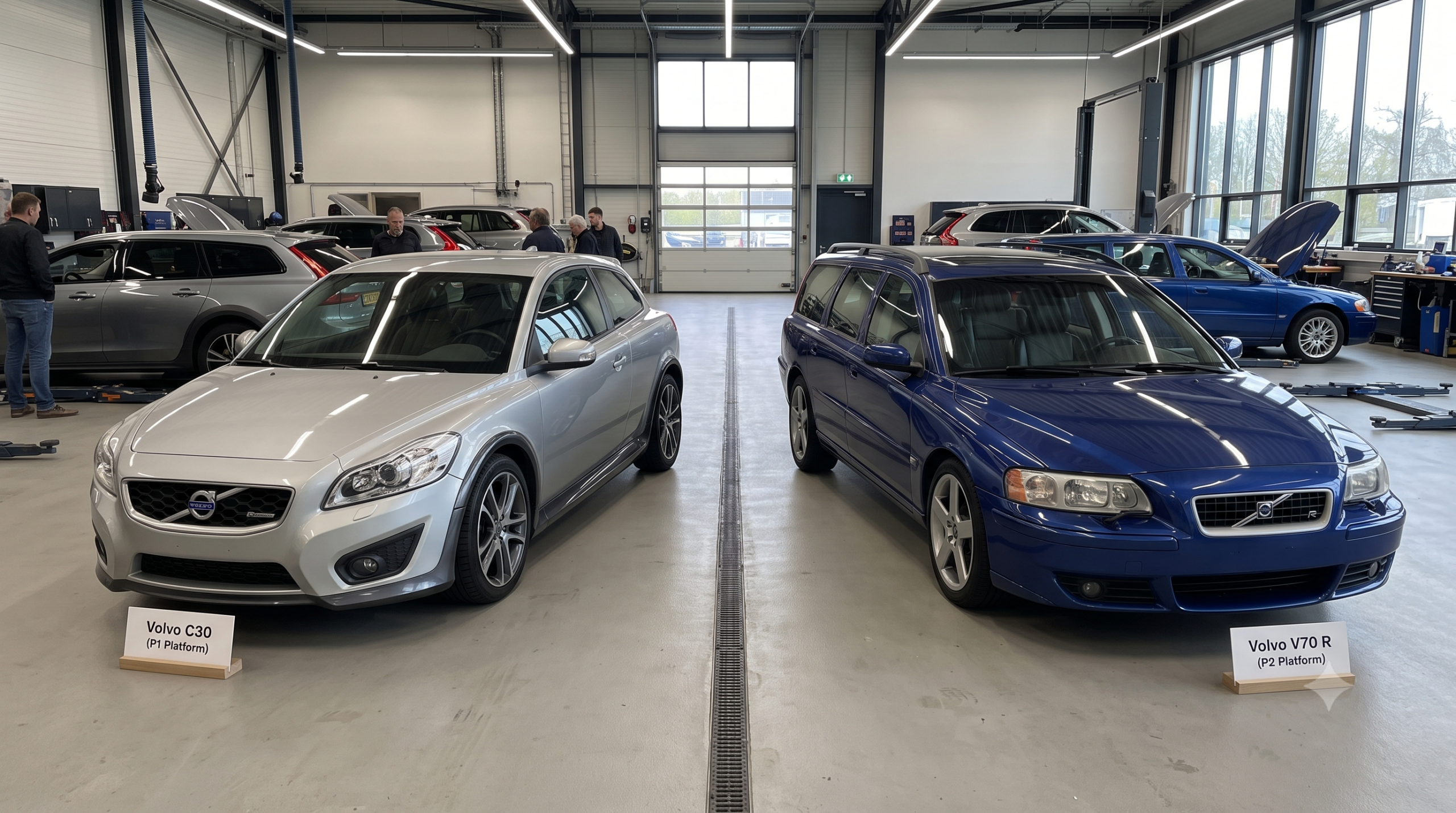
P2 is the older of the two platforms discussed here, despite the higher number suggesting otherwise. It underpins the S60, V70, XC70, and XC90, and was also used for the outgoing S80. Depending on which source you check, P2 production spans roughly 1998 to 2009, covering the first-generation S60 and S80 through the first-generation XC90.
Here’s a detail that surprises a lot of shoppers: P2 was originally developed by Volvo before Ford’s 1999 acquisition, then reworked to meet Ford’s cost requirements once the deal closed. That history explains some of the platform-sharing complaints you’ll see in owner forums — components that started as Volvo-engineered pieces ended up value-engineered to hit a shared parts-bin budget across Ford’s portfolio.
Pull-quote: P2 is the platform where Volvo’s own engineering met Ford’s spreadsheet — and both show up in how the car drives.
Common P2 Ownership Notes
- Owners frequently cite comfort and cabin space as the platform’s strongest suit
- Some P2 engines are associated with variable valve timing (VVT) wear that can get expensive to address
- The ride is generally softer, with more body lean in corners compared to P1
Expert Insight: If your priority is highway comfort over back-road agility, and you don’t mind researching VVT service history before buying, P2 still makes a strong case for itself as a used family car.
The P1 Platform: Smaller, Sportier, Shared With Ford and Mazda
P1 covers the C30, C70, S40, and V50 — Volvo’s compact lineup built between 2004 and 2013. Unlike P2, P1 was co-developed from the outset with Ford and Mazda, using the same underlying C1/EUCD architecture found in the Ford Focus and Mazda 3 of that era.
That shared development wasn’t a straight badge-engineering job, though. Volvo’s version carried a significant amount of safety-related engineering on top of the shared base to justify its position above the Focus and Mazda 3 — this wasn’t simply a rebadged economy car.
Picture two friends cross-shopping a used S40 and a used S60 from the same decade: the S40 driver reports crisper steering feel and less body roll through a cloverleaf on-ramp, while the S60 owner is hauling more cargo on the same trip in a quieter, softer-riding cabin. Neither is wrong — they optimized for different things.
Common P1 Ownership Notes
- Widely reported as more nimble, with steering that feels more directly connected to the front wheels
- The final revision of Volvo’s “N” engine family used in P1 cars — the RNC — simplified some failure-prone PCV components
- The turbocharged 2.5-liter inline-five used in the C30 is frequently cited by owners as the strongest engine in the P1 lineup
Model Coverage: P1 vs P2 at a Glance
| Platform | Models (NA Market) | Years | Best Known For |
|---|---|---|---|
| P1 | S40, V50, C30, C70 | 2004–2013 | Handling, lower running costs |
| P2 | S60, S80, V70, XC70, XC90 | ~1998–2009 | Interior space, ride comfort |
Note that some older forum posts use “P1” loosely to describe pre-2001 850-derived cars like the S70 and first-generation V70 — that’s an outdated or informal usage. The commonly accepted modern definition ties P1 specifically to the 2004+ S40/V50/C30/C70 generation, and P2 to the S60/S80/V70/XC70/XC90 generation that followed the 850/S70 era.
Driving Feel: The Real Difference
If there’s one thing owners on both sides agree on, it’s that these platforms feel genuinely different behind the wheel — this isn’t just badge-deep. One recurring owner comparison sums it up bluntly: P2 handles with more body roll and looser-feeling steering, while a P1-platform car corners closer to a go-kart by comparison.
That said, P2 loyalists push back on the idea that P1 wins across the board. Owner comparisons commonly rate the two platforms as: comfort favors P2, handling favors P1, performance is a toss-up depending on trim, and outright space favors P2.
Quick Tip: If you’re deciding between a same-era S40 (P1) and S60 (P2), don’t just compare specs on paper — the two genuinely drive like different classes of car, not just different sizes of the same one.
Reliability and Running Costs
Neither platform is trouble-free at this age, but the nature of the issues differs. P1 owners frequently describe the platform as tough to break even under enthusiast-level modification, with one longtime owner noting they’ve pushed boosted P1 cars hard without engine failures and without significant AWD system problems.
P2 cars carry a different reputation, with VVT (variable valve timing) wear repeatedly flagged by owners as an expensive repair to budget for — in some cases, owners note the repair cost can approach what a comparable used P1 car sells for outright.
Expert Insight: Before buying either platform used, ask specifically about VVT service history on a P2 car, or PCV/turbo maintenance records on a P1 — these are the recurring pain points owners bring up most.
Value and Market Pricing
Be cautious with any specific used-market price you see quoted for these cars — pricing on forums varies wildly by region, condition, and mileage, and much of it is anecdotal rather than tracked by a formal pricing index. (As of mid-2026, neither platform has significant published resale-value data from major pricing guides, since both sit in the affordable used-car segment rather than the collector market.)
That said, the general owner consensus is fairly consistent: P1 cars tend to be less expensive to buy and are seen as offering better reliability-for-the-money, while P2 cars — particularly performance variants — have historically depreciated faster despite strong original demand.
Pros and Cons by Buyer Type
The Daily Commuter
- ✅ P1 (S40/V50): Compact size, easier parking, lower fuel costs
- ✅ P2 (S60): More trunk space for gear-heavy commutes
- ❌ Both platforms are 15+ years old — expect ongoing maintenance regardless of choice
The Enthusiast/Tuner
- ✅ P1: Reputation for handling well and tolerating higher boost levels
- ✅ P2: More engine variety, including the S60 R and V70 R performance models
- ❌ P2 R-model maintenance costs can run higher than a comparable P1
The Family Buyer
- ✅ P2 (V70/XC70/XC90): Wagon and SUV body styles, more cargo room, comfortable ride
- ❌ P1 doesn’t offer a three-row option — XC90 buyers need P2
FAQ
What does P1 and P2 mean on a Volvo? They’re internal chassis platform codes. P1 covers the S40, V50, C30, and C70; P2 covers the S60, S80, V70, XC70, and XC90.
Is P1 or P2 newer? P1 is the newer platform despite the lower number — it launched in 2004, while P2 dates back to roughly 1998.
Which Volvo platform is more reliable, P1 or P2? Owners generally report P1 as lower-maintenance, largely due to VVT wear issues commonly associated with P2-era engines, though both platforms need careful maintenance-history checks at this age.
Does the Volvo XC90 use the P1 or P2 platform? The first-generation XC90 uses the P2 platform.
Can I use P1 parts on a P2 car, or vice versa? No — despite some shared Ford-era sourcing for individual components, P1 and P2 are structurally different platforms and are not interchangeable at the chassis level.
Key Takeaways
- P1 (S40, V50, C30, C70) is the newer, smaller, sportier platform built 2004–2013
- P2 (S60, S80, V70, XC70, XC90) is the older, larger platform built roughly 1998–2009
- P1 tends to win on handling and running costs; P2 tends to win on space and ride comfort
- P2’s history traces back to a Volvo-only design later adapted to Ford’s cost targets
- Neither platform has strong formal collector-market pricing data yet — treat used listings case-by-case
Which Should You Buy?
If you want a nimbler daily driver with lower expected running costs, look at a P1-platform S40, V50, or C30. If you need wagon or SUV-level space and prioritize ride comfort over cornering sharpness, a P2-platform V70, XC70, or XC90 is the better fit — just budget extra scrutiny for VVT service history before you buy.