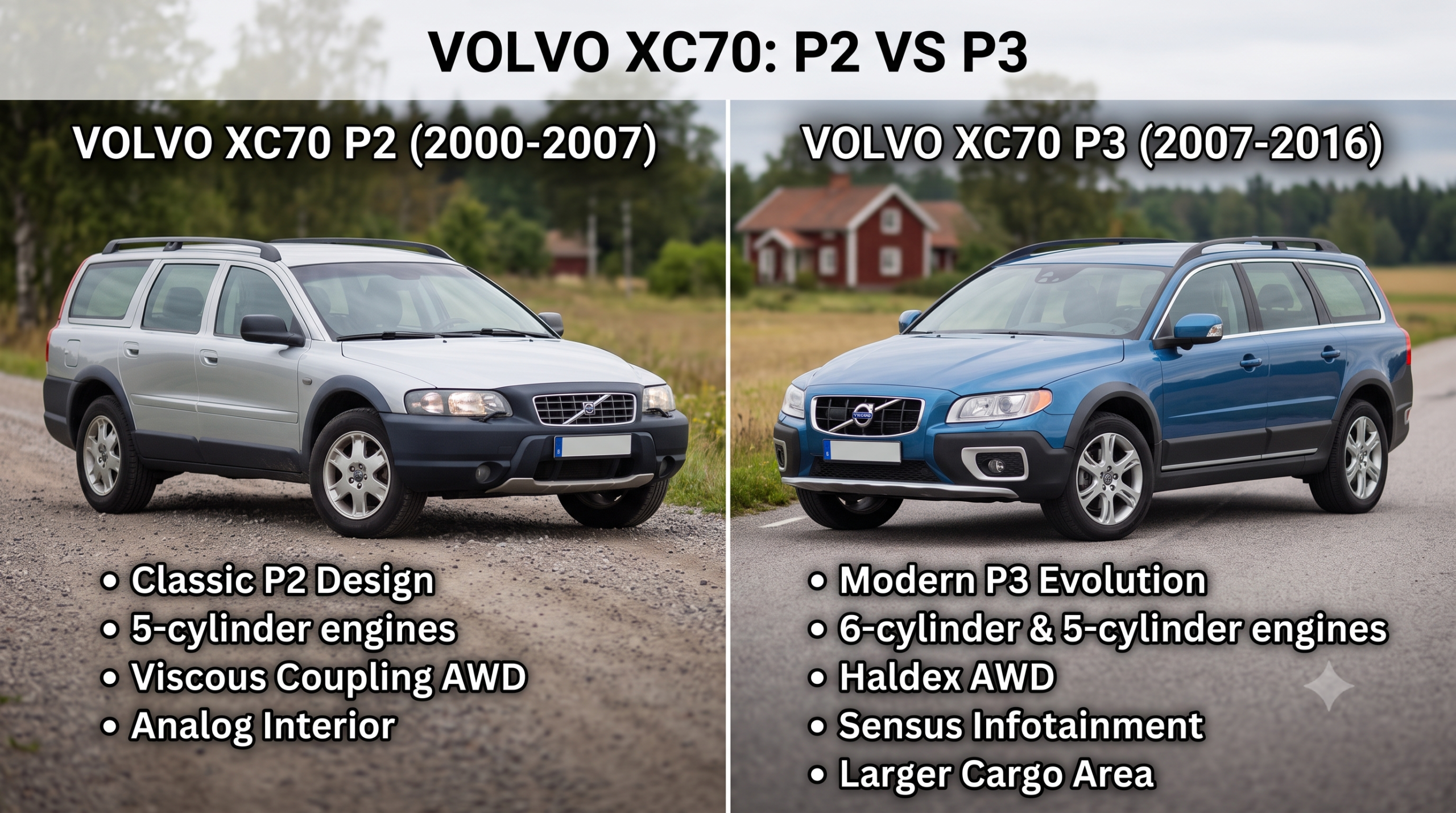
Volvo XC70 P2 vs P3?

Ask ten Volvo XC70 owners which generation is better, and you’ll get eleven opinions—most of them passionate. The P2-vs-P3 debate is one of the longest-running arguments in Volvo enthusiast circles for good reason.
TL;DR
- The P2 XC70 was built from roughly 2003–2007 (with the earlier “V70 XC” predecessor from 2001–2004) and is prized for simplicity, rust resistance, and lower repair costs
- The P3 XC70 was built from 2008–2016 and offers a more modern ride, more rear-seat room, and updated technology
- Owner consensus consistently favors the P2 for durability and lower maintenance costs, and the P3 for ride comfort and interior space
- The P3’s 3.2L six-cylinder engine is frequently criticized by owners as underpowered; the P2’s 2.5T five-cylinder is generally better regarded
- Budget matters: enthusiasts commonly cite $4,000–$8,000 for a good P2, versus $12,000–$20,000+ for a solid P3
The core answer: the P2-generation XC70 (2003–2007) is generally favored by longtime owners for its mechanical simplicity, stronger rust protection, and lower maintenance costs, while the P3-generation XC70 (2008–2016) offers a more modern, comfortable ride with more rear-seat room and updated technology—at a meaningfully higher price and, according to many owners, a less satisfying base engine.
What Defines the P2-Generation XC70?
The P2 XC70 represents the era right after Ford took ownership of Volvo, before Ford’s influence was as deeply woven into the platform.
According to Volvo enthusiast reference sites, the P2 platform covers North American model years 2001–2007, including the V70 XC (2001–2004) and the renamed XC70 (2004–2007). Owners in enthusiast forums consistently describe this generation as having excellent rust protection on the body and note it can be found today in decent condition for roughly $4,000–$8,000.
Quick Tip: If you’re set on a P2 XC70, forum consensus points to the later years (2005–2007) as the sweet spot, since early P2 models (2001–2002) are more commonly flagged as ones to avoid.
What Defines the P3-Generation XC70?
The P3 XC70 marked a full platform overhaul, sharing more DNA with Ford’s European engineering than the P2 generation did.
The P3 XC70 launched for the 2008 model year, built on what Volvo called the P3 (EUCD) platform, and continued through 2016, when a Cross Country version of the SPA-based V90 replaced it in Volvo’s lineup. Owners frequently note the P3 rides less “floaty” than the P2 and offers noticeably more rear-seat room, along with a more modern built-in navigation system.
Expert Insight: Longtime owners on Volvo forums have repeatedly flagged the P3’s 3.2L naturally aspirated six-cylinder as a weak point, with one owner bluntly describing it as underpowered compared to the P2’s turbocharged 2.5T five-cylinder, particularly in low-end acceleration.
P2 vs. P3 XC70: Side-by-Side
| Feature | P2 XC70 (2003–2007) | P3 XC70 (2008–2016) |
|---|---|---|
| Platform origin | Early Ford-era Volvo engineering | EUCD platform, deeper Ford integration |
| Rust protection | Frequently praised as excellent | Reported as less robust by some owners |
| Ride quality | Described as “floatier” | Described as tighter, more planted |
| Rear-seat room | Tighter | More generous |
| Base engine | 2.5T turbocharged 5-cylinder | 3.2L naturally aspirated 6-cylinder (early years) |
| Later engine options | N/A | T6 turbo 6-cylinder, D5 diesel, T5 4-cylinder (2014+) |
| Typical used price | ~$4,000–$8,000 | ~$12,000–$20,000+ |
| Repair/maintenance cost | Generally lower | Generally higher |
Pros and Cons by Buyer Type
Budget-Focused DIY Owners
- ✅ P2 examples are widely available in the $4,000–$8,000 range with strong community repair knowledge
- ✅ Excellent rust protection, a meaningful factor in colder climates
- ❌ Rear-seat space is noticeably tighter than the P3
Comfort and Space-Focused Buyers
- ✅ The P3 offers a smoother, more planted ride and more rear legroom
- ✅ Later P3 years (2013+) are frequently described by owners as notably improved and more reliable
- ❌ A solid P3 typically costs significantly more than a comparable P2, often $12,000 or more
Performance-Minded Buyers
- ✅ The P2’s 2.5T is widely preferred by enthusiasts over the P3’s base 3.2L six-cylinder
- ✅ The P3’s optional T6 turbocharged six-cylinder addresses the base engine’s power complaints for those willing to pay more
- ❌ Turbo P2 engines require premium fuel and return lower fuel economy than some P3 configurations
Quick Tip: If you’re drawn to the P3 but want to avoid its most criticized engine, look specifically for a T6 or D5 diesel variant rather than the base 3.2L six-cylinder that many owners describe as gutless.
Real-World Scenario
Imagine a DIY-minded buyer with a $6,000 budget looking for a dependable winter wagon. Forum consensus is consistent here: at that price point, a well-maintained P2 is the more realistic and durable choice, since a P3 in that range is more likely to need significant near-term repairs.
Now picture a buyer with a $15,000–$18,000 budget who wants modern comfort and more rear-seat room for family trips. A later-model P3, ideally a T6 or D5 diesel from 2013 or newer, is the generation most owners recommend at that budget level.
Which Generation Should You Buy?
Choose the P2 if: your budget is limited, you value mechanical simplicity and rust resistance, and you’re comfortable with DIY maintenance on an older vehicle.
Choose the P3 if: you want more rear-seat room, a more modern ride and tech, and can budget for a later-model year (ideally with the T6 or D5 engine) to avoid the most commonly criticized base engine.
Pull quote: Ask Volvo owners P2 or P3, and you’ll learn more about their priorities than about the actual cars.
FAQ
Which XC70 generation is more reliable, P2 or P3? Owner consensus generally favors the P2 for lower long-term repair costs and stronger rust protection, though well-maintained P3s, especially post-2013, are also frequently praised as dependable.
Is the P3’s 3.2L engine really that underpowered? Many owners describe it as noticeably weaker than the P2’s turbocharged 2.5T, particularly at low RPM, and recommend seeking out the T6 or D5 diesel P3 variants instead if power matters to you.
Which is cheaper to buy, a P2 or P3 XC70? The P2 is typically significantly cheaper, with forum estimates commonly citing $4,000–$8,000 for a good P2 versus $12,000–$20,000+ for a solid P3.
Does the P3 have more interior space than the P2? Yes, owners consistently describe the P3 as having noticeably more rear-seat legroom and a roomier overall cabin compared to the P2.
What replaced the XC70 after the P3 generation ended? The XC70 was discontinued after 2016, with a Cross Country version of the SPA-platform V90 (the V90 Cross Country) taking its place in Volvo’s lineup starting in 2017.
Key Takeaways
- The P2 XC70 (2003–2007) is favored for simplicity, rust resistance, and lower cost
- The P3 XC70 (2008–2016) offers more rear-seat room, a smoother ride, and more modern tech
- The P3’s base 3.2L engine is a common owner complaint—look for T6 or D5 variants instead
- Budget expectations differ significantly: roughly $4,000–$8,000 for P2 versus $12,000–$20,000+ for a solid P3
- Later P3 model years (2013+) are frequently cited as the most improved and reliable
What To Do Next
Decide your budget range first—it will likely determine your generation more than any single feature comparison—then get a pre-purchase inspection focused on rust (for P2) or suspension and engine wear (for P3) before buying.