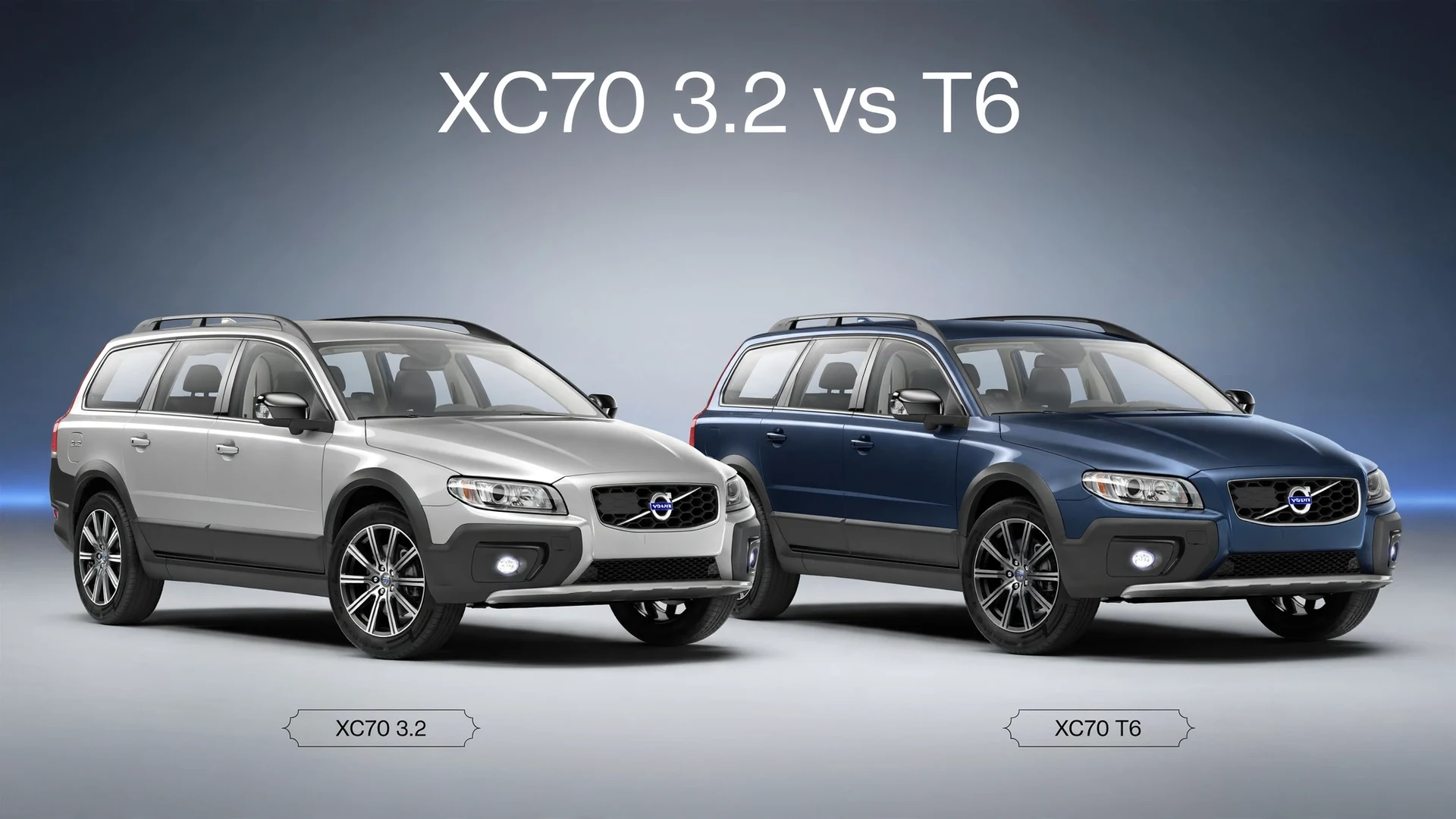
Volvo XC70 3.2 vs T6?

Volvo XC70 3.2 vs T6?
The P3 XC70 (2008–2016) came with two six-cylinder hearts, and choosing between them is the single biggest decision a used buyer faces: the 3.2, a naturally aspirated 3.2-litre inline-six, or the T6, a turbocharged 3.0-litre inline-six. The short answer: the T6 is the better engine — 300 hp and 325 lb-ft from 2,100 rpm (2011+), 0–60 in 6.9 seconds, standard all-wheel drive, and a far more relaxed character. The 3.2 is the rational buy — cheaper to buy, cheaper to fuel, and perfectly adequate — but only from 2011 onward, because early 3.2s have documented oil-consumption issues. Here’s the full comparison with the numbers that matter.
- Power (2011+): 3.2 — 240 hp / 236 lb-ft; T6 — 300 hp / 325 lb-ft @ 2,100 rpm. The T6 is 25% more powerful with 38% more torque, arriving much earlier.
- Performance: T6 does 0–60 mph in 6.9 seconds (Volvo claim). The 3.2 is roughly two seconds slower.
- Economy: EPA rated the 2012 T6 at 16/22 mpg; one owner averaged 10.1 L/100 km. The 3.2 is meaningfully thriftier in real use.
- Prices (2011 new): 3.2 FWD $32,150; T6 AWD $38,200 (+$875 destination on both). AWD was a $2,000 option on the 3.2; standard on the T6.
- Reliability: avoid 2008–2010 3.2s (oil consumption); the 2011+ T6 is the sweet spot of the P3 range.
- Verdict: buy the T6 if the fuel bills don’t scare you; buy a 2011+ 3.2 if they do.
Same Car, Different Engine — Different Personality
It’s easy to think of the 3.2 and T6 as “the slow one and the fast one,” but the difference is really about effort. The 3.2 (B6324S family) is a big, naturally aspirated six that needs revs to deliver: 240 hp arrives high in the range, and while it’s smooth and refined at a cruise, asking it to haul 1,900 kg of wagon plus a loaded boot up a grade means working the gearbox. Owners describe it as adequate — never strained, never exciting.
The T6 (B6304T family) is a different animal. A twin-scroll turbocharger force-feeds the 3.0-litre six to 300 hp, but the headline is the torque: 325 lb-ft from just 2,100 rpm, and it stays flat across the mid-range. In practice that means the T6 barely notices hills, trailers, or full loads — it surfs on torque where the 3.2 has to downshift and shout. Volvo’s own 0–60 claim of 6.9 seconds makes the T6 quicker than many contemporary sports sedans, let alone wagons. Around town and on the motorway, the T6 is simply the more relaxing car — which is what a Volvo is supposed to be.
Performance and Economy: the Numbers
| Specification | 3.2 (2011–2014) | T6 (2011–2014) |
|---|---|---|
| Engine | 3.2L NA inline-6 (B6324S) | 3.0L turbo inline-6 (B6304T) |
| Power | 240 hp (230 hp PZEV) | 300 hp |
| Torque | 236 lb-ft (320 Nm) | 325 lb-ft (440 Nm) @ 2,100 rpm |
| 0–60 mph | ~8.5–9.0 s (est.) | 6.9 s (Volvo claim) |
| Driven wheels | FWD std; AWD +$2,000 | AWD standard |
| EPA economy (2012) | ~18/25 mpg | 16/22 mpg |
| 2011 MSRP (+$875 dest.) | $32,150 (FWD) | $38,200 (AWD) |
| Braked towing | 3,300 lb (1,500 kg) | 3,300 lb (1,500 kg) |
Model-year awareness is critical because outputs changed. The 2008–2010 3.2 made 235 hp; the 2011 refresh brought 240 hp (230 hp in PZEV form for green states). The T6 launched in 2009 with 281 hp and jumped to 300 hp/325 lb-ft for 2011. When comparing used cars, a 2010 T6 and a 2012 T6 are meaningfully different engines in output terms — always check the year, not just the badge.
Real-World Fuel Economy
The EPA rated the 2012 T6 at 16 mpg city / 22 mpg highway — and owners say that’s honest. One long-term owner report averaged 10.1 L/100 km (about 23 mpg US) in mixed driving, which is decent for a 300 hp AWD wagon but still a thirsty car by any modern standard. Around town, high-teens is realistic; lead-footed driving dips into the mid-teens.
The 3.2’s EPA figures were roughly 18/25 mpg (FWD), and the real-world gap is wider than those numbers suggest: the naturally aspirated six sips at a cruise where the turbo six is always moving more air. Owners report low-to-mid-20s in mixed use for the 3.2 — a 15–20% advantage that compounds over years of ownership. Both engines want premium fuel for best performance (the T6 particularly — turbocharged engines knock on regular under load), which widens the running-cost gap further. If you do 15,000 miles a year, the 3.2 saves you roughly $500–$800 annually in fuel alone at US prices.
Reliability: What Each Engine Needs
3.2. The headline issue is oil consumption on 2008–2010 cars: piston-ring problems documented across owner forums, with some engines needing a rebuild. Volvo revised the engine for 2011 and the problem largely disappeared — which is why the “2011+ only” rule exists for the 3.2. Beyond that: the 3.2’s rear-mounted accessory drive (READ unit) and vacuum pump can leak oil expensively (labour-intensive to reach), the PCV/oil-trap system needs periodic replacement, and cooling-system plastics age as on any 15-year-old car. The naturally aspirated engine itself is fundamentally tough — no turbo to fail, no direct-injection carbon issues.
T6. The turbo six is generally the more robust engine, but turbocharging adds failure modes: turbo seals and wastegate actuators wear, the intercooler plumbing can leak boost, and heat management matters — let the car idle briefly after hard runs and change the oil religiously (turbo bearings live or die on oil quality). The T6’s extra standard equipment (it came loaded — leather, moonroof, 18-inch wheels) means more gadgets to age, and its bigger brakes and tyres cost more to replace. Neither engine has systemic timing issues (both use chains on the B6304T/B6324S families — verify by year), and the shared TF-80SC 6-speed automatic is strong in both if the fluid has been changed.
Equipment and Price Differences
The T6 wasn’t just an engine upgrade — it was a trim upgrade. Standard T6 equipment included leather seating, the power moonroof, 18-inch alloys, the watch-dial instrument cluster on later cars, and AWD — much of what cost extra on the 3.2. That $6,050 MSRP gap in 2011 ($32,150 vs $38,200) bought a lot more than 60 hp: it bought the fully-loaded XC70 experience that the 3.2 only reached via the Premier Plus and Platinum rungs.
On the used market, the gap has narrowed but not vanished: T6s command a premium of roughly 15–25% over equivalent 3.2s, and they sell faster. The T6’s standard AWD is worth noting for northern buyers — a FWD 3.2 with the $2,000 AWD option is rare, so most 3.2s you’ll find are front-drivers. If you need all-wheel drive for snow, the T6 is effectively the default choice.
| 3.2 | T6 | |
|---|---|---|
| Standard drivetrain | FWD (AWD +$2,000) | AWD |
| Leather / moonroof | Optional (Premier trim) | Standard |
| Wheels | 17-inch standard | 18-inch standard |
| Best model years | 2011–2014 | 2011–2014 |
| Years to avoid | 2008–2010 (oil use) | 2009–2010 (early build) |
| Fuel requirement | Regular OK | Premium recommended |
Which Engine Should You Buy?
Verdict: The T6 Is Worth It — With One Caveat
Buy the T6 (2011+) if you can stomach the fuel bills: it’s faster, more relaxed, better equipped, holds its value better, and comes with the AWD most buyers want anyway. It’s the engine the XC70 should have had from the start, and the reason enthusiasts seek out the P3.
Buy the 3.2 (2011+, never earlier) if running costs matter more than pace: it’s 15–20% thriftier, simpler without a turbo, cheaper to buy, and perfectly pleasant. Just respect the year cutoff — a cheap 2008–2010 3.2 is cheap because the market knows about the oil consumption. Either way, you’re getting one of the most comfortable, safest wagons of its era; the engine choice just decides how quickly — and how expensively — you get there. And whichever you choose, buy on service history first: a dealer-maintained 3.2 will outlast a neglected T6 every time. Check the service book before you fall for the spec sheet.
Sources
- Volvo Cars press (via mb.cision.com, PDF) — 2011 XC70: 3.2 240 hp (230 PZEV)/236 lb-ft, T6 300 hp/325 lb-ft @ 2,100 rpm, 0–60 in 6.9 s; pricing $32,150/$38,200 + $875 destination; AWD +$2,000 on 3.2.
- matthewsvolvosite.com forums — 3.2 oil-consumption/piston-ring threads (2008–2010 builds).
- volvoxc.com forums — 2012 XC70 T6 owner review: EPA 16/22 mpg, observed 10.1 L/100 km.
- everyauto.com — XC70 research: 2008 3.2 235 hp, 2009 T6 281 hp outputs.
- Jalopnik — XC70 buyer’s guide: P3 year-by-year changes, T6 standard equipment.
Frequently Asked Questions
Which is faster: XC70 3.2 or T6?
The T6, by a wide margin: 0–60 mph in 6.9 seconds (2011+, Volvo claim) versus roughly 8.5–9 seconds for the 3.2. The T6’s 325 lb-ft from 2,100 rpm makes it feel even quicker than the numbers suggest in daily driving.
Is the XC70 3.2 reliable?
The 2011+ 3.2 is fundamentally tough — no turbo, no direct-injection carbon issues. But avoid 2008–2010 cars: documented piston-ring oil-consumption problems can mean an engine rebuild. Watch for READ-unit and vacuum-pump oil leaks on any 3.2.
What mpg does the XC70 T6 get?
EPA rated the 2012 T6 at 16 mpg city / 22 highway. Owners report high-teens around town and low-20s on a run — one owner averaged 10.1 L/100 km. It wants premium fuel for best performance.
Did the XC70 3.2 and T6 change over the years?
Yes. The 3.2 went from 235 hp (2008–2010) to 240 hp (2011+); the T6 from 281 hp (2009–2010) to 300 hp/325 lb-ft (2011+). Always check the model year, not just the badge.
Is the XC70 T6 all-wheel drive?
Yes — AWD was standard on every T6. On the 3.2, front-wheel drive was standard and AWD was a $2,000 option, so most used 3.2s are FWD. If you need AWD for winter, the T6 is the easier find.
Which should I buy: XC70 3.2 or T6?
Buy the 2011+ T6 for pace, equipment, AWD and residuals — if you accept the fuel bills. Buy the 2011+ 3.2 (never 2008–2010) for lower purchase price, 15–20% better economy and turbo-free simplicity.