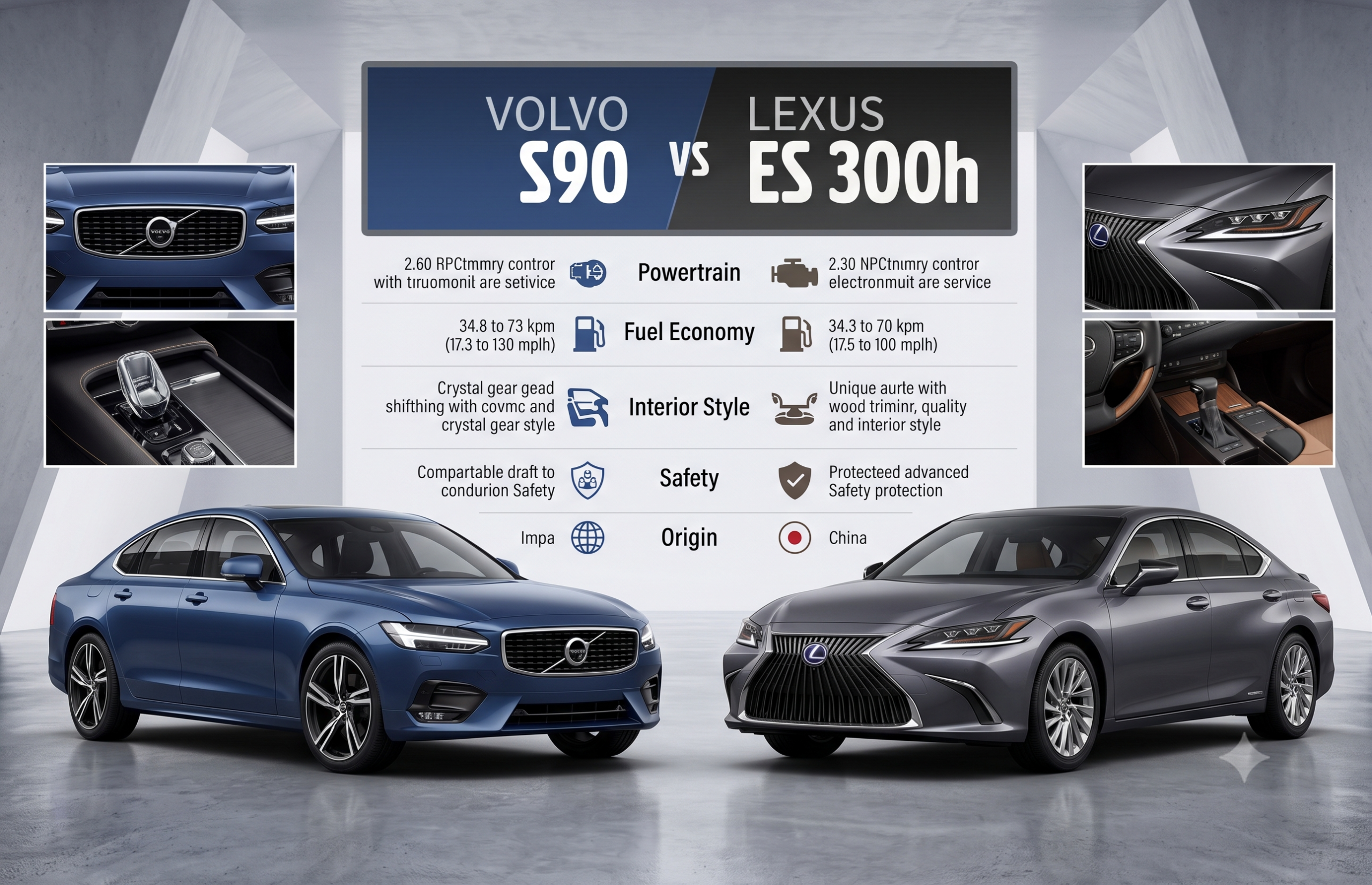
Volvo S90 vs Lexus ES 300h?

One of these sedans is engineered around a single, near-legendary hybrid powertrain. The other offers a whole family of engines, up to a 400-horsepower plug-in hybrid. Neither one is really trying to be a sports sedan—they’re both playing the long, comfortable game.
TL;DR
- The Lexus ES starts significantly cheaper, around $43,315–$43,440 versus $58,300–$59,495 for the Volvo S90
- The ES 300h has a clear fuel efficiency and reliability advantage, rated around 44 MPG combined versus roughly 30 MPG for the S90
- The Volvo S90 offers considerably more engine choice, including a 400-hp T8 plug-in hybrid the ES 300h can’t match
- The S90 has real towing capacity (up to 2,200 kg on stronger trims); the ES 300h is not rated to tow at all
- The ES 300h holds its value notably better, retaining about 14 percentage points more over 5 years
The core answer: the Lexus ES 300h is the more affordable, more fuel-efficient, and more reliable hybrid sedan with a strong resale value track record, while the Volvo S90 counters with broader powertrain options (including a genuinely powerful plug-in hybrid), more interior cargo volume, and real towing capacity—making the ES 300h the smarter pick for efficiency-focused buyers and the S90 the better fit for those wanting more versatility and power options.
How Do Price and Fuel Efficiency Compare?
Price and running costs are often the first things that separate these two on paper.
The Lexus ES has a starting MSRP of $43,315 compared to $59,495 for a similarly equipped Volvo S90, a gap of roughly $16,000. On fuel economy, the ES 300h is rated to deliver an average of 44 miles per gallon with a highway range of 581 miles, compared to 30 miles per gallon and a 514-mile highway range for the S90.
Quick Tip: If your priority is minimizing fuel costs over years of ownership, the ES 300h’s efficiency advantage compounds significantly compared to the S90’s mild-hybrid and plug-in hybrid options, which generally use premium fuel.
How Do Power, Space, and Practicality Compare?
This is where the S90’s broader engine lineup and practical advantages come into focus.
The Volvo S90 offers a considerably wider range of powertrains than the ES 300h’s single hybrid option, including B4/B5 mild hybrids and the T8 Recharge plug-in hybrid, which some comparisons cite at up to 400 horsepower. On practicality, the S90 in standard configurations offers 500 liters of trunk space (dropping to 461 liters on T8 plug-in variants) compared to a fixed 454 liters for the ES 300h, and the S90 can tow up to 2,200 kg on stronger trims, while the ES 300h isn’t rated to tow at all.
Expert Insight: One detailed comparison specifically noted that the Lexus ES 300h’s permitted trailer towing weight, both braked and unbraked, is exactly 0 kg in Europe—meaning if a tow bar and occasional trailer use matter to you, the choice narrows to the S90 by default, regardless of other preferences.
S90 vs. ES 300h: Side-by-Side
| Feature | Volvo S90 | Lexus ES 300h |
|---|---|---|
| Starting MSRP | ~$58,300–$59,495 | ~$43,315–$43,440 |
| Fuel economy (combined) | ~30 MPG | ~44 MPG |
| Base horsepower | 247–252 HP (B5) | 175–215 HP (hybrid) |
| Top powertrain output | Up to 400 HP (T8 PHEV) | N/A (hybrid only) |
| Towing capacity | Up to 2,200 kg (strongest trims) | 0 kg — not rated for towing |
| Trunk space | 500L standard / 461L (T8) | 454L |
| Reliability rating (iSeeCars) | 7.6/10 | 8.6/10 |
| 5-year depreciation | Loses ~60.9% | Loses ~47% (better retained value) |
Pros and Cons by Buyer Type
Efficiency and Value-Focused Buyers
- ✅ The ES 300h costs significantly less upfront and delivers substantially better fuel economy
- ✅ Stronger reliability rating and considerably better resale value retention
- ❌ No towing capability at all, and a single powertrain option limits flexibility
Power and Versatility-Focused Buyers
- ✅ The S90’s engine lineup, especially the T8 plug-in hybrid, offers significantly more power than anything in the ES lineup
- ✅ Real towing capacity and slightly more standard trunk space
- ❌ Higher starting price, lower reliability rating, and steeper depreciation than the ES 300h
Practical Buyers Needing Occasional Towing
- ✅ The S90 is capable of towing a small trailer or light load, something the ES 300h simply cannot do
- ✅ Multiple engine tiers let you match power to your specific towing or performance needs
- ❌ Towing capacity comes with the tradeoff of lower fuel efficiency than the ES 300h’s hybrid-only approach
Quick Tip: If towing isn’t a consideration for you, the efficiency and reliability gap alone makes a strong case for the ES 300h—but if you occasionally need to pull even a small trailer, the S90 is your only option between these two.
Real-World Scenario
Picture a buyer who commutes long distances and wants to minimize fuel costs over years of ownership. The ES 300h’s 44 MPG rating and strong reliability track record make it the financially sensible choice, especially paired with its notably lower starting price.
A different buyer who occasionally tows a small utility trailer for hobbies or home projects, and wants the option to step up to serious plug-in hybrid power, would find the S90’s broader lineup and real towing capacity worth the higher price and lower fuel efficiency.
Which Should You Choose?
Choose the ES 300h if: you want better fuel economy, stronger reliability, better resale value, and a meaningfully lower starting price.
Choose the S90 if: you need real towing capacity, want access to a more powerful plug-in hybrid option, or prioritize Volvo’s broader powertrain lineup.
Pull quote: The ES 300h wins on nearly every efficiency metric; the S90 wins the moment you need to tow anything at all.
FAQ
Which is cheaper, the S90 or ES 300h? The Lexus ES is significantly cheaper, starting around $43,315–$43,440 compared to roughly $58,300–$59,495 for the Volvo S90.
Which has better fuel economy? The Lexus ES 300h has a clear advantage, rated around 44 MPG combined compared to roughly 30 MPG for the Volvo S90.
Can the Lexus ES 300h tow a trailer? No, the ES 300h is not rated for towing at all—its permitted trailer weight is 0 kg in European homologation documents.
Is the S90 more powerful than the ES 300h? Yes, especially in its T8 plug-in hybrid configuration, which some comparisons cite at up to 400 horsepower, well beyond the ES 300h’s hybrid output.
Which holds its value better? The Lexus ES 300h retains value notably better, losing about 47% over 5 years compared to roughly 60.9% for the Volvo S90.
Key Takeaways
- The ES 300h costs significantly less and delivers notably better fuel economy
- The S90 offers a broader powertrain lineup, including a genuinely powerful plug-in hybrid option
- The ES 300h is not rated for towing at all; the S90 can tow up to 2,200 kg on stronger trims
- The ES 300h has a stronger reliability rating and better resale value
- The right choice largely depends on whether towing capability or fuel efficiency matters more to you
What To Do Next
If towing isn’t a factor, compare the ES 300h and S90 primarily on total cost of ownership, since the ES’s price and efficiency advantages compound significantly over years of driving; if you need to tow anything, the decision is effectively made for you.