Volvo Buying vs Leasing?

Trying to decide whether to buy or lease your next Volvo? The honest answer is it depends on how long you keep cars and how much you drive — and Volvo’s current lineup of incentives makes both paths genuinely competitive this year.
TL;DR
- Leasing typically means lower monthly payments but no ownership equity at the end
- Buying means higher payments now but full ownership and no mileage restrictions
- Volvo’s lease deals range from around $379 to $789/month depending on model
- Volvo is also offering 0–2.99% APR financing on several 2026 models this month
- Volvo’s residual values have historically been middling, which affects how competitive its lease payments are compared to some rivals
Volvo Buy vs Lease: The Short Answer
Lease if you like driving something new every few years and don’t rack up big mileage. Buy if you plan to keep the car long-term or drive a lot. Neither choice is universally “better” — it comes down to your driving habits, how you value predictable costs versus long-term ownership, and whether you want to build equity in a vehicle you’ll eventually own outright.
I’ve pulled together this month’s actual Volvo offers alongside general leasing and buying tradeoffs, since the right answer really does depend on your specific situation rather than a one-size-fits-all rule.
What Leasing a Volvo Looks Like Right Now
Currently, dealers have Volvo models available from around $545 to $967 a month for 36 months, according to Edmunds’ lease listings, though your final price depends heavily on your specific trim, mileage allowance, and region.
Specific examples this month include a 2026 XC40 Core Dark for $379/month for 36 months with $5,699 due at signing, and a EX30 Plus Single Motor Extended Range for $489/month with $3,709 due at signing.
Pull quote: A lease payment is really a bet on how much the car will be worth when you hand back the keys — not just a discount on driving it.
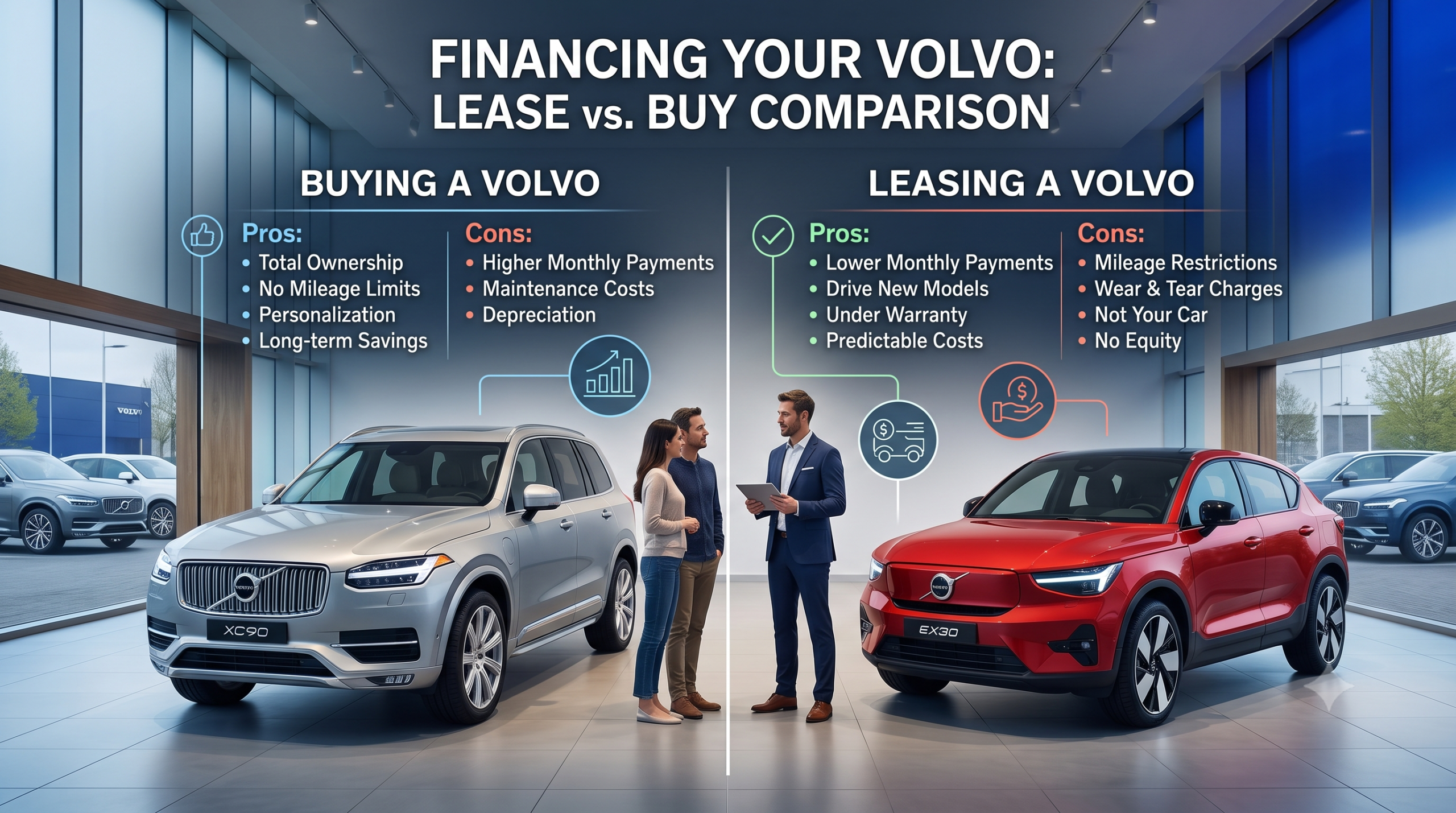
Leasing vs Buying: The Core Tradeoffs
| Factor | Leasing | Buying |
|---|---|---|
| Monthly payment | Generally lower | Generally higher |
| Down payment/due at signing | Often lower | Can be $0 down with financing, but total cost is higher |
| Mileage limits | Yes, typically 10,000–12,000/year | None |
| Ownership at end | None — return or buy out the car | Full ownership once paid off |
| Maintenance responsibility | Often covered under warranty for the lease term | Yours once out of warranty |
| Flexibility to switch models | High — easy to lease something new every few years | Lower — selling/trading takes more effort |
| Long-term cost if kept 7+ years | Higher (repeated leases) | Lower (no more payments after payoff) |
A major factor in a lease payment is a projected high residual value, and Volvo hasn’t traditionally had the highest residual values — without strong residuals, it’s harder for a manufacturer to offer aggressively low lease payments compared to brands with stronger resale reputations.
Where Leasing Makes Sense
It leads for buyers who value predictability and enjoy driving newer cars regularly. Because lease payments are based on the vehicle’s depreciation over the lease term rather than its full price, you’re often paying less per month for the same car.
A few scenarios where leasing tends to make more sense:
- You drive under 12,000 miles a year and don’t anticipate exceeding your mileage allowance
- You want the latest Volvo safety tech and features every few years without the hassle of selling
- You use the vehicle for business and can deduct lease payments
Quick Tip: If you’re eyeing an EV like the EX30 or EX40, leasing can be especially attractive right now — Volvo’s current EV lease allowance and stacking incentives (including Costco member pricing through July 31, 2026) can meaningfully lower your effective monthly cost.
Where Buying Makes Sense
It leads for buyers who keep vehicles long-term or drive more than a typical lease allows. Once a purchased car is paid off, you stop making payments entirely — something leasing never offers, since a new lease (or buyout) always starts the payment clock over again.
Expert Insight: The real cost comparison isn’t lease payment versus loan payment — it’s the total cost over the years you’d actually own or lease multiple vehicles in a row. Buying usually wins if you keep cars past the point most people trade them in.
Real-world scenario: A driver who typically keeps a car for 8–10 years will almost always come out ahead financially by buying and paying it off, even if the monthly lease payment looked more attractive at first glance — while someone who trades in every 3 years anyway may find leasing simply formalizes a habit they were already going to follow.
Pros and Cons by Buyer Type
The Low-Mileage, Frequent-Upgrade Driver
- ✅ Leasing: lower payments, easy access to newer models and tech every few years
- ❌ Buying: ties up more capital in a vehicle you might trade in anyway
The Long-Term Owner / High-Mileage Driver
- ✅ Buying: no mileage caps, full equity once paid off, lower total cost over many years
- ❌ Leasing: mileage overage fees and no ownership stake at lease end
The Business/Tax-Conscious Buyer
- ✅ Leasing: potential tax advantages for business use, depending on your situation
- ❌ Buying: different depreciation and deduction rules apply — consult a tax professional
Alternatives Worth Considering
Consider a Certified Pre-Owned Volvo if you want ownership without new-car pricing — Volvo’s CPO program offers extended peace of mind at a lower purchase price than buying new.
Consider 0% APR financing if you qualify — Volvo is currently offering 0% APR for 72 months on select 2025 EX90 configurations, which can make buying nearly as affordable monthly as leasing, without the mileage restrictions.
FAQ
Is it cheaper to lease or buy a Volvo? It depends on your timeline — leasing usually has lower monthly payments short-term, but buying is typically cheaper over the long run if you keep the vehicle for many years past when a lease would have ended.
What are Volvo’s current lease deals? As of July 2026, deals include a 2026 XC40 for around $379–467/month and a 2026 EX30 from roughly $489–497/month, though exact terms vary by region, trim, and down payment (as of this writing — confirm current offers with your local dealer).
Does Volvo offer 0% financing? Yes, on select models — for example, 0.00% APR for 72 months has been available on certain 2025 EX90 configurations, alongside 2.99% APR offers on several other 2026 models this month.
Can I negotiate a Volvo lease deal? Yes — you can call, text, or email dealership leasing departments for quotes and negotiate just as you would with a purchase price, comparing offers across multiple dealers.
What happens if I go over my mileage limit on a leased Volvo? You’ll typically owe a per-mile overage fee at lease-end, so if you’re unsure about your annual mileage, either buy or negotiate a higher-mileage lease upfront to avoid surprise charges.
Key Takeaways
- Leasing offers lower payments and more flexibility but no long-term ownership
- Buying costs more monthly but eliminates payments entirely once paid off
- Volvo’s current incentives (July 2026) include both lease specials and low-APR financing across several models
- Your driving habits and how long you keep vehicles should drive the decision more than the sticker payment
- Costco members and EV shoppers have access to additional stackable incentives this month
Next Step
Compare a specific model’s lease quote against its purchase/finance quote side by side at your local dealer — the right choice becomes much clearer once you’re looking at real numbers for your actual mileage and timeline.