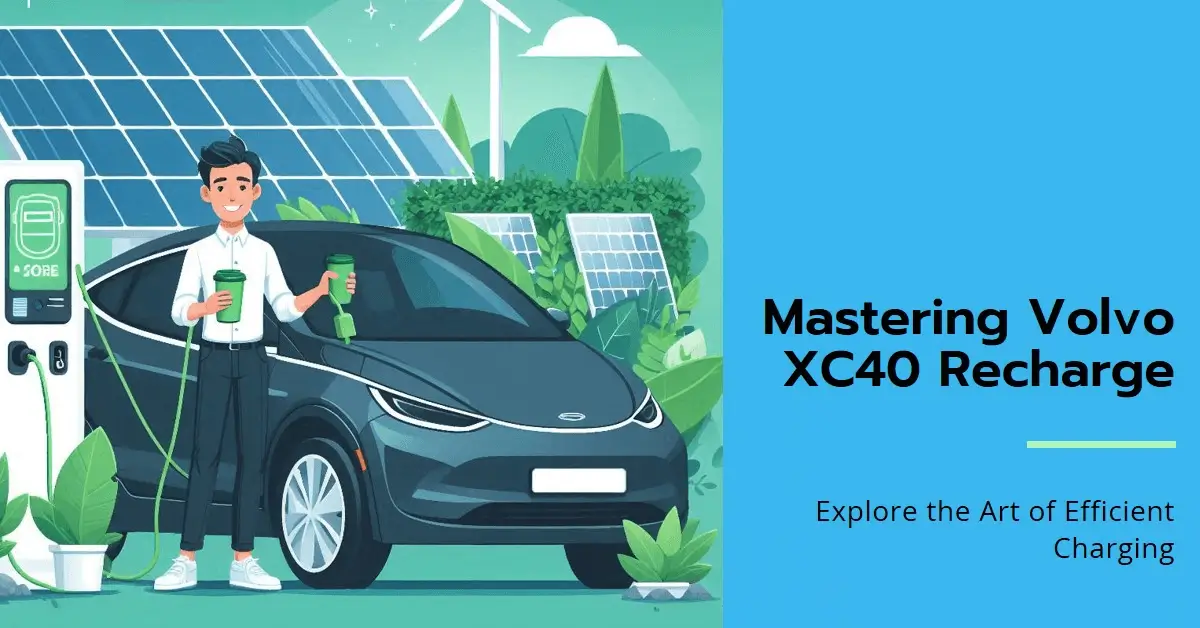
How to Charge a Volvo C40 Recharge?

How to Charge the Volvo C40 Recharge (EC40): A Complete Guide
The first week of owning an electric car involves a lot of standing in parking garages, staring at charging stations, and wondering if you’re doing it right. (You’re probably doing it right.) If you just got a Volvo C40 Recharge — or its 2025-onward successor, the EC40 — here’s everything you need to charge it confidently from day one.
TL;DR
- The C40 Recharge (renamed EC40 for 2025+) charges via a CCS port on the left rear of the vehicle
- Level 1 (120V outlet): ~40 hours for a full charge — fine for emergencies, not for daily use
- Level 2 (home wallbox at 11 kW): ~7–8 hours from empty — the everyday sweet spot
- DC fast charging: 10–80% in roughly 28–30 minutes — road trips sorted
- The C40 Recharge and EC40 can access Tesla Superchargers with a NACS adapter (adapter is free with 2025 EX40/EC40; available for purchase for older C40 Recharge owners)
- Keep the battery between 20% and 80% daily to protect long-term health
First: Is It Still Called the C40 Recharge?
Quick naming note before we get into cables. Starting with the 2025 model year, Volvo renamed the C40 Recharge to the EC40, following its new convention of giving all fully electric models an “E” prefix. The EC40 and C40 Recharge are the same swoopy coupe-SUV underneath — same platform, same Belgian factory, same charging hardware.
Throughout this guide, “C40 Recharge” and “EC40” are used interchangeably. The charging steps are identical regardless of which model year you own.
Pull quote: The C40 Recharge and EC40 are the same car under the skin — every charging method and tip in this guide applies to both.
Where Is the Charging Port?
The C40 Recharge and EC40 use a CCS (Combined Charging System) port, located on the left rear quarter panel of the vehicle. You may need to pull forward or reverse into some charging bays to get the port closest to the charger — worth keeping in mind when selecting a spot.
The CCS port has two sections:
- Upper section: for AC charging (Level 1 and Level 2 at home or at destination chargers)
- Upper + lower combined: for DC fast charging at public rapid chargers
There’s a small flap covering the port — press it to pop it open before plugging in.
Charging Level Comparison
| Charging Level | Power | Where | Charge Time (empty → full) |
|---|---|---|---|
| Level 1 (120V outlet) | ~1.4 kW | Standard home outlet | ~40 hours |
| Level 2 (240V wallbox) | 11 kW | Home wallbox, public destination | ~7–8 hours |
| DC Fast Charging | Up to ~200 kW | Public fast-charge stations | ~28–30 min (10–80%) |
Method 1: Charging at Home with Level 1 (120V)
Level 1 is the “it works, but barely” option. You plug the included portable charging cable directly into a standard household outlet — no installation needed.
What you get: roughly 3–5 miles of range per hour. For most drivers, that means overnight charging adds 30–40 miles — just enough to cover an average commute, but not much more.
When it makes sense: if you drive well under 40 miles a day and have 8–10 hours between drives, Level 1 can technically keep up. It’s also the right choice as a true emergency backup if you’re traveling and need something rather than nothing.
The honest truth: Level 1 charging on a C40 Recharge takes about 40 hours for a full charge from empty. If that’s your only option, you’ll want to plan carefully and never let the battery run low.
Quick Tip: Even if your primary setup is a Level 2 wallbox, keep the portable Level 1 cable in the car. Hotel road trips, relatives’ driveways, and unexpected overnight stops become much less stressful with a backup charging option in the trunk.
Method 2: Home Charging with Level 2 (Wallbox — Recommended)
This is how the vast majority of C40 Recharge owners charge their car, and for good reason. A Level 2 home charger — also called a wallbox or EVSE — runs on a 240V circuit (the same type your dryer uses) and connects to the C40’s 11 kW onboard AC charger.
What you get: a full charge from empty in about 7–8 hours. Plug in after dinner, wake up to 100%. Done.
Setting Up Home Level 2 Charging
- Choose a wallbox — popular options include ChargePoint Home Flex, Enel X JuiceBox, and Grizzl-E. Look for one that delivers at least 32A (7.2 kW) to match the C40’s onboard charger
- Hire a licensed electrician to install a dedicated 240V circuit and mount the unit — typically $200–$600 for installation depending on your panel and distance
- Register the charger with your utility company — some offer off-peak rate schedules that significantly lower your charging costs
- Connect and configure — most modern wallboxes let you set charging schedules through an app, so you can charge automatically during cheaper overnight hours
Expert Insight: The C40 Recharge’s onboard charger maxes out at 11 kW. Buying a wallbox rated above that won’t charge the car any faster — the car is the limiting factor. A 32A, 7.2 kW unit is the sweet spot for most home installs.
Charging Schedule Tip
Most electricity providers charge lower rates overnight (typically 10 PM – 6 AM). Setting the wallbox to charge only during off-peak hours can cut your monthly charging cost meaningfully. A U.S. Department of Energy analysis estimates EV owners who time-shift their charging save 30–50% on charging costs compared to daytime charging at standard rates.
Method 3: DC Fast Charging (Road Trips and Quick Top-Ups)
DC fast charging is where the C40 Recharge genuinely impresses. When the battery is warm and the charger is capable, the car can hit peak charging rates of around 150–200 kW, adding usable range at pace.
Real-world expectation: plan on about 30 minutes from 10–80% on a strong 150–200 kW CCS station. Independent charging tests found the dual-motor variant with the 82 kWh battery (2024+ models) reaches this range reliably in ideal conditions; cold weather or weaker chargers can push the session to ~40 minutes.
How to Use a Public DC Fast Charger
- Find a station — use Google Maps built into the car, the Volvo Cars app, or apps like PlugShare or Electrify America to locate CCS fast chargers nearby
- Pull up with the left rear of the car facing the charger
- Open the charging flap on the left rear quarter panel
- Grab the CCS connector from the station holster and plug it firmly into the car — you’ll feel a click when it seats
- Activate the session — tap your RFID card, use the station’s app, or pay by credit card at the terminal (station-dependent)
- Monitor progress on the station screen, in the car’s instrument display, or via the Volvo Cars app
- Unplug when you’ve hit your target — no need to wait for 100%; 80% is the standard recommendation
Quick Tip: Arrive at a DC fast charger with the battery pre-conditioned for best speeds. The Volvo Cars app and in-car navigation both trigger battery pre-conditioning automatically when you route to a fast charger. Let the nav do the work.
DC Fast Charging Speed Curve
The C40 Recharge doesn’t maintain peak speed all the way to 80%. Here’s what the curve looks like in practice:
- 10–40%: The car pulls maximum power — this is the fastest phase
- 40–60%: Speed holds reasonably well, typically 120–160 kW on newer packs
- 60–80%: Power tapers progressively — normal battery behavior to protect cell health
- 80–100%: Very slow — rarely worth waiting for unless you specifically need the full range
This is why the “10–80%” benchmark is the standard measure for EVs. Going from 80–100% takes almost as long as going from 10–80%.
Method 4: Tesla Supercharger Network (NACS Adapter)
This is a bigger deal than it sounds. The Tesla Supercharger network has more than 17,800 stations compatible with Volvo fully electric vehicles, and access to it significantly expands the C40 Recharge’s road-trip charging options.
What you need: a NACS (North American Charging Standard) adapter. The NACS adapter is not included as standard with the C40 Recharge (2022–2024) and must be purchased from your Volvo Cars retailer. It is included as standard equipment with the 2025 EC40.
Important limits on the adapter:
- For DC fast charging only — it does not work with Tesla Destination Chargers or any AC outlet
- Only Generation 3 (V3) Superchargers and later are compatible with Volvo vehicles
- Do not use a third-party adapter — Volvo specifically warns that only approved adapters should be used
How to Charge at a Tesla Supercharger
- Open the Volvo Cars app and navigate to the map — Supercharger stations show up with a dedicated pin
- Stations requiring the NACS adapter are marked with a “NACS fast charging adapter required” badge
- At the station, attach the NACS adapter to the Supercharger cable
- Open your car’s DC charging port flap and plug the adapter in firmly
- Select the station number in the Volvo Cars app, choose a connector, and tap Start Charging
- Payment is handled through your Volvo Cars app account
Expert Insight: Set up your public charging account in the Volvo Cars app before your first road trip. Having payment configured ahead of time means you won’t be fumbling with signup screens in a parking lot with 12% battery remaining.
Buyer Personas: What Charging Setup Fits Your Life
The Urban Apartment Dweller
Parks on the street or in a shared garage — no home charging access.
- Pro: Public Level 2 and DC fast charging networks have grown dramatically; plugging in at work or shopping is increasingly convenient
- Con: Without home charging, you’re dependent on public infrastructure and occasional waits
- Best strategy: Use public Level 2 at work or shopping as your primary source; reserve DC fast charging for longer trips. The Volvo Cars app helps locate nearby stations.
The Suburban Homeowner
Has a garage, drives 30–50 miles daily.
- Pro: This is the ideal EV ownership scenario — Level 2 home charging makes the C40 Recharge feel effortless
- Con: Initial wallbox installation cost (~$200–$600 for labor plus hardware)
- Best strategy: Install a Level 2 wallbox, set it to charge overnight on off-peak rates. You’ll rarely need public charging for daily use.
The Frequent Road Tripper
Regularly drives 150+ miles in a single day.
- Pro: DC fast charge to 80% in ~30 minutes; Supercharger network access expands options significantly
- Con: Twin Motor AWD variants have slightly less range (257 miles vs. 297 for RWD) — plan charging stops accordingly
- Best strategy: Route through the car’s built-in Google Maps for automatic fast-charge waypoints; pre-condition the battery before arriving at each stop.
Battery Health: The 20–80 Rule
Every EV owner hears this eventually, and it’s worth understanding. It’s recommended to charge to only 80% or so to prevent battery degradation, and to avoid letting the battery drain all the way to 0% — starting to look for a top-up opportunity at around 20% is a good habit.
Lithium-ion batteries experience the most chemical stress at the very top and very bottom of their charge range. Keeping the daily charge limit at 80% and avoiding regular deep discharges below 20% slows that stress considerably. The C40 Recharge’s 8-year/100,000-mile battery warranty provides a baseline of protection, but good charging habits keep degradation even lower than warranty levels.
When to charge to 100%: Long trips where you need maximum range. Doing this once a week or less has negligible impact on long-term battery health.
Pull quote: Charge to 80% for daily use, 100% only before long trips. Your battery in year five will thank you.
Charging Cost Snapshot
What does it actually cost to charge a C40 Recharge? The answer depends heavily on your electricity rate and where you charge, but here are useful benchmarks (as of mid-2026):
- Home Level 2 at ~$0.15/kWh average US rate: Filling the 82 kWh battery from empty costs roughly $12–$13 — equivalent to under $1.50 per gallon if the C40 were gas-powered
- Public DC fast charging at ~$0.35–$0.50/kWh: A 10–80% session adds about 60 kWh of usable energy, costing roughly $21–$30 — still well below the cost of filling a gas tank
- Tesla Supercharger: Rates vary by location; paid through the Volvo Cars app
Quick Tip: If your utility offers a time-of-use rate plan, the overnight charging savings alone can pay for a wallbox installation within a year or two of ownership.
FAQ: Charging the Volvo C40 Recharge
Can I charge the C40 Recharge with a standard household outlet? Yes — the car comes with a portable Level 1 cable for standard 120V outlets. It works, but it’s slow (~40 hours for a full charge). It’s best used as an emergency backup, not a daily charging solution.
Does the C40 Recharge come with a charging cable? Yes. Volvo includes a portable Level 1 cable as standard. For Level 2 home charging, you’ll need to install a separate wallbox; many wallboxes come with their own cable.
How long does it take to charge the C40 Recharge from empty? About 7–8 hours on a Level 2 home wallbox (11 kW), or around 28–30 minutes from 10–80% on a DC fast charger. Level 1 from empty takes approximately 40 hours.
Do I need to buy anything extra to use Tesla Superchargers? If you have a 2022–2024 C40 Recharge, yes — you’ll need to purchase the NACS fast-charging adapter from your Volvo Cars retailer. The 2025+ EC40 includes the adapter as standard equipment.
Is it safe to leave the C40 Recharge plugged in overnight? Yes, completely safe. Modern EVs have battery management systems that stop active charging once the set limit (typically 80% or 100%) is reached. Leaving it plugged in doesn’t overcharge the battery.
Key Takeaways
- The C40 Recharge was renamed EC40 for 2025 — same car, same charging hardware
- The CCS charging port is on the left rear of the vehicle; open the flap before plugging in
- Level 2 home wallbox (11 kW, ~7–8 hours) is the recommended everyday charging method
- DC fast charging delivers 10–80% in ~28–30 minutes on a strong CCS station — ideal for road trips
- Tesla Supercharger access requires a NACS adapter (included with 2025 EC40; available for purchase for older C40 Recharge owners)
- Keep the battery between 20–80% for daily use to protect long-term cell health
Next Step
If you haven’t yet installed a Level 2 home wallbox, that’s the single biggest upgrade to your C40 Recharge ownership experience. Visit volvocars.com/us/cars/electrification/charging-your-volvo for Volvo’s official guidance, or contact your local Volvo Cars retailer to discuss home charging options. And get that Volvo Cars app set up — public charging payment, Supercharger access, and charge scheduling all run through it.