Volvo VNL 730 vs 780: Same Sleeper, Different Sky — Which Roof Fits Your Haul?

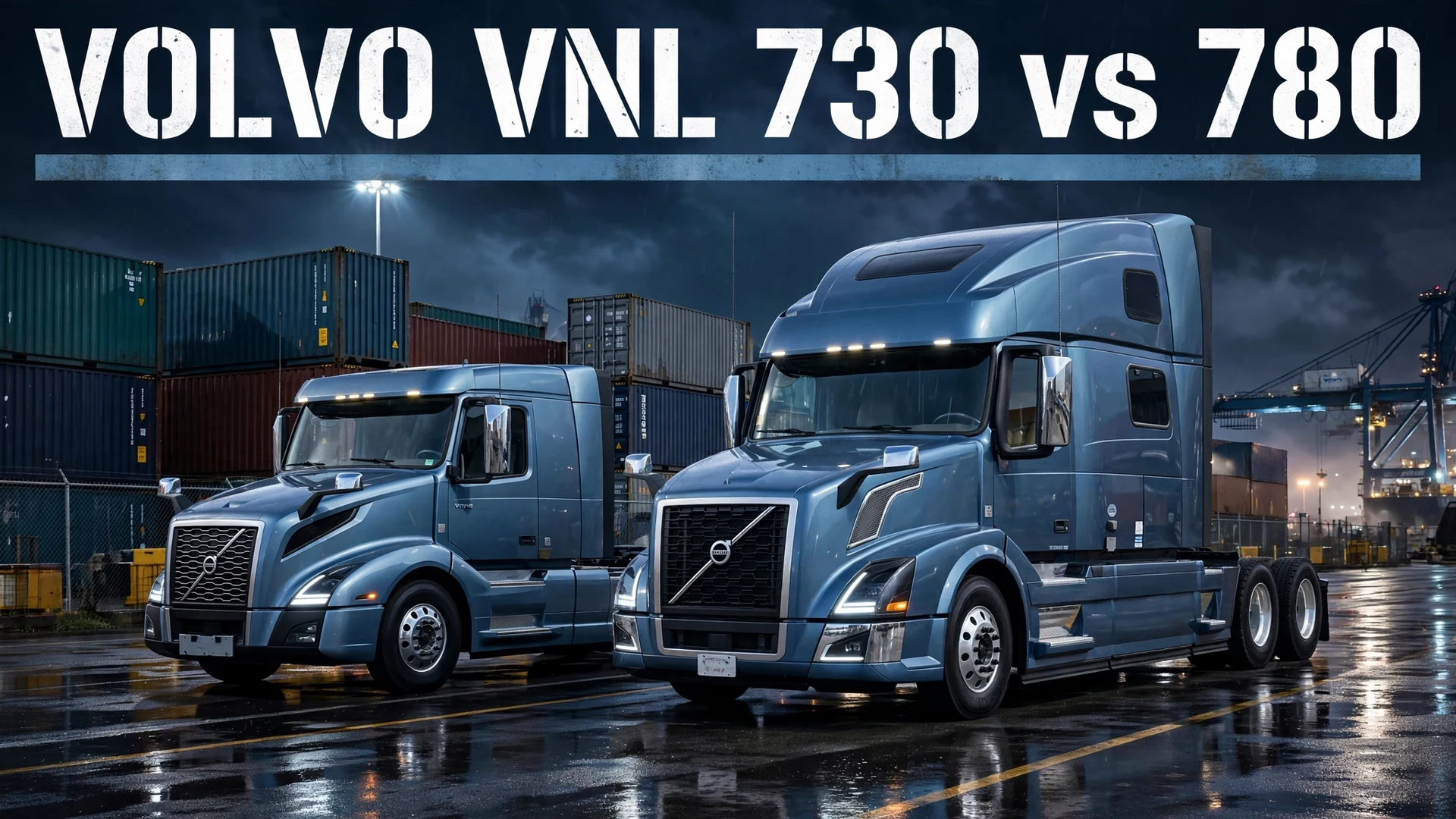
The short answer: the Volvo VNL 730 and VNL 780 share the identical 77×95-inch sleeper — the difference is entirely above your head. The 780 is the full “condo” high-roof with about two more feet of rear sleeper height; the 730 is the mid-roof version: 86 inches at the rear of the sleeper, 425 lbs lighter, and up to 29% less aerodynamic drag when paired with a low trailer. Choose the 780 for maximum living space, the 730 for fuel economy on tanks, flatbeds, lowboys, and heavy haul.
Key Takeaways
- Same sleeper footprint: both the VNL 730 and VNL 780 use a 77-inch-deep, 95-inch-wide sleeper. The only dimensional difference is roof height.
- Rear sleeper height: 86 inches on the 730 — a full two feet less than the ~110-inch 780 — yet Volvo designed it so a 6-foot-4-inch driver can still stand upright between the seats.
- Weight and drag: the mid-roof 730 weighs about 425 lbs less and produces up to 29% less drag with a low trailer, per Volvo’s launch figures.
- Shared everything else: chassis, powertrain options (D12, D13, D16, Cummins ISX), bunk configurations, and feature levels carried over from the 780 unchanged.
- Right tool for the job: the 730 was built for tanks, flatbeds, lowboys, heavy haul, and containers; the 780 for general long-haul and drivers who want maximum condo living space.
Same Sleeper, Different Sky
When Volvo Trucks North America rolled the VN 730 (as it was launched) and its classic-styled sibling the VT 830 onto the stage at the Mid-America Trucking Show in Louisville in March 2006, the pitch from president and CEO Peter Karlsten was unusually blunt: these were application-focused alternatives for customers who want the same large sleeper and premium level of features and benefits already found in the VT 880 and VN 780, but with a lower roof height. Production began in the second half of 2006.
The logic was aerodynamic, not aesthetic. Roughly 36 percent of the sleeper market at the time was mid-roof, and Volvo saw owner-operators hauling freight that never needed a tall roof — tankers, flatbeds, lowboys, heavy-haul equipment, containers, grain and liquid loads. Pairing a tall condo roof with a trailer four feet shorter is like sailing a parachute behind the cab. Volvo’s own claim: a mid-roof sleeper can produce up to 29 percent less drag when coupled with a low trailer.
Crucially, Volvo changed nothing else. Every chassis, powertrain, axle, suspension, wheelbase, fuel-tank, and chassis aerodynamic-treatment option available on the 780 was offered on the 730 — including the big Volvo D16 engine. The bunk menu was identical too: a single 53×79-inch bunk, two innerspring 53-inch mattresses with extra underbunk storage, dual bunks with a 42-inch lower and 32-inch upper, or a single 42-inch lower bunk.
VNL 730 vs 780 Specs at a Glance
| Specification | Volvo VNL 730 | Volvo VNL 780 |
|---|---|---|
| Roof style | Mid-roof | High-roof “condo” |
| Rear sleeper height | 86 inches | ~110 inches (about 2 ft taller) |
| Sleeper depth | 77 inches | 77 inches |
| Sleeper width | 95 inches | 95 inches |
| Standing room | 6’4″ driver can stand upright between the seats | Full stand-up condo throughout |
| Weight vs. sibling | ~425 lbs lighter | Heavier (condo structure) |
| Drag with low trailer | Up to 29% less (Volvo claim) | Higher roof catches more air |
| Engines offered | D12 / D13 / D16, Cummins ISX | D12 / D13 / D16, Cummins ISX |
| Bunk options | Single 53″, dual 53″, dual 42″/32″, single 42″ | Same four configurations |
| Ideal applications | Tanks, flatbeds, lowboys, heavy haul, containers | Dry van, reefer, general long-haul |
| Successor (2018+ VNL) | VNL 760 | VNL 860 |
The Roofline, Side by Side
The Numbers That Matter
Both trucks roll on the same bones, so the comparison compresses to three deltas — height, weight, and drag — plus the trailer they were each built to pull.
What the Extra Two Feet Buys You
This is the lifestyle part of the comparison, and it’s where owner-operators split hardest. The 780’s condo roof turns the sleeper into a genuine living room: owners describe a genuinely spacious interior, and — critically for teams — you can sit at the workstation table with the top bunk down. On the 730, that same setup requires folding the upper bunk up; comfortably, anyway, as one owner put it.
The trade-offs cut both ways. A condo takes noticeably more energy to heat in January and cool in July — a real line item if you idle or run a parking heater all winter. The 780 also projects the classic “big rig” presence many drivers simply prefer; as one driver on the forums said, it’s “specious and beautiful inside.” The 730 gives up that cathedral feel but pays you back at the pump and on the scale, especially hauling freight where the trailer sits well below a standard dry van.
For solo drivers who mostly sleep at floor level and use the bunk as a bed rather than an office, the 730’s 77-inch-deep sleeper is the same bed in a slightly shorter room. For teams running coast to coast, the 780’s standing room and bunk-down workspace are hard to give up. The trucks even attracted different personalities at launch: the aero-minded bought the VN 730, while the VT 830 offered the same mid-roof concept with classic styling for drivers who wanted road presence.
Engines: What Pulled Both Trucks
Because the 730 inherited the 780’s full powertrain menu, engine choice was identical — which means used buyers shop the same three eras:
- Pre-2007: the Volvo D12 (12.1L) was the volume engine, with the D16 (16.1L, introduced 2005, 450–600 hp) as the heavy-haul flagship. Cummins ISX was also offered.
- 2007 emissions: Volvo’s new family — D11 (10.8L, 325–405 hp, 1,250–1,450 lb-ft), D13 (12.8L, 335–485 hp, 1,350–1,650 lb-ft), and D16 (16.1L, 450–600 hp, 1,650–2,050 lb-ft). The D13 quickly became the default long-haul choice; the D16 ruled heavy haul until Volvo discontinued it in North America in 2017.
- Transmissions: Volvo’s I-Shift 12-speed automated manual was the signature pairing — one 730 owner on the forums runs a D12 500 hp with I-Shift pulling dry van — with manual options available for traditionalists.
Which Sleeper Fits Your Operation?
Buying a Used 730 or 780 in 2026
These are 2006–2017 trucks, so you’re shopping the used market exclusively. The model years matter less than the spec sheet:
- Emissions era is everything. Pre-2007 trucks (D12, early D16) avoid DPF/DEF complexity but are now pushing two decades old. 2008–2010 trucks added DPFs; 2011+ added DEF/SCR. Each step trades simplicity for cleaner running — price accordingly.
- Match the engine to the work. A D13 is the sensible all-rounder; a D16 is glorious overkill for a 45,000-lb dry van but exactly right for 100,000-lb permits. Note the D16 was discontinued in North America in 2017, so parts support for it is a narrower channel.
- Check the condo’s extras. On 780s, inspect the upper-bunk mechanism, cabinet latches, and the HVAC system’s ability to heat/cool the big volume — the systems that make condo living pleasant are also the ones that wear.
- Roof seals and fairings. On both models, check roof-cap seals, side fairings, and the sleeper-to-cab boot for leaks and wind noise — 15+ years of flex takes its toll.
- Know the successors. The 730’s spiritual successor is the VNL 760 and the 780’s is the VNL 860 in the 2018+ lineup. If a seller’s asking price for a late 780 approaches clean used 860 money, walk up a generation instead.
Frequently Asked Questions
Is the sleeper the same size in a VNL 730 and 780?
Yes. Both use an identical 77-inch-deep, 95-inch-wide sleeper with the same bunk configurations. The only dimensional difference is roof height: 86 inches at the rear of the sleeper on the 730 versus about 110 inches on the 780.
Can you stand up in a VNL 730?
Yes — Volvo specifically designed the mid-roof cab so a 6-foot-4-inch driver can stand upright between the seats. You lose the 780’s full stand-up condo space, particularly with the upper bunk down, but the basic act of standing is not a problem.
Which gets better fuel economy, the 730 or the 780?
The 730 has the edge on paper: it’s about 425 lbs lighter and Volvo claimed up to 29% less drag when coupled with a low trailer. But the gap depends on the trailer — with a standard tall dry van or reefer, the 780’s roofline actually matches trailer height better, narrowing the difference.
What replaced the VNL 730 and 780?
In the 2018-and-newer VNL lineup, the 730’s role was taken by the VNL 760 (high-roof, 70-inch sleeper) and the 780’s by the VNL 860 (the 77-inch-sleeper condo flagship). There is no direct mid-roof 77-inch model in the current range.
What engines came in the VNL 730 and 780?
Both trucks shared the identical engine menu: the Volvo D12 (pre-2007), then the 2007-emissions D11, D13, and D16 family — D13 (335–485 hp) as the volume choice, D16 (450–600 hp) as the heavy-haul flagship — plus the Cummins ISX as an alternative. The D16 was discontinued in North America in 2017.
The Bottom Line
Volvo never intended the 730 as a lesser 780 — it was the same truck wearing a shorter hat for a specific job. If your trailer sits low, the 730’s mid-roof is the smarter, cheaper-to-run tool, and you keep the identical 77-inch sleeper to sleep in. If you live in the truck solo or with a partner for weeks at a time, the 780’s extra two feet of sky is worth every pound. Pick the roof that matches your trailer and your life, not the one that looks biggest in the brochure.