Volvo XC70 vs V90 Cross Country: Utilitarian Tank vs Luxury Flagship

For more than two decades, the lifted, all-weather Swedish station wagon has been the undisputed chariot of architects, professors, ski patrollers, and outdoor enthusiasts who refuse to drive a cookie-cutter SUV. In the history of this proud lineage, two nameplates stand as legendary bookends: the rugged, beloved Volvo XC70 (P3 platform, 2008–2016) and its sleek, ultra-luxurious successor, the Volvo V90 Cross Country (SPA platform, 2017–2025). How do these two generations compare in utility, reliability, trail capability, and daily livability?
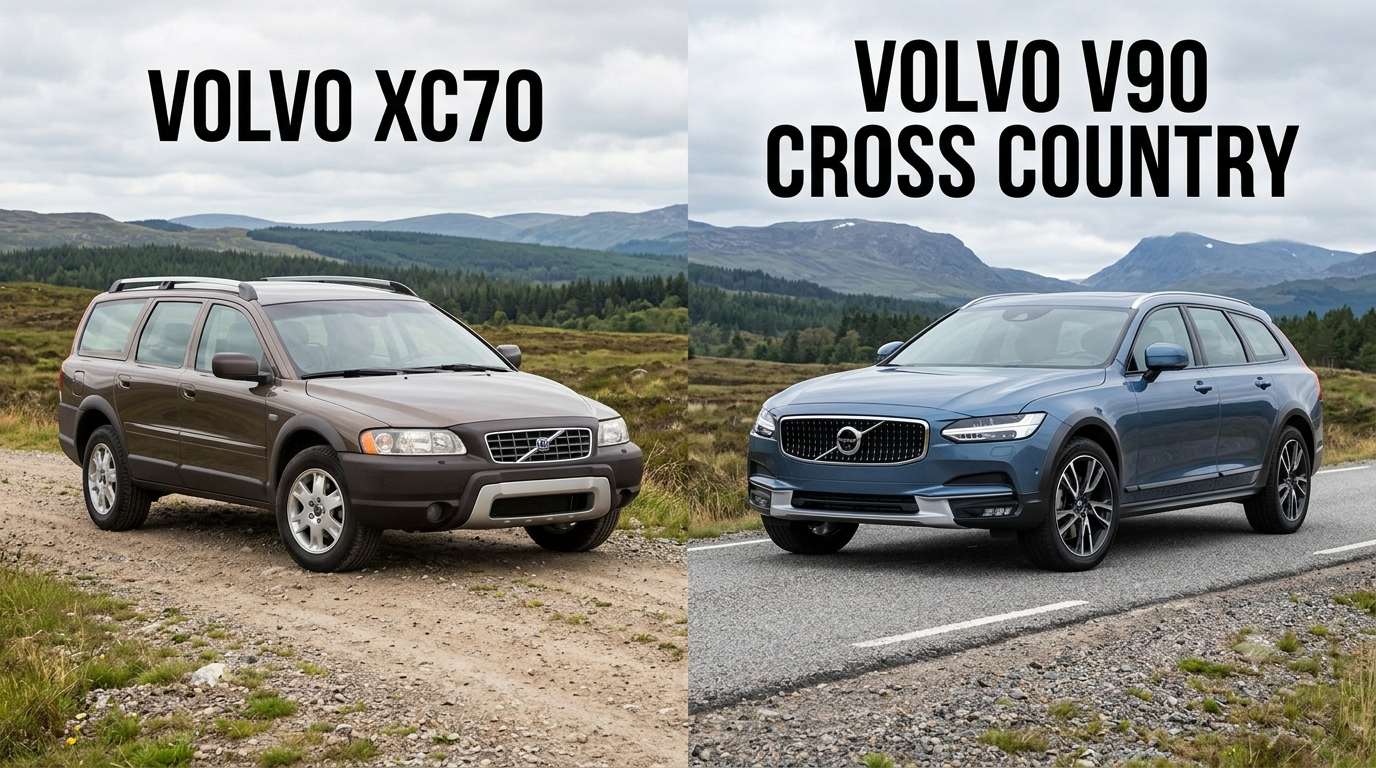
The transition from the beloved P3-generation Volvo XC70 (2008–2016) to the SPA-generation V90 Cross Country (2017–2025) marks the evolution of Swedish all-road wagons from rugged utilitarian workhorses into high-luxury executive cruisers. Both share identical 8.3 inches (210 mm) of ground clearance, but diverge in philosophy: the XC70 features a boxy vertical tailgate with 72.1 cu ft of maximum cargo volume and indestructible 3.0L T6 inline-six engines with timing chains, while the V90 Cross Country features sleek executive styling, Bowers & Wilkins audio, 48V hybrid powertrains, and cutting-edge Google connectivity.
Identical 8.3 Inches (210 mm) across both generations
XC70 Wins: 72.1 cu ft boxy volume vs 53.9 cu ft in sleek V90 CC
XC70: 3.0L T6 Turbo Inline-6 (Chain) | V90: 2.0L Drive-E 4-Cyl
V90 CC Wins: Bowers & Wilkins audio, Pilot Assist, Google AAOS
While both vehicles offer an identical 8.3 inches of ground clearance and robust all-wheel drive, they were designed for different worlds. The XC70 is a functional tool—a boxy, indestructible, 300,000-mile companion with an enormous cargo bay and bulletproof inline-six power. The V90 Cross Country is a rolling Scandinavian penthouse—an executive luxury flagship with whisper-quiet acoustics, semi-autonomous Pilot Assist driving, and bespoke materials. Below is our comprehensive generational comparison.
Specification Face-Off: The Workhorse vs. The Flagship
Compare the core mechanical, cargo, and dimensional specifications of both Cross Country generations:
| Attribute | Volvo XC70 (P3 Generation: 2008–2016) | Volvo V90 Cross Country (SPA: 2017–2025) | Detailed Comparative Advantage |
|---|---|---|---|
| Ground Clearance | 8.3 Inches (210 mm) | 8.3 Inches (210 mm) | Dead Tie: Both clear deep snow, gravel ruts, and fire roads with identical trail confidence. |
| Maximum Cargo Volume | 72.1 Cubic Feet (Upright Boxy Tailgate) | 53.9 Cubic Feet (Raked Aerodynamic Glass) | XC70 Wins Big: 18.2 cu ft more usable volume; vertical tailgate easily swallows large dog crates and appliances. |
| Engine Choices | 3.2L Inline-6 (240 hp) or 3.0L T6 Turbo (300 hp) | 2.0L 4-Cyl Drive-E T6 / B6 MHEV (295–316 hp) | XC70 Wins Durability: Heavy-duty timing chain, iron sleeves, legendary 300k+ mile mechanical longevity. |
| Chassis & Luxury Tech | Traditional hydraulic steering, analog dials, Sensus | Pilot Assist, Google AAOS, Bowers & Wilkins 1,460W | V90 CC Crushes: Modern flagship safety, whisper-quiet laminated glass, concert-hall audio fidelity. |
| Wheel & Tire Package | 16″ or 17″ wheels with high-profile all-season rubber | 19″, 20″, or 21″ wheels with lower-profile tires | XC70: High sidewalls resist potholes and trail rocks. V90 CC: Sharper highway turn-in. |
XC70 Wins
72.1 cu ft (Boxy tailgate)
53.9 cu ft (Sloping glass)
XC70 is vastly superior for dogs
XC70 T6 Wins
3.0L T6 Inline-6 (Timing Chain)
2.0L 4-Cyl Drive-E (Timing Belt)
XC70 is an indestructible tank
V90 CC Wins
Bowers & Wilkins, Google AAOS
Classic Sensus / Analog dials
V90 CC is an executive sanctuary
Interactive Tool: Volvo XC70 vs. V90 Cross Country Priority Matcher
Select your primary ownership priority below to find your optimal Swedish all-road wagon:
Compare cargo utility, mechanical longevity, and executive luxury:
All-Wheel-Drive Systems: Haldex Gen 4/5 vs. BorgWarner Torque Vectoring
Both wagons deliver exceptional all-weather traction, but their electronic architectures represent different eras of all-wheel-drive development:
- Volvo XC70 AWD (Haldex Generation 4 & 5): The P3 XC70 utilizes an electro-hydraulic multi-plate wet clutch coupling at the rear differential. It maintains a constant 95:5 front-to-rear torque bias during highway cruising to optimize fuel economy, instantly transferring up to 50% of engine torque rearward the millisecond front wheel slip is detected. It is simple, rugged, and easily serviced with fresh fluid and filter every 50,000 miles.
- Volvo V90 Cross Country AWD (BorgWarner Gen V + Active Cornering): The V90 CC integrates its AWD coupling with advanced electronic stability programming. Utilizing Corner Traction Control by Torque Vectoring, the system actively brakes the inside wheels while routing power to the outside wheels during spirited cornering, effectively pulling the long wagon through turns with zero understeer.
Under the Hood: The 3.0L T6 READ Unit vs. The 2.0L Drive-E Timing Belt
Mechanically, the two wagons represent contrasting schools of thought regarding powertrain longevity:
- The P3 XC70 3.0L T6 (B6304T4): Widely regarded as one of the finest engines Volvo ever built. It uses a heavy-duty timing chain designed for the vehicle’s lifespan. However, because the engine was mounted transversely, Volvo engineered the Rear End Auxiliary Drive (READ)—a compact gear-driven assembly mounted between the engine and transmission to drive the alternator, AC compressor, and water pump. On high-mileage models (past 150,000 miles), the READ unit bearings can develop a rumbling whine requiring specialized rebuild tools ($800–$1,200 repair).
- The V90 Cross Country Drive-E (T6 / B6): The modern 2.0-liter 4-cylinder engine uses a traditional rubber timing belt. While easier to access and service than the READ unit, the timing belt must be replaced every 120,000 miles or 10 years without fail. Because the Drive-E is an interference engine, a snapped belt causes instant valve destruction.
Towing Capacity & Roof Cargo: Overlanding Comparison
For outdoor adventurers and overlanders, roof and hitch load ratings are critical:
- Hitch Towing Capacity: The Volvo XC70 is rated to tow up to 3,300 lbs (1,500 kg) with an aftermarket Class III 2-inch receiver. The V90 Cross Country boasts an upgraded factory-rated towing capacity of 3,500 lbs (1,588 kg) in North America and up to 2,200 kg (4,850 lbs) in Europe, featuring an optional factory semi-electric folding towbar that deploys at the touch of a trunk button.
- Dynamic vs. Static Roof Load: Both wagons feature a maximum dynamic (moving) roof load rating of 220 lbs (100 kg)—plenty for two sea kayaks or a large Thule cargo box. For rooftop tent camping, their ultra-rigid Boron steel roof pillars support a static (parked) load exceeding 600 lbs (272 kg), easily holding a two-person hardshell tent and occupants.
Frequently Asked Questions About XC70 vs V90 Cross Country
Generational Titan Clash: P3 Rugged Utility vs SPA Executive Flagship
The comparison between the Volvo XC70 (manufactured from 2001 to 2016 across P2 and P3 platforms) and the Volvo V90 Cross Country (manufactured from 2017 to present on the SPA platform) represents the evolution of the luxury rugged wagon concept:
- Volvo XC70 (The Rugged Tool): Unapologetic utility vehicle. Features thick unpainted charcoal plastic front and rear bumpers designed to shrug off brush scratches, high-profile 65-series sidewall tires, massive upright cargo glass, and legendary plush “sofa” seating.
- Volvo V90 Cross Country (The Executive Tourer): A modern Scandinavian flagship. Sleek aerodynamic styling, tailored leather dashboards, 19-to-21-inch diamond-cut wheels, Google built-in, Bowers & Wilkins sound, and cutting-edge Pilot Assist semi-autonomous driving technology.
Powertrain Durability: SI6 3.2L / 3.0L T6 vs Drive-E B6
Under the hood, these two generations feature contrasting mechanical layouts:
| Metric / System | Volvo XC70 T6 AWD (P3 Platform, 2011–2015) | Volvo V90 Cross Country B6 (SPA Platform, 2022+) |
|---|---|---|
| Engine Architecture | 3.0L Short Inline-6 Turbo (B6304T4) | 2.0L Drive-E Turbo + E-Charger + 48V ISG |
| Valvetrain Drive | Heavy-Duty Timing Chain (No Belt) | Rubber Timing Belt (150k / 10 Yr Interval) |
| Horsepower Output | 300 HP (325 HP with Polestar tune) | 295 HP @ 5,400 RPM |
| Torque Output | 325 lb-ft @ 2,100 RPM | 310 lb-ft @ 1,800 RPM |
| Transmission | Aisin TF-80SC 6-Speed Automatic | Aisin TG-81SC 8-Speed Automatic |
| EPA Highway Fuel Economy | 24 MPG Highway | 29 MPG Highway |
| Ground Clearance | 8.3 inches (210 mm) | 8.3 inches (210 mm) |
The Boxiness Factor: Cargo Volume & Real-World Utility
While the modern V90 Cross Country is longer overall (195.2 inches vs 190.5 inches for the XC70), the older XC70 possesses a decisive advantage for pet owners and outdoor adventurers: tailgate verticality.
The XC70 features a near-vertical rear tailgate window and boxy roofline, allowing large square dog travel crates (such as Variocage double kennels) to slide flush against the rear glass. In contrast, the V90 Cross Country features a raked, sloping aerodynamic rear window that impinges on tall, boxy cargo height, though floor length is slightly longer.
Haldex AOC Generation Differences: Gen IV Filter vs Gen V Filterless
Enthusiasts maintaining both generations must recognize a crucial all-wheel-drive maintenance difference: The P3 XC70 uses a Haldex Generation IV coupling with a replaceable paper cartridge oil filter and fluid reservoir. The SPA V90 Cross Country uses a BorgWarner Gen V system that eliminated the external filter in favor of a small plastic pre-filter mesh screen on the electric pump, requiring pump removal and screen cleaning during fluid flushes.
Frequently Asked Questions