Volvo V40 vs Mini Cooper: Which Small Premium Hatch Is the Smarter Used Buy?

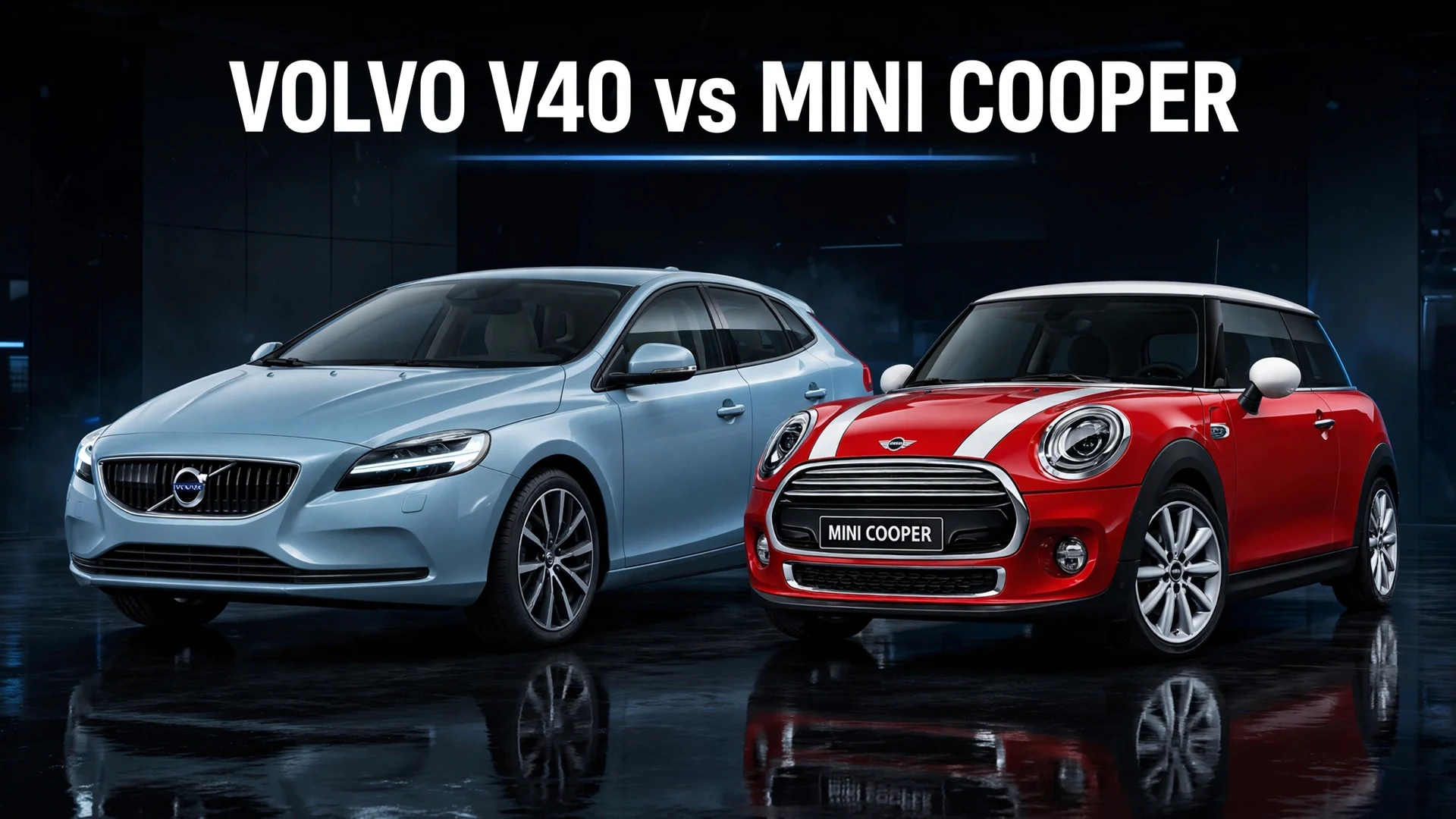
The Volvo V40 and the Mini Cooper get compared a lot, and on paper the pairing looks odd. One is a discontinued Swedish compact hatchback that was never sold in America; the other is a British style icon still rolling off production lines today. Here is the honest version: where the numbers actually land, what breaks on each, and which buyer each car really suits in 2026.
- Different size classes: the V40 is 4,369 mm long — nearly 55 cm longer than a 3-door Mini Cooper — with 335 litres of boot against the Mini’s 211.
- Different lifespans: the V40 was built from 2012 to 2019 and is used-only now; the Mini has run continuously since 2001 across four generations.
- America decides for you: the V40 was never sold new in the US, so American shoppers are choosing between a used import curiosity and a Mini they can buy new.
- Safety is the V40’s trump card: its 2012 Euro NCAP result — 5 stars, 98% adult occupant, world-first pedestrian airbag — was a record at the time.
- Reliability splits by generation: the V40’s diesels need DPF/EGR attention, while on the Mini side the R56’s N14 engine is the one to be wary of; the F56’s BMW B-series engines are far stronger.
Why this comparison is weirder than it looks
Most head-to-heads pretend the two cars are natural rivals. They are not — at least, not in the way a Golf and a Focus are. The V40 is a C-segment compact, the class above the Mini, which sits in the micro/A-segment. Volvo aimed the V40 at the Audi A3 and BMW 1 Series; Mini aimed the Cooper at nobody in particular, because nothing else looks or feels quite like it.
Then there is the timeline problem. The V40 had a single seven-year production run, 2012 to 2019, and then it was gone — no direct successor in the same hatchback form. The Mini, meanwhile, has been in continuous production since BMW relaunched the brand in 2001, evolving through the R50, R56, F56, and now the latest J01/F65 generation. Comparing a car with one generation against a car with four means you are always comparing a fixed target against a moving one.
And the geography problem: the V40 was engineered for Europe, Australia, and Asia. It was never officially sold in the United States — a fact that reshapes the whole decision, which is why this guide treats the US buyer as a separate case below.
The size gap, drawn to scale
Numbers in a table rarely convey physical presence. Here are the two cars’ lengths drawn to the same scale:
Bars drawn to scale at 1 px per 10 mm.
That half-metre is the whole story in miniature: the V40 seats five in genuine comfort while the Mini seats four with a rear bench best described as occasional, and the Volvo swallows 335 litres of luggage against the Mini’s 211.
The numbers that matter
| Spec | Volvo V40 (2012–2019) | Mini Cooper (F56 3-door) |
|---|---|---|
| Production | 2012–2019, single generation | 2001–present (R50 → R56 → F56 → J01/F65) |
| Body style | 5-door hatchback | 3-door hatchback (5-door F55 also offered) |
| Length | 4,369 mm | 3,821 mm |
| Wheelbase | 2,647 mm | 2,495 mm |
| Boot, seats up | 335 litres | 211 litres |
| Seats | 5 | 4 |
| Kerb weight | 1,357–1,498 kg | 1,085–1,215 kg |
| Top petrol engine | 2.0L turbo T5 — 245 hp, 350 Nm | 2.0L turbo Cooper S — 192 hp, 280 Nm |
| 0–60 mph | 6.0 s (T5) | 7.4 s (Cooper 1.5T) |
| Combined economy | ~51 mpg (T2 1.5) | ~62 mpg (Cooper 1.5T) |
| Euro NCAP | 5 stars (2012) | 4 stars (2014, F56); 5 stars (2024+ gen) |
| Sold new in the US | Never | Yes — still on sale |
Figures are manufacturer/press data for representative variants; economy figures are UK combined cycle.
How quick are they, really?
Neither car is slow in its quickest form, but the spread between the fastest and slowest variants is wide — wider than most shoppers expect. The V40 T5’s 245 hp Drive-E engine makes it genuinely rapid; the entry T2 is merely adequate.
0–60 mph times. Shorter bar = quicker.
The headline surprise: the quickest V40 out-sprints the quickest classic Mini of the same era. The V40 T5 hits 60 mph in 6.0 seconds and runs to 149 mph, while the F56 Cooper S needs 6.8 seconds. But the V40’s range is broader — the 122 hp T2 takes a leisurely 9.5 seconds, slower than even the base 136 hp Mini at 7.4. Engine choice matters enormously on the Volvo; on the Mini, even the base car feels brisk because there is barely a tonne of car to move.
Two very different histories
The V40 lived one life. The Mini has lived four. That asymmetry explains a lot about used prices, parts support, and how each car is perceived today.
Simplified to petrol hatch generations; Clubman, Countryman and electric variants omitted.
This matters practically. Mini parts, specialists, and knowledge are everywhere because the car never left the market. The V40 is well supported by Volvo’s dealer network — it shares its P1 platform with the S40, V50, and C30, so mechanical parts are not exotic — but some trim and body parts are getting harder to find, and values reflect a car with no new-car halo keeping interest alive.
What goes wrong: the reliability reality check
This is where generation knowledge pays for itself: “a used Mini” and “a used V40” each hide very different risk profiles depending on engine and year.
| Area | Volvo V40 | Mini Cooper |
|---|---|---|
| Engine watch-outs | Diesels: DPF and EGR clogging on short trips; 2.0L diesels from 2014–2017 had an overheating issue covered by a Volvo recall. Early 5-cylinder petrols can suffer PCV failures (whistling, oil use). The 1.5L turbo is sensitive to poor fuel quality. | R56 (2006–2013): the N14 turbo engine’s timing-chain tensioner is infamous — the “death rattle” on cold starts, typically 50k–80k miles, can destroy the engine if ignored. Carbon buildup on intake valves needs walnut blasting every 40–60k miles; high-pressure fuel pump failures and heavy oil consumption are documented. F56 (2014+): BMW B38/B48 engines are far stronger — routine servicing is the main requirement. |
| Gearboxes | Aisin torque-converter autos are solid; 8-speed on Drive-E cars is well regarded. Early Powershift dual-clutch (pre-2015) is the one to avoid. | Aisin automatics are solid; manuals are generally robust across generations. |
| Electrics & cabin tech | Sensus infotainment can get glitchy with age; check every function on the test drive. | R56 electric power-steering pump failures are known; F56 cars are much better. |
| Crash safety | 5 stars (2012) — 98% adult occupant, a record at the time, plus the world’s first pedestrian airbag. | 4 stars for the F56 in 2014 testing; the current 2024+ generation holds 5 stars. |
| Parts & support | Mechanical parts shared with S40/V50/C30; dealer support continues but some trim is drying up. | Excellent — still in production, huge aftermarket. |
Buy the V40 on engine choice — favour the Drive-E petrols, be cautious with high-mileage diesels used for short trips — and buy the Mini on generation: the F56’s BMW engines transformed its reputation, while the R56 needs a specialist’s eye, especially any N14 turbo without timing-chain history.
Which one is for you?
Pick the buyer you most resemble — each pane names a winner and the single biggest caveat.
Verdict
Buy the Volvo V40 if you want the most car for the money: more space, five seats, a genuinely record-setting safety story, and — in T5 form — pace that embarrasses the Mini. It is the rational used buy in every market where Volvo sold it, provided you choose the engine carefully and accept that it is a discontinued car.
Buy the Mini Cooper if you are buying with your heart, parking in a city, or living in America. It is smaller, less practical, and (in R56 form) potentially needier — but it is also more fun per mile, still in production, and backed by a parts and specialist network the V40 cannot match. Just make it an F56 or newer, and check that timing chain on any R56 turbo.
Either way, buy on condition and history: a full service record and a clean cold start tell you more than the odometer ever will.
Frequently asked questions
Is the Volvo V40 bigger than the Mini Cooper?
Yes, notably. The V40 is 4,369 mm long against 3,821 mm for the 3-door Mini Cooper — a difference of nearly 55 cm — and it offers 335 litres of boot space versus 211 litres, plus five seats instead of four. They sit in different size classes: compact versus micro.
Was the Volvo V40 ever sold in the United States?
No. The V40 was sold in Europe, Australia, and parts of Asia from 2012 to 2019 but was never officially offered in the US. American buyers choosing between these two are effectively choosing the Mini, unless they go down the grey-import route.
Which is faster, the Volvo V40 T5 or the Mini Cooper S?
The V40 T5. Its 2.0-litre Drive-E turbo makes 245 hp and reaches 60 mph in 6.0 seconds, against 6.8 seconds for the 192 hp F56 Mini Cooper S. The V40 is the sleeper here — heavier, but with considerably more power.
Is a used Mini Cooper R56 reliable?
It needs careful buying. The 2007–2012 Cooper S models with the N14 engine are known for timing-chain tensioner failure (the “death rattle”), carbon buildup on intake valves, and high-pressure fuel pump issues. A non-turbo R56 with full history is a safer bet, and the later F56 generation’s BMW engines are far more robust.
Which one should I buy as a used car in 2026?
For space, safety, and value in Europe or Australia: a Drive-E petrol V40 (T2–T5), avoiding high-mileage diesels used for short trips. For city use, warranty, or any US purchase: an F56-generation (2014+) Mini Cooper or Cooper S. Always verify service history and get a pre-purchase inspection.
Two hatches, two philosophies: the Volvo gives you more of everything except newness, and the Mini gives you less of everything except fun. Pick the philosophy, then pick the best-maintained example of it you can find.