Volvo vs Tesla Crash Test?

Volvo vs Tesla Crash Test?
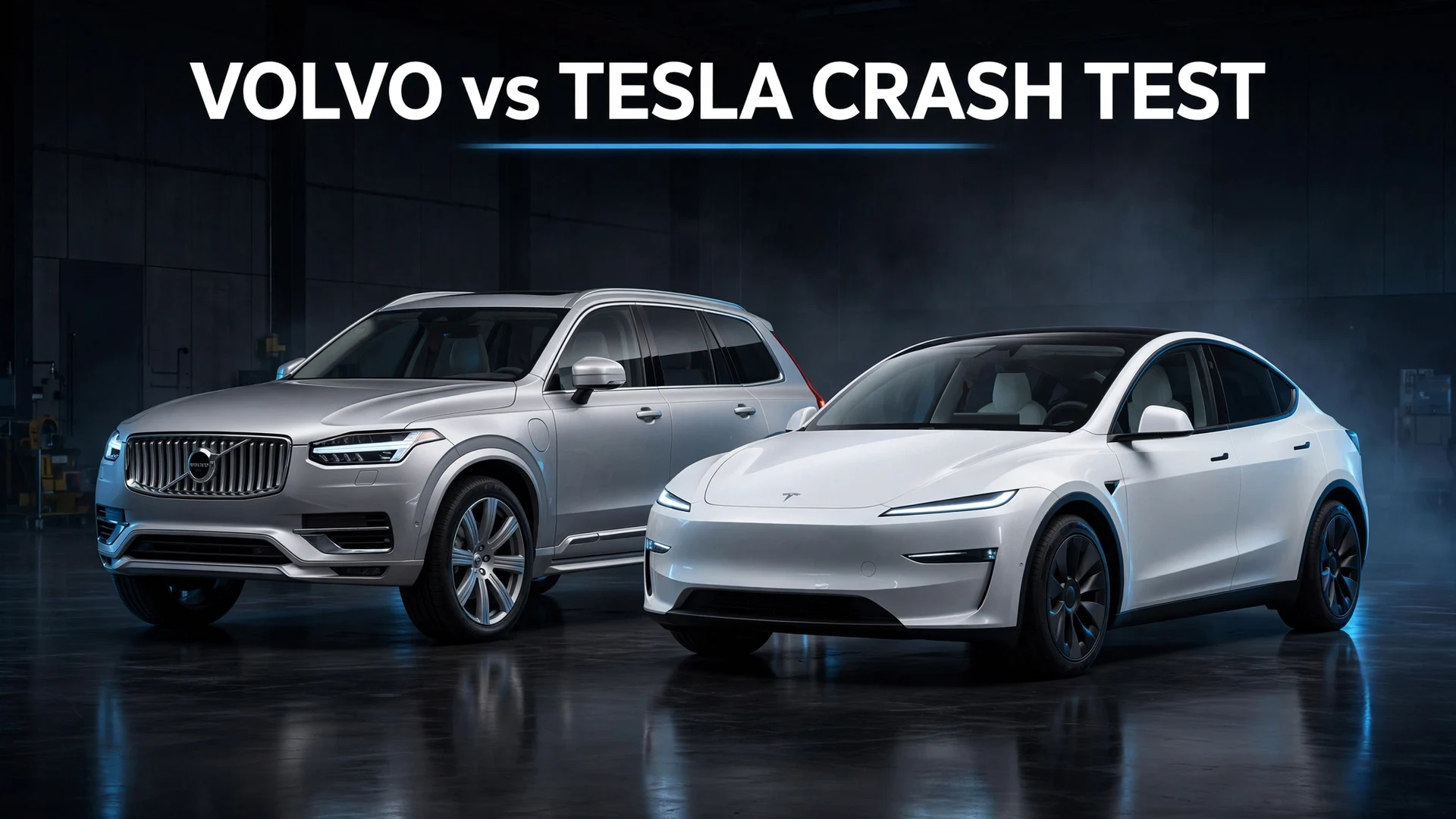
No one has staged a head-to-head crash between a Volvo and a Tesla — and no published test program pits one brand directly against the other. What exists instead is a public record from the world’s major crash-test authorities, and both brands sit at the top of it. The short answer: the Tesla Model Y (2022) holds the highest-scoring Euro NCAP result ever recorded under that protocol, while Volvo’s XC90 posted a landmark 100% Safety Assist score in 2015, and both the 2025 Model Y and the 2025 Volvo XC90 Plug-In Hybrid hold the IIHS’s top award, Top Safety Pick+. The honest comparison is not about which survives a wreck, but where each edges ahead: Tesla leads in active crash-avoidance scoring; Volvo’s edge is structural protection and whiplash/pedestrian design.
Key Takeaways
- Euro NCAP: Volvo XC90 (2015): 97% adult, 87% child, 72% pedestrian, 100% Safety Assist (a record). Tesla Model Y (2022): 97% adult, 87% child, 82% vulnerable road users, 98% Safety Assist — the highest result under the 2020–2022 protocol.
- IIHS: the 2025 Tesla Model Y and 2025 Volvo XC90 Plug-In Hybrid both earned Top Safety Pick+ (July 2025). Both scored Good in the updated side test; the Model Y scored Good vs. Acceptable for the XC90 in pedestrian crash prevention.
- NHTSA: the 2024 Tesla Model Y earned 5 stars overall including 5 in rollover; the 2024 Volvo XC90 earned 5 stars overall with 4 in rollover.
- Tesla’s Q3 2025 data claims one crash per 6.36 million miles with Autopilot — company-reported, with methodological caveats flagged by analysts.
- There is no real head-to-head Volvo-vs-Tesla crash; cross-year score comparisons are distorted by stricter test protocols over time.
What “Crash Test” Actually Means Here
Search results for “Volvo vs Tesla crash test” often imply the two brands have been crashed into each other. They haven’t. Independent bodies — Euro NCAP in Europe, the IIHS and NHTSA in the US — test individual models against fixed barriers, poles, and moving sleds, then publish scores. Comparing brands means comparing how their representative models performed in the same programs, in the same era.
That era matters. Euro NCAP tightens its protocols every few years, so a 97% adult-occupant score in 2015 is not the same achievement as 97% in 2022 — the later test is harder. Where newer results exist (the facelifted 2025 Model Y, the Volvo EX90), they are included and dated.
The Ratings, Program by Program
Use the tabs to move between the three major test programs. All figures below are the published results from each body, verified against the original releases.
Volvo XC90 (tested 2015): 5 stars. Adult occupant 97%, child 87%, pedestrian 72%, and a perfect 100% in Safety Assist — the first car from any manufacturer to max out that category, with full points in the AEB car-to-car tests. Euro NCAP named it Best in Class (Large Off-Road) for 2015.
Tesla Model Y (tested 2022): 5 stars. Adult 97%, child 87%, vulnerable road users 82%, Safety Assist 98% — the highest overall score recorded under the 2020–2022 protocol. Euro NCAP noted the camera-only Tesla Vision system “performs remarkably well in preventing collisions with other cars, cyclists and pedestrians,” and credited the far-side airbag and single-piece rear casting.
Newer results: the facelifted 2025 Model Y earned 5 stars in September 2025 (91% adult, 93% child, 86% VRU, 92% Safety Assist) under a tougher protocol — not directly comparable. The Volvo EX90 also earned 5 stars in that round (92% adult, 93% child, 86% Safety Assist; LiDAR not fitted to the tested car).
2025 Tesla Model Y — Top Safety Pick+ (awarded July 24, 2025). Rated Good in the small overlap front, moderate overlap front, and updated side tests, with Good-rated headlights and Good front crash prevention for both vehicles and pedestrians.
2025 Volvo XC90 Plug-In Hybrid — Top Safety Pick+ (same round). Also Good in small overlap front, moderate overlap front, and the updated side test, with Acceptable-rated headlights — but its pedestrian front crash prevention rated Acceptable, one notch below the Model Y. Note the award applies only to XC90 Plug-In Hybrids built after December 2024; the standard XC90 also holds a 2025 Top Safety Pick+ listing.
About the updated side test: IIHS toughened its side-impact test in 2021, using a heavier barrier (about 4,200 lb vs. 3,300 lb) striking at higher speed. Both the Model Y and XC90 PHEV earned Good under this test — the crash configuration that injures the most side-impact victims.
2024 Tesla Model Y: 5-star overall rating — 5 stars in frontal crash, 5 in side crash, and 5 in rollover resistance. Tesla has noted the Model Y records one of the lowest rollover risks NHTSA has measured for an SUV, thanks to the low-mounted battery pack.
2024 Volvo XC90: 5-star overall rating — 5 stars in frontal and side crash, 4 stars in rollover resistance, the typical pattern for a tall SUV. The mild-hybrid and plug-in hybrid (Recharge) variants are rated separately but share the 5-star overall result.
2026 Model Y: earned 5 stars in every NHTSA category and, in May 2026, became the first vehicle to pass NHTSA’s new driver-assistance tests (lane keeping assist, blind spot warning/intervention, pedestrian AEB) for cars built from November 2025 onward.
Euro NCAP Category Scores: XC90 vs. Model Y
The two headline tests, side by side. Both are 5-star cars tested under their respective era’s protocol — the chart compares category percentages, not cross-year difficulty.
Ratings at a Glance
| Rating / metric | Volvo XC90 | Tesla Model Y |
|---|---|---|
| Euro NCAP overall | 5 stars (2015) | 5 stars (2022) |
| Euro NCAP adult occupant | 97% | 97% (2022 protocol — tougher test) |
| Euro NCAP child occupant | 87% | 87% |
| Euro NCAP pedestrian / VRU | 72% | 82% |
| Euro NCAP Safety Assist | 100% (first car ever to max it) | 98% |
| IIHS award | Top Safety Pick+ (2025 XC90 PHEV, built after Dec 2024) | Top Safety Pick+ (2025; Good pedestrian crash prevention) |
| IIHS updated side test | Good | Good |
| NHTSA overall | 5 stars (2024) | 5 stars (2024) |
| NHTSA rollover | 4 stars | 5 stars |
| Latest program result | EX90: 5 stars, Euro NCAP 2025 | First to pass NHTSA’s 2026 ADAS tests |
Beyond the Labs: Real-World Safety Records
Crash tests measure physics; the real world measures outcomes. Here the comparison gets harder, because the two brands publish very different kinds of evidence.
Volvo’s evidence is historical and structural. Engineer Nils Bohlin invented the three-point seatbelt at Volvo in 1959, and Volvo waived the patent so every manufacturer could use it — a design Volvo estimates has saved over a million lives. That lineage runs through the Side Impact Protection System (1991), the first seat-mounted side airbags (1994), WHIPS whiplash protection (1998), and City Safety autobrake standard on the XC60 in 2008.
Tesla’s evidence is telematic. Its quarterly Vehicle Safety Report publishes fleet crash rates from its own data: Q3 2025 recorded one crash per 6.36 million miles with Autopilot engaged, versus one per 993,000 miles without, against a US national average of roughly one per 702,000 miles (NHTSA/FHWA, 2023). Treat this carefully: it is company-reported, Autopilot miles skew toward easier highway driving, and the figure has declined year-over-year for three straight quarters. Separately, NHTSA opened an investigation in October 2025 into roughly 2.9 million Teslas with Full Self-Driving, and flagged more than 50 incidents where the system appeared active, including 13 fatal crashes involving Autopilot.
What cannot be verified from public data: any claim that one brand’s owners die or are injured at a lower rate than the other’s. Neither company publishes comparable actuarial outcome data, and independent datasets mix too many variables — driver age, region, mileage — to credit to the car. Any article claiming a definitive real-world winner is speculating.
Verdict
On published crash-test evidence alone, the Tesla Model Y has the stronger recent record: the highest Euro NCAP score under its protocol, a 2025 Top Safety Pick+ with better pedestrian crash-prevention than the XC90, 5 stars in every NHTSA category including rollover, and the first pass of NHTSA’s new driver-assistance tests. Its advantage is concentrated in active safety — avoiding the crash in the first place.
The Volvo XC90’s case is different: a pioneering 100% Safety Assist result that set the standard others chased, consistently Good structural scores including the toughest side impact, and a safety culture built into design rather than software. Its current IIHS award is narrower — only plug-in hybrids built after December 2024 qualify.
Buy the Model Y if your priority is the latest crash-avoidance technology and you value the strongest available scores in the current test regimes, particularly if you drive mostly on highways where its driver-assistance strengths apply. Buy the XC90 if you want a three-row family SUV with top-tier structural protection, the best whiplash and side-impact engineering pedigree in the business, and a safety record that doesn’t depend on keeping software features switched on.
Sources
- XC90 Euro NCAP 2015 Best in Class scores — Drive
- Model Y Euro NCAP 2022 results — InsideEVs
- IIHS: Model Y and XC90 PHEV earn top award, July 2025
- IIHS detail: pedestrian crash prevention ratings — Autoblog
- Model Y Euro NCAP 2025 result — Autocar India
- Model Y NHTSA 5-star score — TeslaNorth
- Model Y first to pass NHTSA’s new ADAS tests — Carscoops
- XC90 NHTSA ratings — CarBuzz
- Tesla Q3 2025 Vehicle Safety Report — TeslaNorth
- Autopilot safety data critique — Electrek
- Volvo safety heritage timeline — Volvo Cars Canberra
FAQ
Has a Volvo ever been crash-tested against a Tesla?
No. No published program has crashed a Volvo into a Tesla, and neither Euro NCAP, IIHS, nor NHTSA stages brand-versus-brand impacts. Comparisons come from each model’s separate results against barriers, poles, and sleds.
Which has the better Euro NCAP score: Volvo XC90 or Tesla Model Y?
By percentage, the Model Y (2022) edges it: 97% adult, 87% child, 82% vulnerable road users, 98% Safety Assist — the highest result under that protocol at the time. The XC90 (2015) scored 97% adult, 87% child, 72% pedestrian, and a record 100% in Safety Assist. Protocols differ, so cross-year percentages are not strictly comparable.
Do both cars have the IIHS Top Safety Pick+ award?
Yes. The 2025 Tesla Model Y and the 2025 Volvo XC90 Plug-In Hybrid both earned Top Safety Pick+ in July 2025. The Model Y scored Good in pedestrian front crash prevention where the XC90 rated Acceptable, and the Volvo award applies only to plug-in hybrids built after December 2024.
Are Volvo and Tesla both 5-star rated by NHTSA?
Yes, both earned 5-star overall ratings. The 2024 Model Y scored 5 stars in frontal, side, and rollover tests; the 2024 XC90 scored 5 stars in frontal and side but 4 stars in rollover resistance, the normal pattern for a tall SUV.
Is Tesla’s Autopilot actually safer than human drivers?
Tesla’s own Q3 2025 report says Autopilot-engaged driving saw one crash per 6.36 million miles versus a US average of about one per 702,000 miles. That data is company-reported, skews toward highway driving, and has declined year-over-year for three quarters. NHTSA is separately investigating Full Self-Driving-equipped Teslas. No independent dataset proves a definitive real-world safety advantage for either brand.
Which is safer for a family: Volvo XC90 or Tesla Model Y?
Both are among the safest vehicles you can buy. Choose the Model Y for the strongest active-safety and crash-avoidance scores in current testing. Choose the XC90 if you need three rows, value Volvo’s structural and whiplash-protection engineering, or prefer safety that doesn’t depend on driver-assistance software being engaged.