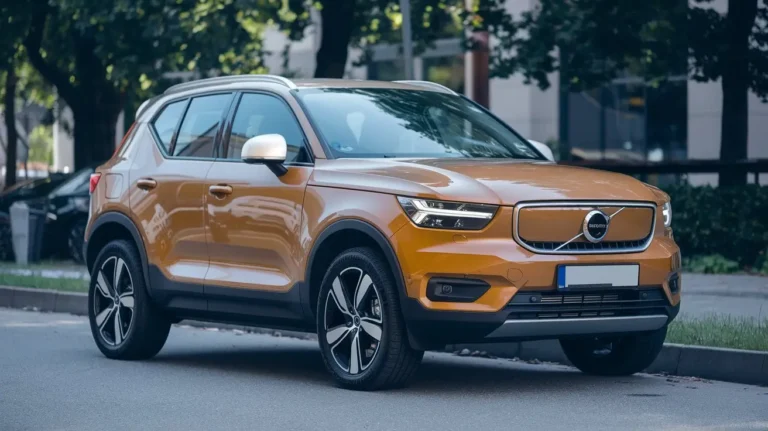
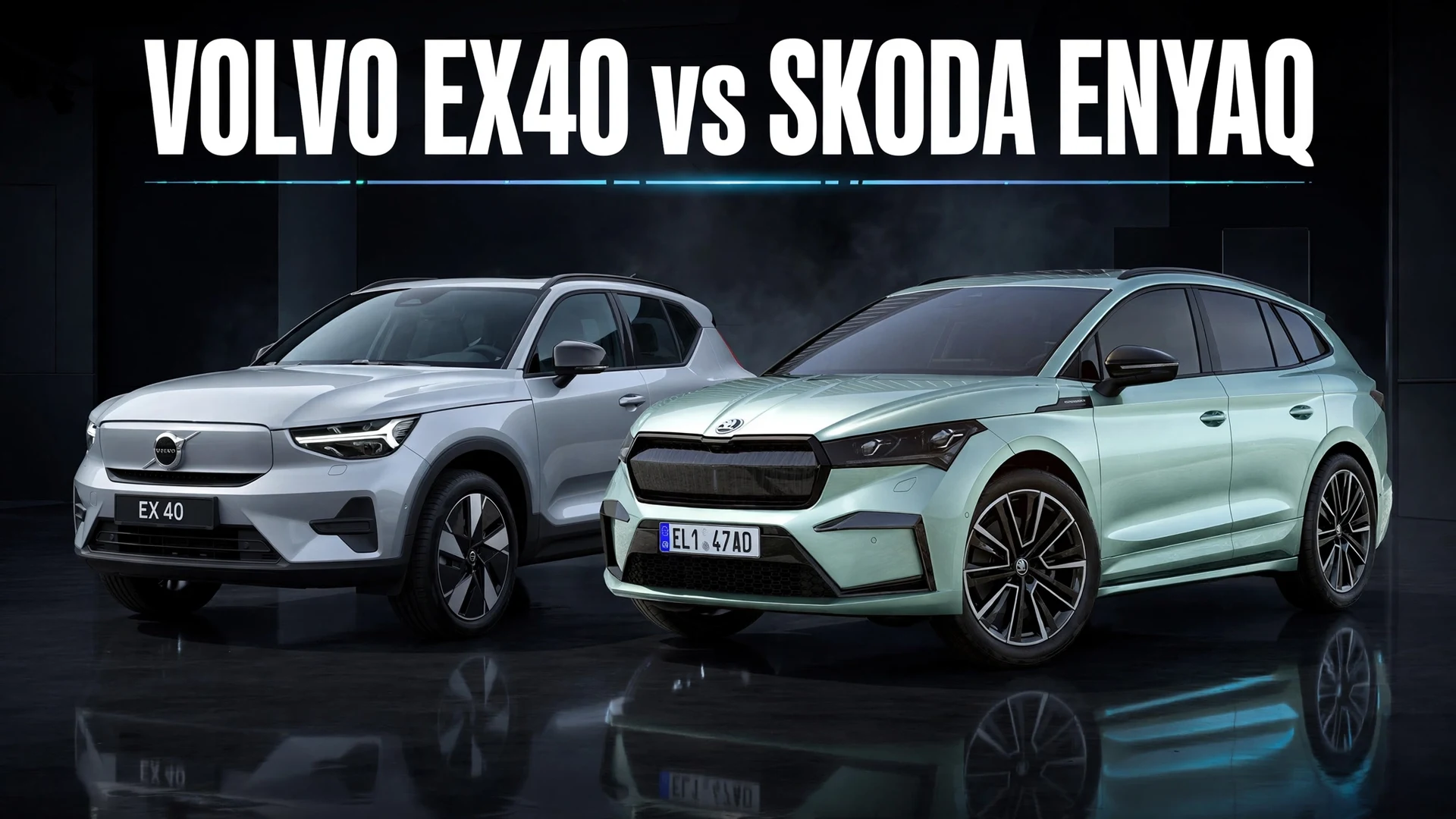
Volvo EX40 vs Skoda Enyaq: Specs, Range & the US Catch (2026)

On paper, the Volvo XC40 and the Skoda Enyaq look like natural rivals: two European electric crossovers, similar money, similar mission. In practice, comparing them takes some untangling — because the XC40 most Americans know isn’t electric at all, and Skoda has never sold a single car in the United States. Not now, not ever.
This guide sorts it all out: which Volvo actually competes with the Enyaq (the EX40, formerly the XC40 Recharge), how the two compare on specs, range, charging and practicality, and which one wins for each kind of buyer — including what Americans should look at instead.
Key Takeaways
- Skoda has never sold cars in the US, and VW Group says it has no plans to change that — so this comparison is really for European (and other non-US) shoppers.
- The gas mild-hybrid XC40 Americans know is not the Enyaq’s rival. Volvo’s true competitor is the electric EX40 (renamed from the XC40 Recharge for 2025).
- The Enyaq wins on space and range-per-euro: up to ~370 miles WLTP and 585 litres of boot, starting under €45,000 in Germany.
- The EX40 wins on charging speed (205 kW, 10–80% in ~28 minutes) and twin-motor performance (402 hp, 0–60 in 4.6 seconds).
- Americans cross-shopping these cars should look at the Volkswagen ID.4 — it shares the Enyaq’s MEB platform and is sold in the US.
Two different continents, two different Volvos
First, Skoda is not sold in the United States — as a deliberate corporate strategy, not a trim-planning quirk. VW Group leadership has said repeatedly it has no plans to bring the Czech brand across the Atlantic: no dealer network, no homologation, no service footprint.
Second, the XC40 that Americans drive is a gasoline mild-hybrid — a fine small SUV, but not an electric car, and comparing it to the fully electric Enyaq is a category error. Volvo’s actual electric answer is the EX40: for 2025, Volvo renamed the XC40 Recharge to EX40 and retired the Recharge badge entirely, reserving the XC40 name for the mild-hybrid line. Same car, clearer badge.
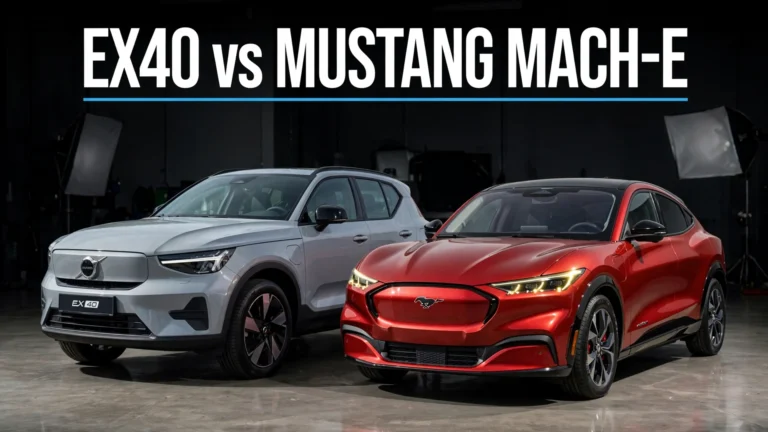
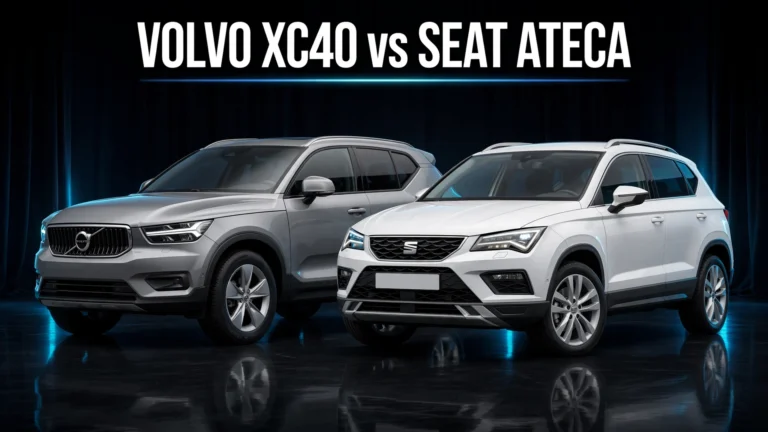
So the honest comparison is Volvo EX40 vs Skoda Enyaq — two compact electric crossovers from European brands, aimed at the same buyer, priced in the same neighbourhood. That’s the comparison this article makes.
Meet the contenders: sixty-second profiles
The Volvo EX40 is the veteran here. Launched as the XC40 Recharge in 2021, moved single-motor versions to rear-wheel drive in 2024, and added the 82 kWh battery and 205 kW fast charging — then simply changed its name for 2025. Two powertrains: 248 hp single-motor with 296 miles of EPA range, and 402 hp twin-motor good for 260 miles and 0–60 in 4.6 seconds. US pricing starts at $53,795.
The Skoda Enyaq is the quiet giant. Launched in 2021 and facelifted for 2025, it rides on VW Group’s MEB platform — the same bones as the Volkswagen ID.4 and Audi Q4 e-tron. Three powertrains: the 204 hp Enyaq 60 (~272 miles WLTP), the 282 hp Enyaq 85 (up to ~370 miles WLTP in Coupe form), and the 85X all-wheel-drive version. It’s longer and roomier than the EX40, starts at €44,400 in Germany, and there is no US version — none is planned.
Specs at a glance
| Spec | Volvo EX40 Single ER | Volvo EX40 Twin | Skoda Enyaq 60 | Skoda Enyaq 85 |
|---|---|---|---|---|
| Power | 248 hp | 402 hp | 204 hp | 282 hp |
| Torque | 310 lb-ft | 494 lb-ft | 229 lb-ft | 402 lb-ft |
| Drive | RWD | AWD | RWD | RWD (AWD on 85X) |
| Battery (usable) | 82 kWh | 78 kWh | 59 kWh | 77 kWh |
| Range | 296 mi EPA | 260 mi EPA | ~272 mi WLTP | ~364 mi WLTP (SUV) |
| 0–60 / 0–62 mph | 6.9 s | 4.6 s | 8.1 s | 6.7 s |
| DC fast charging | 205 kW | 205 kW | 165 kW | 135 kW |
| 10–80% charge time | ~28 min | ~28 min | ~24 min | ~28 min |
| Cargo (seats up / folded) | 16 / 57.5 cu ft | 16 / 57.5 cu ft | 20.7 / 60.4 cu ft | 20.7 / 60.4 cu ft |
| Towing (braked) | 2,000 lb | 2,000 lb | 2,205 lb | 2,205 lb |
| Length | 174.2 in | 174.2 in | 183.4 in | 183.4 in |
| Starting price | $53,795 (US) | ~$55,545 (US) | €44,400 (DE) | €48,900 (DE) |
| Sold in the US? | Yes | Yes | No | No |
Range figures use different test cycles — EPA for the Volvo, WLTP for the Skoda — so the numbers are not directly comparable. WLTP figures typically run 15–25% higher than EPA for the same car. Prices are manufacturer figures in each car’s home currency.
Range: how far each one really goes
Range is the headline number, and it’s where the comparison needs the most care. The EX40’s 296-mile figure is an EPA rating; the Enyaq’s ~364 miles is WLTP — and WLTP usually lands 15–25% higher than EPA for the same car, so don’t read the gap at face value.
Adjust roughly for the cycle difference and the two flagships land close together: the Enyaq 85’s ~364 WLTP miles works out to roughly 300 EPA-equivalent miles — a touch more than the EX40 Single Motor ER’s 296 EPA miles, despite the Enyaq being the bigger car. That’s the efficiency dividend of the 2025 facelift’s slippery 0.225-Cd coupe body.
The Enyaq 60’s 272 WLTP miles undercuts the EX40 Twin’s EPA range while costing far less — and the Enyaq Coupe 85’s 370 WLTP miles is the longest leg here by a comfortable margin.
Charging: the EX40’s strongest card
This is where Volvo fights back hardest. The EX40 charges at up to 205 kW on either powertrain and completes a 10–80% stop in about 28 minutes. The Enyaq 85 peaks at 135 kW (the 60 manages 165 kW, the 85X hits 175 kW) — similar 10–80% times on paper, but less time spent at peak speed on a busy charger.
One practical footnote: the EX40 still uses a CCS port in the US, with Tesla Supercharger access via an adapter; native NACS ports are planned for future Volvo EVs.
Size and practicality: the Enyaq plays a class up
The Enyaq is simply the bigger car: 4,658 mm long on a 2,766 mm wheelbase versus the EX40’s 4,425 mm and 2,702 mm. That shows up where families feel it — 585 litres of boot with the seats up (20.7 cu ft) expanding to 1,710 litres (60.4 cu ft), against the EX40’s 16 / 57.5 cu ft. The Enyaq’s rear bench is genuinely adult-usable for long trips; the EX40’s is a compact-car back seat. If cabin space decides it, the Enyaq wins outright — it’s effectively a size class above, closer in footprint to a Volvo XC60 than an XC40.
Cabins and tech: Scandinavian calm vs Czech cleverness
The EX40 leans on Volvo’s Google built-in infotainment — native Maps, Assistant and Play Store apps — wrapped in the leather-free, textile-heavy materials that are now Volvo’s signature. The Enyaq counters with Skoda’s “Simply Clever” playbook: a 13-inch touchscreen, available augmented-reality head-up display, wireless CarPlay and Android Auto, and nine airbags including a centre airbag. Volvo feels plusher; Skoda gives you more equipment per euro. Both carry five-star Euro NCAP ratings.
Price and ownership: the Enyaq’s home turf
On price, the Enyaq is the clear value champion. In Germany it starts at €44,400 for the 60 and €48,900 for the 85 — and that’s for a car a size up from the EX40. The EX40 starts at $53,795 in the US, with the Twin Motor adding about $1,750.
Running costs favour both equally — cheap home electricity, minimal servicing — but the Enyaq’s lower purchase price gives it the better total-cost story. The EX40 counters with Volvo’s 4-year/50,000-mile warranty and included maintenance in the US.
One American-specific note: with federal EV tax credits having ended for vehicles acquired after September 30, 2025, neither car benefits from a US federal incentive — the EX40 is built in Ghent, Belgium, and the Enyaq isn’t sold here at all.
Which one are you? Pick your buyer profile
The verdict
In Europe, the Skoda Enyaq is the rational pick for most buyers: more space, more range per euro, and a lower price. The Volvo EX40 is the emotional pick: faster, quicker-charging, plusher inside, carrying the stronger badge — but you pay for it and get less car for the money.
In the United States there is no contest, because Skoda doesn’t sell cars here. The EX40 wins by default — and the savvy American move is to cross-shop it against the Volkswagen ID.4, the Enyaq’s platform twin wearing a badge you can actually buy.
Frequently asked questions
Is the Skoda Enyaq sold in the United States?
No. Skoda has never sold cars in the US, and VW Group leadership has repeatedly stated there are no plans to bring the brand to America. The Enyaq is sold across Europe and in select other markets, but not in North America.
What is the Volvo equivalent of the Skoda Enyaq?
The Volvo EX40 — the electric crossover renamed from the XC40 Recharge for 2025. The gasoline mild-hybrid XC40 sold in the US is not the Enyaq’s rival; the EX40 is, with 248–402 hp, up to 296 miles of EPA range, and a $53,795 starting price.
Which has more range, the EX40 or the Enyaq?
On paper, the Enyaq: up to ~370 miles WLTP in Coupe 85 form versus the EX40 Single Motor ER’s 296 miles EPA. But the figures use different test cycles — WLTP runs 15–25% higher than EPA — so the real-world gap is much smaller, roughly a wash between the two flagships.
Is the Enyaq basically a Volkswagen ID.4?
Mechanically, they’re close cousins: both ride on VW Group’s MEB electric platform and share battery and motor technology. The Enyaq is slightly longer, tuned more for comfort, and generally better equipped for the money in Europe. The ID.4 is the one you can buy in the US — it’s built in Chattanooga, Tennessee.
Should I buy an EX40 or wait for the EX30?
Different cars for different buyers. The EX30 is smaller, cheaper (from $34,950), and quicker in Twin Motor form, but it’s leaving the US market and has less cargo space. The EX40 is the established, roomier choice with a longer track record. If you need the space, buy the EX40; if you want the bargain and can find an EX30, move fast.