Volvo XC70 P2 vs P3?

Volvo XC70 P2 vs P3?
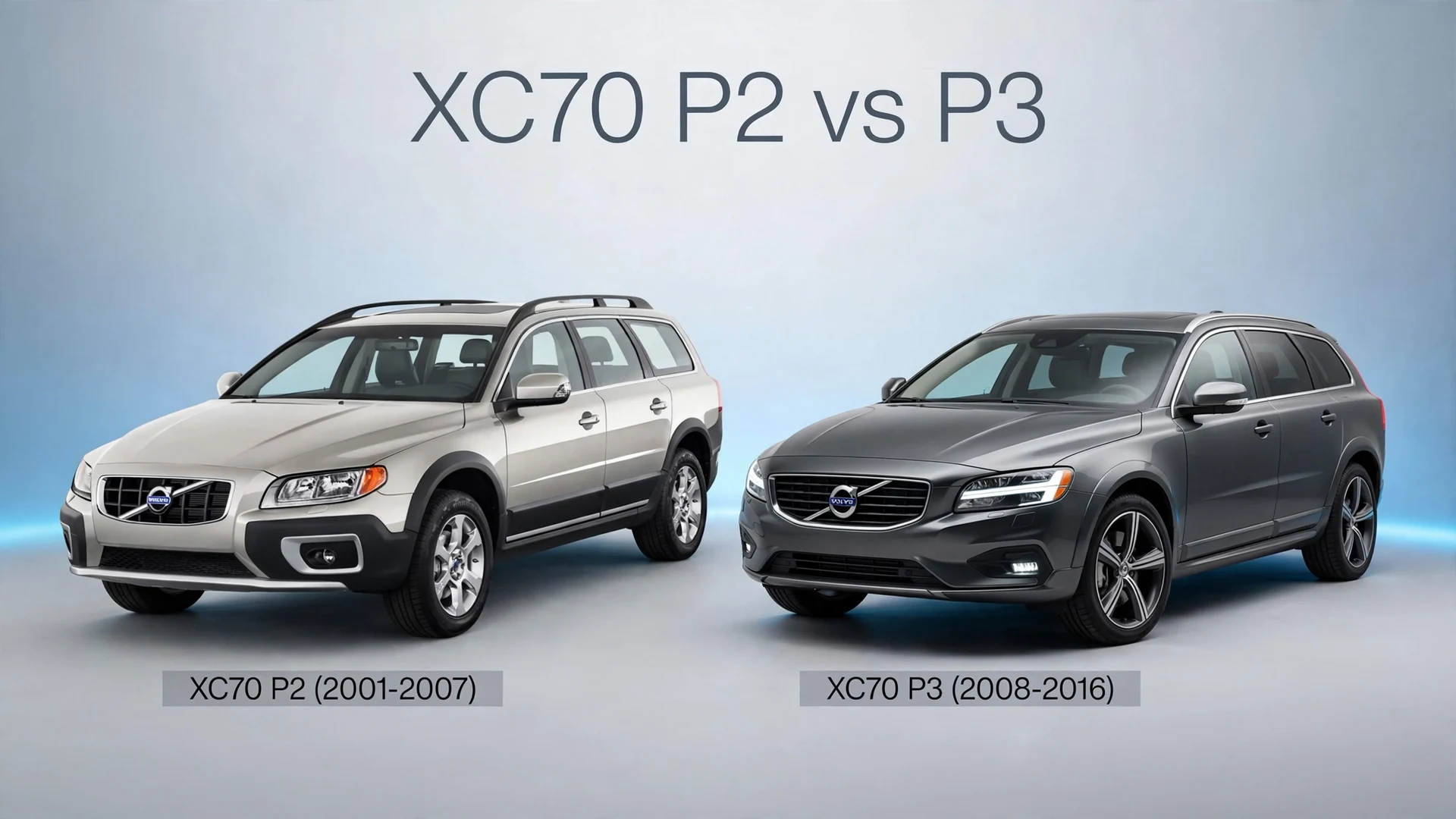
The XC70 lived two distinct lives: the P2 (2001–2007), the original raised wagon built on Volvo’s own platform with the beloved 2.5T five-cylinder, and the P3 (2008–2016), the bigger, plusher, more complex successor on Ford-EUCD architecture with 3.2 and T6 sixes. The short answer: buy a late P2 (2005–2007) for mechanical simplicity and DIY-friendliness, or a 2011+ P3 for modern safety, refinement and pace — and avoid early examples of both generations. The P2 is the enthusiast’s Volvo; the P3 is the better car. Here’s how to choose between them with real numbers.
- P2 (2001–2007): 2.5T five-cylinder — 208 hp, 236 lb-ft (320 Nm) from just 1,500 rpm; 5-speed auto; simpler, lighter, DIY-friendly.
- P3 (2008–2016): 3.2 six — 235 hp (240 hp from 2011), 236 lb-ft; T6 — 281 hp, then 300 hp/325 lb-ft from 2011, 0–60 in 6.9 s.
- Best years: 2007 for the P2 (fully mature); 2011+ for the P3 (power bump, most early faults fixed). Avoid P2 2001–2002 and P3 2008–2010.
- Economy: the P3 3.2 is thirstier than the P2 2.5T in the real world despite the newer platform — physics doesn’t care about model codes.
- Verdict: P2 for character and simplicity; P3 for safety tech, refinement and the T6’s pace. Condition beats generation, always.
Two Generations, Two Characters
The P2 XC70 (sold as the V70 XC for 2001–2002, then XC70) is peak old-school Volvo: a V70 wagon jacked up with cladding, skid plates and standard all-wheel drive, powered almost exclusively by the 2.5T — a 2.5-litre turbo five-cylinder making 208 hp and 236 lb-ft of torque from just 1,500 rpm. It’s mechanical, honest, and deeply loved: owners describe the five-pot’s torque delivery as the defining XC70 experience, and the P2’s simpler electronics mean a home mechanic can still do most jobs.
The P3 (2008–2016) moved to the EUCD platform shared with the S80, grew in every dimension, and chased the premium market properly: quieter cabin, vastly better seats, modern safety tech (City Safety, BLIS, active cruise on option), and a 6-speed automatic. But it also replaced the five-cylinder with a 3.2-litre inline-six (235 hp, 236 lb-ft) that owners found smooth but thirsty and oddly flat below 3,000 rpm — the old 2.5T’s low-end shove was missed. The 2009 arrival of the T6 (281 hp, then 300 hp/325 lb-ft from 2011) finally gave the P3 the pace its size deserved.
The Engines: Five-Cylinder Soul vs Six-Cylinder Smooth
| Engine | Power / torque | Gearbox | Character |
|---|---|---|---|
| P2 2.5T (2001–2007) | 208 hp / 236 lb-ft (320 Nm) @ 1,500 rpm | 5-speed auto | Torquey, characterful, simple |
| P3 3.2 (2008–2010) | 235 hp / 236 lb-ft | 6-speed auto | Smooth but thirsty; avoid early cars |
| P3 3.2 (2011–2014) | 240 hp / 236 lb-ft | 6-speed auto | Improved; the sensible P3 pick |
| P3 T6 (2009–2010) | 281 hp / 295 lb-ft | 6-speed auto | Fast, but early-build caveats |
| P3 T6 (2011–2014) | 300 hp / 325 lb-ft @ 2,100 rpm | 6-speed auto | 0–60 in 6.9 s; the one to have |
| P3 T5 2.5T (2015–2016) | 250 hp / 266 lb-ft | 8-speed auto | Return of the five-pot; rare, excellent |
Platform and Chassis: What Changed Underneath
The P2 rides on Volvo’s P2 platform — the same bones as the S60, S80 and XC90 — with a Haldex all-wheel-drive system (Gen II on early cars, Gen III later) that runs front-drive until slip, then sends up to 50% rearward. It’s a simple, proven setup: change the Haldex/AOC fluid and filter every 50,000 miles and it lasts. The P2’s steering is light, the ride is soft, and the whole car feels like what it is: a tough, slightly agricultural wagon that’ll do 250,000 miles with maintenance.
The P3’s EUCD platform brought a stiffer shell, better crash performance, more sophisticated multi-link rear suspension, and a newer Haldex generation with faster response. It also brought weight — the P3 is roughly 150–200 kg heavier than the P2 — which is why the 235 hp 3.2 never felt as lively as its numbers suggested. The P3’s interior is a different league: the floating centre console, the watch-dial instruments on later cars, and seats that long-distance drivers still rave about — widely considered the most comfortable in any wagon of the era. But complexity grew too: more modules, more sensors, and jobs (like the 3.2’s rear-mounted accessories) that make mechanics sigh.
Which Years to Buy — and Which to Avoid
P2: buy 2005–2007, avoid 2001–2002. The early P2s had the troublesome AW55 5-speed automatic (valve-body failures) and first-year electrical gremlins; by 2005 the transmission was sorted, the software matured, and the 2007 is the connoisseur’s pick — the final, fully-developed year with every running change applied. The 2.5T wants a timing belt every 105,000 miles/10 years (it’s an interference engine — a snapped belt kills it), PCV system checks (the “glove test” for crankcase pressure), and angle-gear/AOC fluid changes.
P3: buy 2011+, avoid 2008–2010. The early 3.2s are the problem children: oil consumption from piston-ring issues on some 2008–2010 builds (expensive — engine rebuild territory), plus the usual first-year niggles like early software bugs and trim rattles. The 2011 refresh brought 240 hp, fixed most of the oil-burning, and matured the electronics. The 2011+ T6 (300 hp) is the driver’s choice; the 2015–2016 T5 with the 2.5-litre five-cylinder and 8-speed auto is the rare sweet spot — old-school engine, modern gearbox — but they’re scarce and sellers know it. On any P3, check for the 3.2’s vacuum-pump and accessory-drive (READ unit) leaks, service the AWD coupling, and make sure all the electronic driver aids actually work — a dead BLIS or park-assist module is an expensive fix. Budget for the 6-speed auto’s fluid change if there’s no record of one, and inspect the front subframe bushes for wear on high-mileage cars, and listen for wheel-bearing drone on the test drive — a classic high-mileage XC70 tell.
Running Costs and Known Faults
| Issue | P2 (2001–2007) | P3 (2008–2016) |
|---|---|---|
| Engine | PCV clogging; timing belt critical | 3.2 oil consumption (2008–10); vacuum-pump leaks |
| Gearbox | AW55 valve body (2001–02) | TF-80SC generally strong; fluid changes help |
| AWD | Angle gear / DEM failures | AOC pump; needs fluid services |
| Suspension | Simple, cheap parts | More complex; rear air on some |
| Electrics | Simpler; fewer modules | More to go wrong; software-dependent |
| Real-world economy | ~22–25 mpg (2.5T) | ~20–23 mpg (3.2); T6 ~18–21 |
Fuel economy deserves honesty: neither generation is frugal. The P2 2.5T returns low-20s mpg in mixed use; the heavier P3 3.2 does worse despite the newer engine — high-teens to low-20s — and the T6 dips into the high teens around town (EPA rated the 2012 T6 at 16/22 mpg). Buy either as a wagon that happens to do everything, not as an economy choice. Parts for the P2 are cheaper and more available from independents, and the car’s simpler electronics mean more jobs are DIY-able; P3 parts cost more but the cars are newer, so you’ll need fewer of them. Insurance is reasonable for both — they’re family wagons with strong safety records, which underwriters like.
Which XC70 to Buy
Verdict: Heart Says P2, Head Says 2011+ P3
Buy the P2 (2005–2007) if you want the last of the mechanical Volvos: the five-cylinder’s torque, DIY-friendly engineering, cheaper parts, and a character no modern car replicates. It’s the one you’ll bond with.
Buy the P3 (2011+) if you want the better car: safer, quieter, more refined, and — in T6 form — genuinely quick. The 2011 refresh fixed the early sins, and a well-kept 2012–2014 T6 is one of the great used wagons. Either way, the rule is the same: buy the newest, best-maintained example of the right years, and walk away from the cheap early cars — their purchase price is just the deposit on their repair bills.
Sources
- Jalopnik — Volvo XC70 buyer’s guide: P2/P3 year splits, 2008 3.2 235 hp, 2009 T6 281 hp, 2011 240/300 hp outputs, best-year guidance.
- matthewsvolvosite.com forums — P2 2.5T specs (208 hp/236 lb-ft @ 1,500 rpm), oil-consumption threads, angle-gear/DEM discussions.
- Volvo Cars press — 2011 XC70: T6 300 hp/325 lb-ft @ 2,100 rpm, 0–60 in 6.9 s; 3.2 240 hp (230 PZEV).
- volvoxc.com forums — 2012 XC70 owner review: T6 EPA 16/22 mpg, real-world 10.1 L/100 km.
- matthewsvolvosite.com — 3.2 oil-consumption/piston-ring issue threads (2008–2010).
Frequently Asked Questions
What years are the Volvo XC70 P2 and P3?
The P2 XC70 ran from 2001 to 2007 (badged V70 XC for 2001–2002); the P3 ran from 2008 to 2016. The P2 used the 2.5T five-cylinder; the P3 used 3.2 and T6 sixes, then a 2.5T five-cylinder T5 for 2015–2016.
Which is more reliable: XC70 P2 or P3?
A late P2 (2005–2007) is simpler and cheaper to fix — fewer modules, DIY-friendly. A 2011+ P3 is the more reliable modern car once the early 3.2 oil-consumption issues were resolved. Avoid 2001–2002 P2s and 2008–2010 P3s.
What is the XC70 3.2 oil consumption problem?
Some 2008–2010 3.2 engines suffer excessive oil consumption from piston-ring issues, documented in owner forums — potentially engine-rebuild territory. The 2011 refresh largely resolved it. Check oil level and consumption history on any early 3.2.
Is the XC70 T6 better than the 3.2?
Yes, if you can afford the fuel: the 2011+ T6 makes 300 hp and 325 lb-ft from 2,100 rpm (0–60 in 6.9 s) versus the 3.2’s 240 hp, with standard AWD. Expect high-teens mpg around town — EPA rated it 16/22 mpg.
What should I check when buying a used XC70?
Timing belt receipt (P2 2.5T), PCV system, angle-gear/AWD function, transmission fluid history, oil consumption (early 3.2), and full service records. On any XC70, test the AWD on a loose surface and check for accessory-drive oil leaks.
Which XC70 is the best to buy?
The enthusiast’s pick is the 2007 2.5T — the final sorted P2. The rational pick is a 2012–2014 T6 — modern safety, 300 hp, early faults fixed. The unicorn is the 2015–2016 T5: five-cylinder engine with the 8-speed auto.