
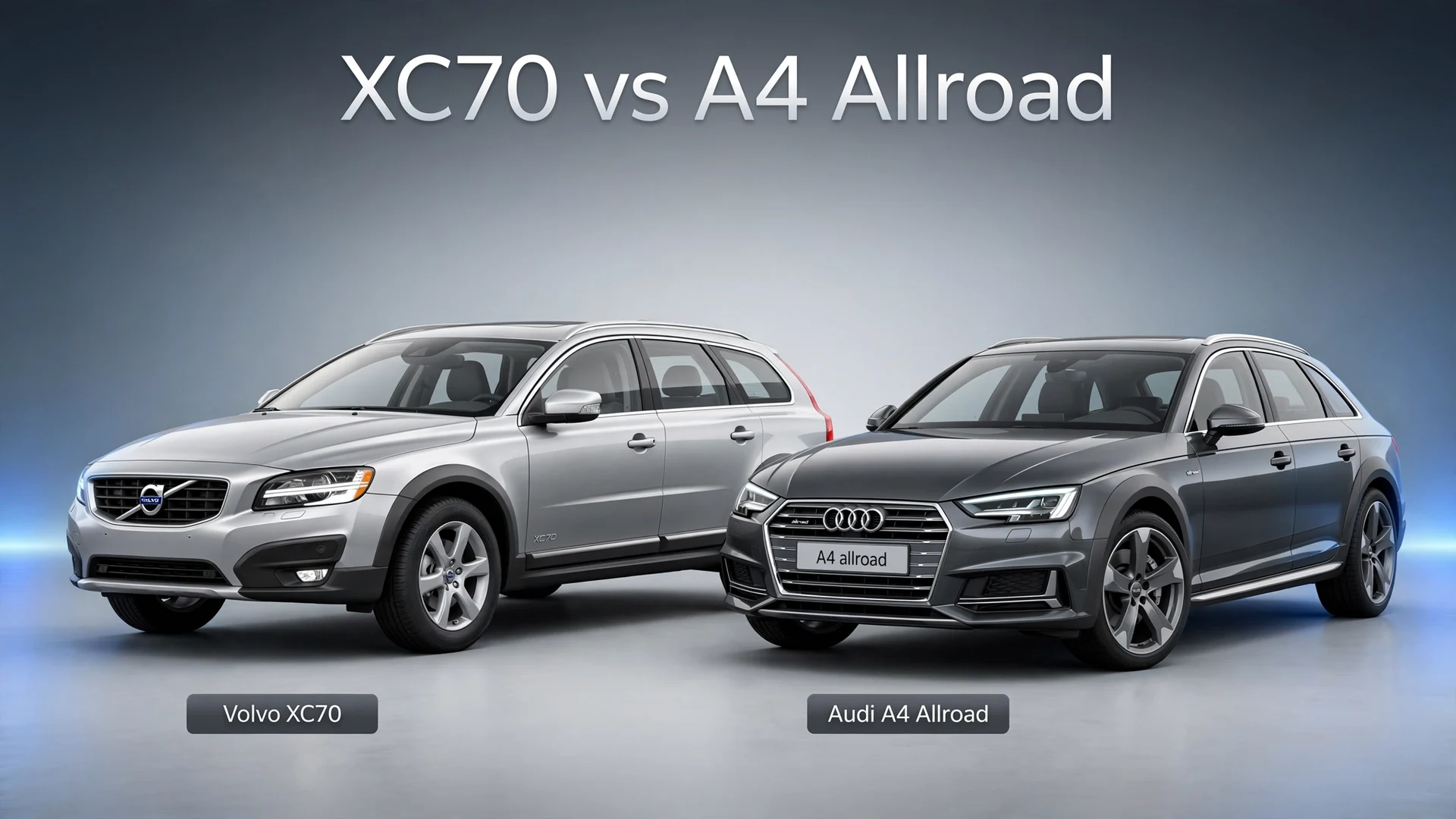
Volvo XC70 vs Audi A4 Allroad?

Volvo XC70 vs Audi A4 Allroad?
The Volvo XC70 and Audi A4 Allroad invented — and then defined — the lifted luxury wagon: a regular wagon with raised suspension, cladding, and all-wheel drive for people who need SUV capability without the SUV. Comparing the core generations (P3 XC70, 2008–2016, against the B8 Allroad, 2009–2016), the XC70 is the more practical, more rugged used buy: 8.3 inches of ground clearance versus 7.1, a cavernous 72.1 cu ft of maximum cargo against 50.5, and stronger engines that drink regular fuel. The Allroad is the sharper, more modern-feeling drive, with better fuel economy and a nicer cabin. Buy the XC70 for utility and value; buy the Allroad for driving pleasure and tech.
- Generations compared: P3 Volvo XC70 (2008–2016) vs B8 Audi A4 Allroad (2009–2016); the B9 Allroad (2017+) is newer still.
- Ground clearance: 8.3 in (XC70) vs 7.1 in (Allroad) — the Volvo is meaningfully more SUV-like off pavement.
- Cargo: 72.1 cu ft max (XC70) vs 50.5 cu ft (Allroad) — the Volvo swallows over 40% more.
- Power: XC70 T5 250 hp / T6 300 hp on regular fuel vs Allroad 2.0T 211 hp on premium.
- Economy: Allroad wins the EPA numbers, 21/28 mpg vs 19/26 mpg — but the fuel-grade difference narrows the real-world cost gap.
- Verdict: XC70 for space, clearance, and used value; Allroad for handling, efficiency, and interior polish.
Same Idea, Different Execution
Both cars answer the same question — “what if a wagon could do 80% of an SUV’s job?” — but they start from opposite ends. The XC70 is essentially a V70 with a lift kit: Volvo raised the ride height by roughly two inches over the standard wagon, added body cladding and skid plates, and fitted standard all-wheel drive. It feels like a junior SUV. The Allroad takes the A4 Avant and raises it more modestly, keeping the car’s low center of gravity and sporty character. Note the B8 Allroad has conventional steel suspension — the troublesome air suspension belongs to the earlier C5-generation Allroad (2000–2005), not this one.
The wheelbases tell you how close the packaging is: 110.8 inches for the XC70, 110.4 for the Allroad (2014 figures). But the Volvo is the bigger vehicle in every other dimension — 4.6 inches longer, 3.3 inches wider, 5.1 inches taller — and it weighs about 200 lb more. That size difference is the whole story of this comparison: the XC70 maximizes the wagon format, while the Allroad stays compact and car-like.
Dimensions and Cargo: The Volvo’s Home Turf
| Dimension (2014 models) | Volvo XC70 | Audi A4 Allroad (B8) |
|---|---|---|
| Length | 190.5 in | 185.9 in |
| Width | 75.8 in | 72.5 in |
| Height | 63.1 in | 58.0 in |
| Ground clearance | 8.3 in | 7.1 in |
| Cargo, seats up | 33.3 cu ft | 27.6 cu ft |
| Cargo, seats folded | 72.0 cu ft | 50.5 cu ft |
| Curb weight | 4,092 lb | 3,891 lb |
| Fuel tank | 18.5 gal | 16.9 gal |
The cargo numbers deserve emphasis: 21.5 cubic feet of extra maximum space is the difference between “fits the dog crate and the luggage” and “choose one.” The XC70’s taller roofline and boxier tailgate make the space genuinely usable, too — owners consistently report fitting items the Allroad’s sloping rear glass rejects. Combined with the bigger fuel tank, the XC70 is simply the better long-distance load-lugger.
Engines and Transmissions
Volvo offered the P3 XC70 with three engines in the US, Audi offered the B8 Allroad with one:
| Engine | Configuration | Power / torque | EPA city/hwy |
|---|---|---|---|
| XC70 T5 (2014–2016) | 2.5L turbo 5-cyl | 250 hp / 266 lb-ft | 19 / 26 mpg |
| XC70 3.2 (2008–2015) | 3.2L inline-6 | 240 hp / 236 lb-ft | 18 / 25 mpg |
| XC70 T6 (2008–2016) | 3.0L turbo inline-6 | 300 hp / 325 lb-ft | 17 / 23 mpg |
| Allroad 2.0T (B8, 2009–2016) | 2.0L turbo 4-cyl | 211 hp / 258 lb-ft | 21 / 28 mpg |
| Allroad 2.0T (B9, 2017+) | 2.0L turbo 4-cyl | 252 hp / 273 lb-ft | 22 / 30 mpg |
The XC70 wins on outright output in-period: even the volume T5’s 250 hp beats the B8 Allroad’s 211, and the T6’s 300 hp / 325 lb-ft makes it the effortless highway cruiser of the pair. The Allroad counters with efficiency — 21/28 mpg plays 19/26 — and the newer B9 (252 hp) largely closes the power gap while stretching economy to 22/30.
But read the fine print at the pump: the Audi’s 2.0T requires premium fuel, while the Volvo five- and six-cylinders run happily on regular. At a 40–50 cent per gallon premium spread, the Allroad’s EPA advantage shrinks considerably in real dollars. The Volvo’s 18.5-gallon tank also gives it far greater range between fill-ups — a meaningful touring advantage.
Transmissions: the XC70 uses Volvo’s 6-speed Geartronic automatic across the range — smooth, conventional, and generally durable. The B8 Allroad uses an 8-speed Tiptronic automatic; the B9 moves to a 7-speed S tronic dual-clutch, which is slicker but brings dual-clutch maintenance considerations (mechatronic servicing) that the Volvo’s torque-converter box avoids.
All-Wheel Drive: Two Philosophies
The XC70 uses a Haldex-based on-demand system: front-wheel drive until slip is detected, then up to 50% of torque goes rearward (with later Instant Traction generations reacting pre-emptively). It’s effective and fuel-efficient, but fundamentally reactive — enthusiasts note it feels FWD-biased right up until it doesn’t.
The B8 Allroad uses proper Torsen-based quattro with a 40:60 rear-biased nominal split — full-time all-wheel drive that feels planted and neutral in all conditions. The B9 switched to “quattro with ultra technology,” which decouples the rear axle when cruising to save fuel and reconnects predictively. On-road, the Audi system is the more sophisticated and more satisfying of the two; in deep snow with proper tires, both will get you home, and owners of each swear by their car’s winter ability.
Reliability: What Breaks on Each
Neither car is fragile, but each has well-documented weak spots that should shape which example you buy.
XC70: The 3.2-liter inline-6 is known for oil consumption via piston-ring wear on higher-mileage examples — check the dipstick and service history. The T6’s turbo six is the stronger engine but watch for PCV/breather-box issues and coolant leaks at the thermostat housing. The Haldex all-wheel-drive system needs its fluid and filter serviced (many owners skip it; the Active On-Demand Coupling pump can fail). The 6-speed automatic is generally robust with fluid changes. Suspension-wise, the XC70’s taller springs and standard shocks are simple and cheap to refresh — a real advantage over air-sprung rivals.
A4 Allroad (B8): The 2.0T’s big one is oil consumption on 2009–2011 cars — worn piston rings led to an Audi warranty extension, so verify whether the fix was performed. The timing-chain tensioner on early B8 2.0Ts can fail with catastrophic (engine-out) consequences; listen for chain rattle on cold start and check for tensioner service. Water pumps and thermostat housings leak. The B9 (2017+) largely resolved the oil-consumption issue and is the safer used buy, though it commands a premium. Body-wise, the Allroad’s cladding and underbody protection hold up well, but check for parking-lot rash on the lower trim.
Parts and servicing costs favor the Volvo slightly — the five-cylinder T5 and 3.2 are straightforward engines any independent Volvo shop knows intimately, while the Audi’s direct-injection turbo four and dual-clutch (B9) demand specialist attention.
Used-Buying Verdict
On price: comparable-condition XC70s typically trade 15–25% below equivalent B8 Allroads, and the gap widens against B9 cars. That discount buys a lot of maintenance — and the Volvo needs less of it.
Verdict: Utility vs Polish
The XC70 is the honest workhorse of the lifted-wagon world: bigger inside, taller off the ground, stronger engines, regular fuel, simpler mechanicals, and cheaper to buy and keep. The A4 Allroad is the connoisseur’s choice: better to drive, thriftier on paper, and nicer to sit in — but smaller, thirstier for premium fuel, and carrying the B8 2.0T’s well-known engine caveats. If your wagon needs to work like an SUV, buy the Volvo. If it needs to feel like a sports sedan that happens to carry skis, buy the Audi.
Sources
- blog.autotempest.com — “Want A Deal On An Audi Allroad? Try A Volvo XC70!” (ground clearance 8.3 vs 7.1 in; cargo 72.1 vs 50.5 cu ft; 250 vs 220 hp period figures; 21/28 vs 19/26 mpg; premium vs regular fuel).
- truedelta.com — 2014 Volvo XC70 vs 2014 Audi allroad specifications (dimensions, weights, cargo 72.0 vs 50.5 cu ft, fuel capacity).
- autotrader.ca — 2013 Audi A4 allroad vs 2014 Volvo XC70 side-by-side (211 hp 2.0T vs 240 hp 3.2 / 300 hp T6; transmissions; fuel consumption).
- iseecars.com — Audi A4 allroad vs Volvo XC70 comparison (B9 261 hp base, 26 mpg combined both, range figures).
- audiworld.com / volvoxc.com owner forums — AWD system impressions, Allroad C5 air-suspension history, XC70 snow performance reports.
Frequently Asked Questions
Which has more ground clearance, XC70 or A4 Allroad?
The Volvo XC70, at 8.3 inches versus 7.1 inches for the B8 A4 Allroad. The XC70 sits a full 5 inches taller overall and is meaningfully more SUV-like on rough tracks and in deep snow.
Which has more cargo space?
The XC70 by a wide margin: 33.3 cu ft behind the rear seats and 72.0 cu ft maximum, versus 27.6 and 50.5 cu ft for the Allroad. The Volvo holds over 40% more with the seats folded.
Does the Audi Allroad require premium fuel?
Yes — the Allroad’s 2.0T requires premium unleaded, while the XC70’s five-cylinder and six-cylinder engines run on regular. That narrows or erases the Audi’s EPA fuel-economy advantage in real-world cost.
Which is more reliable, XC70 or A4 Allroad?
The XC70 has the simpler, more forgiving record: watch for 3.2 oil consumption and Haldex service history. The B8 Allroad’s 2.0T needs documented attention to the oil-consumption fix (2009–2011) and the timing-chain tensioner. The B9 Allroad (2017+) is the safer Audi buy.
Can the XC70 or Allroad tow?
Volvo rates the XC70 for 3,300 lb towing in the US, making it the only real tower of the two — Audi publishes no US tow rating for the A4 Allroad. For serious towing, neither replaces a proper SUV.
Which holds its value better?
The A4 Allroad depreciates less steeply and commands higher used prices, especially B9 cars. The XC70 is the value buy — comparable examples typically trade 15–25% cheaper, which more than offsets its slightly higher fuel use.