Volvo P1 vs P2?

Volvo P1 vs P2?
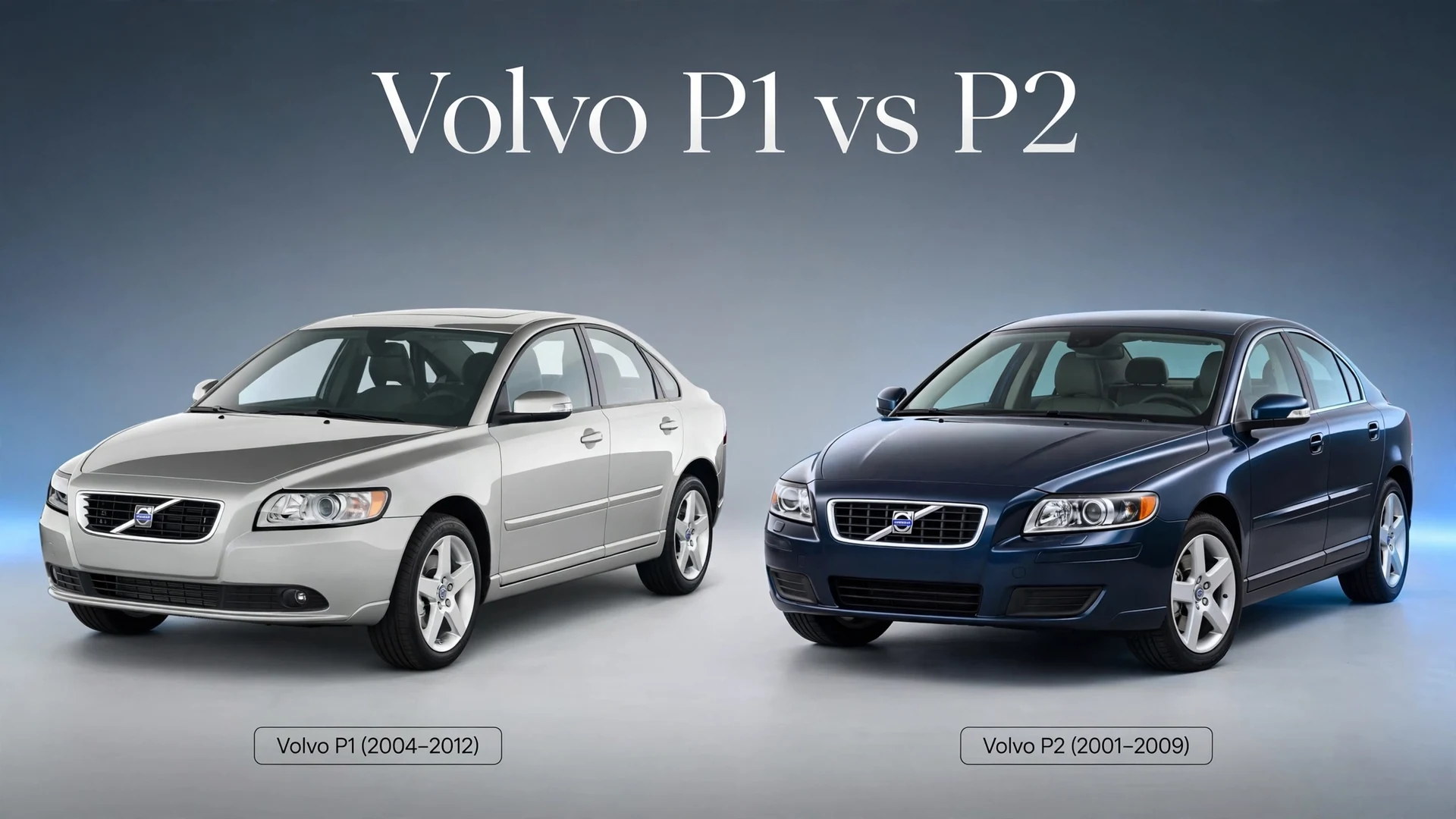
Volvo’s P1 platform (2004–2013: S40 II, V50, C30, C70 II — the compact, Ford C1-based range) and P2 platform (1999–2014: S80, S60, V70, XC70, XC90 — Volvo’s own large-car architecture) are the two used-Volvo worlds most buyers choose between without realizing it. The short answer: P1 cars are smaller, cheaper, more fuel-efficient, and easier to park — ideal first Volvos and commuters. P2 cars are bigger, more refined, more capable tow/haul vehicles with the legendary 5-cylinder engines — better family cars and long-distance cruisers. Neither is “better”; they’re different sizes answering different needs. Here’s the full comparison.
- P1 (2004–2013): compact C-segment cars on Ford C1 architecture (shared with the Focus): S40 II, V50, C30, C70 II.
- P2 (1999–2014): Volvo’s own midsize/large architecture: S80 I, S60 I, V70 II, XC70 II, XC90 I.
- Shared DNA: the P1 T5 models use the same 2.5L 5-cylinder white-block family as P2 cars — same timing-belt and PCV discipline applies.
- P1 watch-outs: Powershift dual-clutch (diesel models), a long recall list (clutch master cylinder, washer-fluid fire risk), suspension knocks, sump leaks.
- P2 watch-outs: ETM (1999–2002), AW55-50 valve body (2001–2002), PCV clogging, AWD angle-gear sleeve.
- Verdict: P1 for commuting and city life; P2 for family duty, towing, and long-haul comfort.
What P1 and P2 Actually Are
The platform codes describe two fundamentally different engineering programs. P1 is Volvo’s version of Ford’s global C1 platform, developed during Ford’s ownership and shared with the contemporary Ford Focus and Mazda 3. That shared parentage is P1’s superpower and its stigma in one: economies of scale made these the most affordable Volvos of their era, with widely available mechanical parts — but purists note they’re the least “pure Volvo” Volvos ever sold. Models: the second-generation S40 sedan (2004–2012), V50 wagon (2005–2012), C30 hatchback (2007–2013), and second-generation C70 convertible/coupe (2006–2013).
P2 is Volvo’s own large-car architecture, engineered in Gothenburg with no Ford involvement — the last of the fully independent Volvo platforms before Ford-era sharing (P1, P3) and later Geely-era SPA. It underpins the S80 (1999–2006), S60 (2001–2009), V70/XC70 (2001–2007), and the long-lived XC90 (2003–2014). Bigger in every dimension, built around the 5-cylinder white-block engines, and engineered for American highways and Swedish winters alike.
Size and Mission Compared
| Attribute | P1 (S40/V50/C30) | P2 (S60/V70/XC70/XC90) |
|---|---|---|
| Segment | Compact (C-segment) | Midsize to large (D/E-segment) |
| Typical length | ~4.4–4.5 m (S40/V50); 4.26 m (C30) | ~4.6–4.8 m (S60/V70); 4.95 m (XC90) |
| Seating / cargo | 5 seats, compact cargo | 5–7 seats; wagons/SUV swallow far more |
| Architecture origin | Ford C1 (shared with Focus/Mazda 3) | Volvo in-house |
| Drivetrain | Mostly FWD; some AWD (T5 AWD, D5) | FWD or full Haldex AWD range |
| Towing | Light (~1,300–1,600 kg braked) | Up to ~2,250 kg (XC90) |
| City friendliness | Easy to park, nimble | Big; XC90 is a handful downtown |
| Fuel economy | Better (lighter, smaller engines) | Thirstier, especially T6/V8 |
The Shared DNA Nobody Mentions
Here’s the detail that changes how you evaluate a P1 car: the T5 models share P2’s engine family. The 2.5-liter turbocharged 5-cylinder in a C30 T5, S40 T5, or V50 T5 is the same white-block architecture as the 2.5T in P2 S60s and V70s — same timing-belt service discipline (every ~10 years/120k miles), same PCV breather system that clogs with neglect, same cam-seal leaks when the PCV is ignored, same general indestructibility when maintained. A well-kept P1 T5 is, mechanically, a smaller P2 where it counts most.
The base P1 engines are the Ford/Mazda-shared 4-cylinders (1.6, 1.8, 2.0 gasoline; 2.0D diesel) — economical and parts-plentiful, but without the Volvo 5-cylinder’s character or longevity reputation. The 2.4i 5-cylinder splits the difference. Diesels (D5 2.4, 2.0D) were Europe-market staples; the 2.0D paired with the Powershift dual-clutch automatic deserves special caution (below).
P1 Trouble Spots
P1 cars have a longer recall history than their size suggests. Haynes’ common-problems data for the S40/V50 lists recalls for: faulty exhausts, washer fluid leaking into pump wiring (fire risk), clutch master cylinders (35,855 cars), vacuum hoses (18,989 cars), cracking engine support members, water ingress into the cooling fan (fire risk), rear wheels that could come loose, fuel-pump and engine failures, leaky coolant tanks, and faulty gear selectors. Most were fixed under recall long ago — but verify recall completion on any car you’re considering, since independent-market cars sometimes missed them.
Beyond recalls, the owner-reported pattern includes: front-end knocking under acceleration/deceleration (incorrectly seated driveshaft), grinding from the front suspension over speed bumps (spring contacting the strut mount), sump oil leaks, hard starting, and rear-suspension knocks. The Powershift MPS6 dual-clutch (2.0D diesel models) can suffer mechatronic/hydraulic-pressure faults — expensive, specialist-only repairs. And like their P2 cousins, the 5-cylinder P1s need PCV oil-trap maintenance; neglected breathers lead to cam-seal leaks and the wobbling-axle/CV-boot wear that age brings to all high-mileage FWD cars.
P2 Trouble Spots (Recap)
P2’s greatest-hits fault list is well documented by two decades of owner data: the ETM electronic throttle module (1999–2002), AW55-50 automatic valve-body failures (worst in 2001–2002; $3,500–$4,000 dealer repairs), clogged PCV systems causing oil consumption and blown seals, AWD angle-gear splined-sleeve wear (XC70/V70R/S60R), DIM dashboard pixel/solder failures, and the non-negotiable timing-belt service on the 5-cylinders. P2 suspension wears too — control-arm bushings, strut mounts, sway-bar links — but parts are cheap and every Volvo shop knows the drill.
| System | P1 (typical faults) | P2 (typical faults) |
|---|---|---|
| Transmission | Powershift dual-clutch mechatronics (diesel); manual shift-lever recall (2010) | AW55-50 valve body (2001–02); avoid early T6’s GM 4T65 |
| Engine breathing | Same PCV discipline on 5-cyl models | PCV clogs → leaks; service ~100k mi |
| Recalls | Long list: clutch master cyl, washer-fluid fire risk, cooling fan, fuel pump | Shorter list; ETM-era issues dominate |
| Suspension noises | Driveshaft knock, spring/strut-mount grind | Bushing, mount, and link wear (cheap parts) |
| Electrics | Simpler; fewer chronic module faults | DIM pixels, CEM, alarm siren module |
| AWD | Limited AWD range; fewer complaints | Angle-gear sleeve wear on AWD models |
| DIY friendliness | Easy; huge Focus/Mazda3 parts overlap | Excellent; biggest Volvo DIY community |
Running Costs Compared
Purchase: both are cheap now, but P1 is cheaper — a decent S40 or V50 often sells for less than an equivalent-condition P2 S60, and C30s (especially T5s) are the enthusiast bargain of the pair. The C70 convertible commands a premium in both generations’ terms.
Fuel: P1 wins clearly. A 2.0 or 2.4i S40/V50 returns genuinely economical real-world figures; the T5s are thirstier but still lighter than any P2. P2’s 5-cylinders are honest but not frugal, and the XC90 V8 exists in a different fuel economy universe entirely.
Maintenance: both are DIY-friendly with excellent parts availability — P1 benefits from the Ford/Mazda shared-parts bin for running gear, while P2 benefits from the deepest Volvo-specific aftermarket of any platform. Specialist labor costs are similar. Insurance favors the cheaper, smaller P1 cars.
Longevity: this is P2’s trump card. The 5-cylinder white blocks and the P2 structures have a proven 250k+-mile record with maintenance; high-mileage P1 4-cylinders are less proven at extreme mileages, though the T5-engined P1s inherit the 5-cylinder’s reputation. Rust protection is good on both by the standards of their eras.
Which Should You Buy?
Verdict: Size First, Badge Second
P1 vs P2 isn’t a quality contest — it’s a sizing decision. The P1 cars are among the smartest cheap used buys in the Volvo world: economical, safe, parts-plentiful, and (in T5 form) genuinely fun. The P2 cars are the definitive Volvos of their era: bigger, tougher, more refined, and proven to astronomic mileages. Choose P1 when the car needs to fit your city life and your budget; choose P2 when the car needs to carry your family and your trailer. Either way, buy on maintenance history — a serviced PCV and a documented timing belt matter more than the platform code.
A final thought for the enthusiast: the P1 platform hides the T5 manual cars — the C30 T5 and the S40 T5 with three pedals — which are increasingly sought after by Volvo enthusiasts while ordinary examples still trade cheaply. If that’s your target, patience is the strategy: set alerts on the enthusiast classifieds, pounce on the documented car, and don’t settle for an example with patchy history. For everyone else, the ordinary 2.4i and 2.5T cars remain some of the cheapest safe, comfortable transport on the road — just make sure the PCV and timing belt have been done, and the platform code won’t matter much at all.
Sources
- NHTSA Technical Service Bulletin MC-10231934-9999 (Volvo, 2023) — official P1/P2 platform-to-model-year mapping.
- Haynes (UK) — Volvo S40/V50 common problems and recall list: clutch master cylinder (35,855 cars), vacuum hose (18,989), washer-fluid and cooling-fan fire risks, suspension noises, sump leaks.
- Volvo Cars media — Powershift dual-clutch launch: 450 Nm capacity, 8% fuel saving, 2.0D pairings in C30/S40/V50.
- Nordic Business Report (2010) — Volvo recall of 29,226 C30/S40/V50 for 6-speed manual shift-lever ball joint.
- TurboBricks — P1 C30 T5 ownership: transmission service, timing/aux belts, engine mounts, PCV oil-trap maintenance, CV boots.
- Matthews Volvo Site — P2 parts-failure poll and AW55-50/ETM reliability discussions.
Frequently Asked Questions
What is the Volvo P1 platform?
P1 is Volvo’s compact-car platform (2004–2013), based on Ford’s C1 architecture shared with the Ford Focus and Mazda 3. It underpins the second-generation S40 (2004–2012), V50 wagon (2005–2012), C30 hatchback (2007–2013), and second-generation C70 (2006–2013).
What is the Volvo P2 platform?
P2 is Volvo’s in-house midsize/large-car architecture (1999–2014), engineered in Gothenburg with no Ford involvement. It underpins the S80 (1999–2006), S60 (2001–2009), V70/XC70 (2001–2007), and XC90 (2003–2014).
Do P1 Volvos have the same engines as P2?
Partially: P1 T5 models (C30 T5, S40 T5, V50 T5) use the same 2.5L 5-cylinder white-block engine family as P2 cars, with the same timing-belt and PCV maintenance needs. Base P1 cars use Ford/Mazda-shared 4-cylinder engines instead.
What is wrong with the Volvo Powershift transmission?
The Powershift MPS6 dual-clutch (fitted to 2.0D diesel P1 models) can suffer mechatronic and hydraulic-pressure faults that trigger limp-home modes — expensive, specialist-only repairs. Volvo claimed 450 Nm capacity and 8% fuel savings, but used buyers should demand documented gearbox history.
Are P1 Volvos reliable?
Reasonably, with caveats: the 5-cylinder T5 models inherit P2’s proven drivetrain, and the Ford-shared running gear has plentiful parts. But P1s carry a long recall list (verify completion), suspension-noise issues, and the Powershift diesel gearbox risk. Buy on history, not mileage.
Should I buy a P1 or P2 Volvo?
Choose P1 for commuting, city driving, lower running costs, and first-car duty. Choose P2 for family space, towing, 7 seats (XC90), long-distance comfort, and maximum proven longevity. Both are DIY-friendly with strong parts support.