Yanmar vs Volvo Penta?

Yanmar vs Volvo Penta?
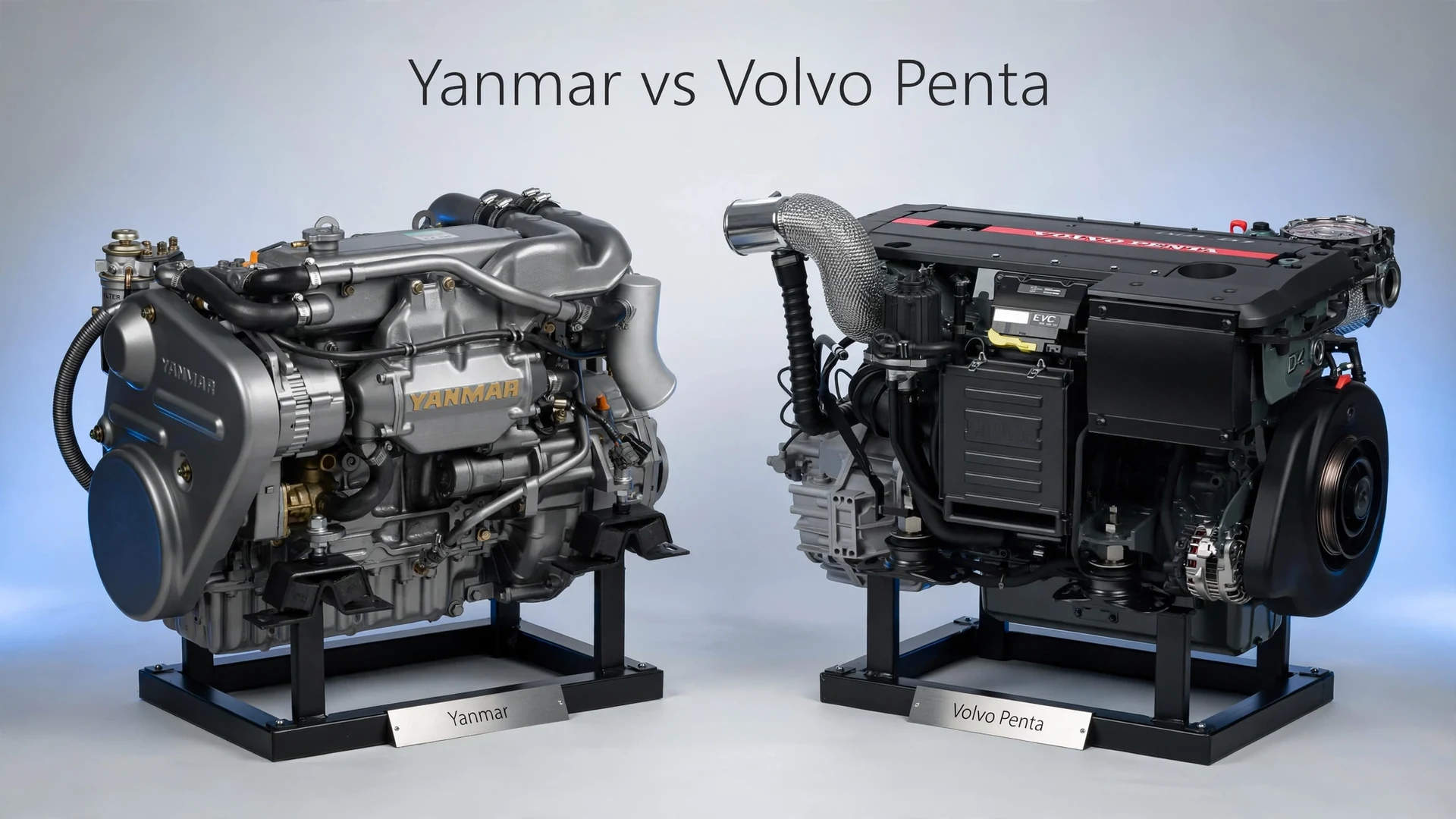
Ask “which is better, Yanmar or Volvo Penta?” in any yacht club and you’ll get a bar fight. Here’s the answer that actually helps: neither brand is better in the abstract — the right choice depends on the application. For sailboat auxiliaries, Yanmar’s JH series (3JH5E: 39 hp, 1.642 L, 173 kg) is the benchmark for simplicity and global parts availability, while Volvo Penta’s D2-40 (39.6 hp) counters with smoother common-rail running and superb European dealer support. For bigger planing boats, both make excellent modern common-rail engines — and the deciding factors are your local dealer’s competence, what fits your engine beds, and which saildrive or sterndrive you’re already committed to. Read on for the numbers that matter.
- Sailboat diesels: Yanmar 3JH5E — 39 hp at 3,000 rpm, mechanical injection, 173 kg dry; Volvo Penta D2-40 — 29.1 kW (39.6 hp) ISO 8665, common-rail, 115 A alternator.
- Design philosophy: Yanmar designs engines as marine units from a blank sheet; Volvo Penta marinizes proven industrial blocks (e.g. Perkins-based D-series) — both approaches work, but feel different.
- Electronics: modern Yanmar common-rail engines (4JH-CR series) idle and run more cleanly but are more sensitive to dirty fuel and electrical faults than older mechanical Yanmars.
- Parts costs: owners report both brands’ genuine parts as expensive — Volvo historically more so in some markets, Yanmar in others. Shop the parts, not the badge.
- The real decider: local dealer competence, installation quality, gearbox/saildrive compatibility, and where you cruise matter more than the name on the rocker cover.
Sailboat Auxiliaries: 3JH5E vs D2-40, the Numbers
The 35–45 hp sailboat auxiliary is where these brands meet most often, so let’s compare like with like. Yanmar’s 3JH5E is a 1.642-litre three-cylinder making 39 hp (28.7 kW) at 3,000 rpm, weighing 173 kg dry without gear, with mechanical fuel injection, a 125 A alternator, and a choice of straight, angle-drive or SD60 saildrive transmissions. Volvo Penta’s D2-40 makes 29.1 kW (39.6 hp) to ISO 8665, ships with a 115 A alternator, and pairs with the 130S saildrive or MS25 gearbox.
On paper they’re near-identical in output. In character they differ: the Yanmar is the simpler machine — mechanical injection you can troubleshoot with hand tools, no ECU to get wet — while the D2-40’s common-rail system starts easier, idles more cleanly, and (owners report) burns 2–4% less fuel. That simplicity gap matters most where it matters most: mid-ocean, the Yanmar’s lack of electronics is a feature, not a deficiency. In a marina with a Volvo dealer next door, the D2’s refinement wins.
| Specification | Yanmar 3JH5E | Volvo Penta D2-40 |
|---|---|---|
| Power (ISO 8665) | 39 hp / 28.7 kW @ 3,000 rpm | 29.1 kW (39.6 hp) |
| Cylinders / displacement | 3 / 1.642 L | 4 (Perkins-based block) |
| Fuel system | Mechanical direct injection | Common-rail |
| Dry weight (no gear) | 173 kg | ~200 kg (approx.) |
| Alternator | 125 A | 115 A |
| Transmissions | Straight / angle drive / SD60 saildrive | 130S saildrive / MS25 gearbox |
| Idle quality | Workmanlike | Smoother (common-rail) |
Design Philosophy: Marine-First vs Marinized
Yanmar builds marine engines from scratch — the JH series was designed as a boat engine, with marine-duty cooling, mounts, and service points laid out for an engine room, not an engine bay. That’s why you’ll find Yanmars in everything from 30-foot cruisers to commercial fishing boats across Asia: the company is, by owner accounts, one of the largest marine diesel producers in the world, and its engines are designed to be serviced by people with modest tools in remote places.
Volvo Penta takes the opposite route: start with a proven industrial/automotive block (the D-series traces to Perkins/Shibaura lineage) and marinize it thoroughly — marine cooling, marine electrics, marine mounts, and Volvo’s own control systems. The upside is refinement and parts commonality with huge industrial volumes; the downside, owners say, is that some service points feel designed for a workshop, not a bilge. Neither philosophy is wrong — but they explain why the two engines feel so different to live with.
Common-Rail vs Mechanical Injection: What It Means at Sea
This is the technical heart of the debate. Older mechanical-injection Yanmars (2GM, 3GM, 3JH2) are legendary for a reason: no ECU, no high-pressure pump, no sensors — just a fuel system a competent owner can bleed, time, and repair with basic tools. They’re noisy and smoky by modern standards, but they start and they run, and 30-year-old examples still cross oceans.
Modern common-rail engines — Yanmar’s 4JH-CR series and Volvo’s D-series — are objectively better engines: cleaner, quieter, more economical, easier starting, better throttle response. But they’re more sensitive to contaminated fuel (water or dirt kills high-pressure pumps and injectors), more dependent on clean electrical connections, and when they fail, they fail in ways that need a laptop and a dealer. The practical advice: if you cruise remote areas, fit serious fuel filtration (a proper Racor-style primary filter with water separation) regardless of brand — it’s cheap insurance that matters more than which badge you chose. And if your boat still has a good mechanical Yanmar, think very carefully before “upgrading” it.
The Model Lineups, Compared
| Yanmar model | Power | Volvo Penta equivalent | Power |
|---|---|---|---|
| 3YM30 | 29 hp | D1-30 | 30 hp |
| 3JH5E | 39 hp | D2-40 | 40 hp |
| 4JH5E | 54 hp | D2-55* | 55 hp |
| 4JH57 (common-rail) | 57 hp | D2-75* | 75 hp |
*D2-55/D2-75 are established Volvo Penta D-series models — verify current availability on volvo-penta.com, as the range evolves.
For larger planing boats the comparison moves to Yanmar’s 6LY/6LP families against Volvo Penta’s D4/D6 — modern common-rail sixes on both sides, and here the differences narrow further: both are smooth, powerful, and electronically sophisticated. Volvo’s advantage here is its integrated sterndrive packages (DPI/DPS) and the EVC control ecosystem — joystick docking, glass-cockpit integration — which is genuinely best-in-class. Yanmar’s advantage is often price and, in commercial/marine markets, parts availability. Match the engine to the drive system your boat already has: repowering from one brand’s sterndrive to another’s is rarely worth the transom surgery.
Parts, Service and the Real Cost of Ownership
Ask owners about parts prices and you’ll hear the same complaint about both brands: genuine marine parts are expensive, full stop. Volvo Penta has a reputation for eye-watering prices on proprietary items (saildrive diaphragms, EVC components), though its global dealer network is superb in Europe and the Americas — there’s usually a dealer within a day’s sail. Yanmar’s network is arguably stronger in Asia-Pacific and among commercial operators, and pattern parts are widely available for the older mechanical engines.
Service intervals are comparable — typically annual or every 100–200 hours for oil and filters, with coolant, belts and impellers on calendar schedules. The saildrive diaphragm deserves special mention: both brands recommend replacement on a roughly 7-year interval, and it’s a haul-out job — budget for it on any used boat with a saildrive, regardless of brand. The single best money you can spend is a pre-purchase engine survey: compression, oil analysis, and a hard run under load reveal more than any forum thread ever will.
Which Engine for Your Boat?
Verdict: Match the Engine to the Mission
Buy Yanmar if you want the simplest, most field-serviceable sailboat auxiliary with the deepest global support — the 3JH5E remains the default choice for a reason, and the 4JH5E covers the 50 hp class well. Buy Volvo Penta if you value refinement, European dealer density, and the integrated sterndrive/control ecosystem for bigger boats. And if you’re repowering: the cheapest, most reliable engine is almost always the one that bolts to the gearbox, saildrive, beds and exhaust you already have. Survey the installation, not just the engine — and whatever badge you choose, change the fuel filters.
Sources
- Volvo Penta — D2-40 product bulletin (PDF): 29.1 kW ISO 8665, 130S saildrive, 115 A alternator.
- Yanmar Marine — JH series selection table 2022 (PDF): 3YM30 29 hp, 3JH5E 39 hp @ 3,000 rpm, 1.642 L, 173 kg, 125 A alternator, SD60 saildrive; 4JH5E 54 hp; 4JH57 57 hp.
- YBW Forums — “Volvo Penta vs Yanmar” owner thread: simplicity vs refinement, parts costs, dealer networks.
- YBW Forums — “Volvo D4 or Yanmar 4LH-STE” thread: 4LH-STE durability reputation, common-rail fuel sensitivity.
Frequently Asked Questions
Which is more reliable: Yanmar or Volvo Penta?
Both are reliable when maintained. Older mechanical-injection Yanmars have the legendary reputation for simplicity and longevity; modern common-rail engines from both brands are refined and economical but more sensitive to dirty fuel and electrical faults. Maintenance history matters more than brand.
What is the difference between the Yanmar 3JH5E and Volvo Penta D2-40?
Both are ~39–40 hp sailboat auxiliaries. The 3JH5E (39 hp @ 3,000 rpm, 173 kg) uses mechanical injection — simpler to service in the field. The D2-40 (29.1 kW) uses common-rail injection — smoother, cleaner, easier starting, but ECU-dependent.
Are Volvo Penta parts more expensive than Yanmar?
Owners report both brands’ genuine parts as expensive. Volvo Penta has a reputation for very high prices on proprietary items in some markets; Yanmar can be pricier in Europe than in Asia-Pacific. Always price the parts you’ll actually need before choosing.
Should I repower my sailboat from Volvo to Yanmar or vice versa?
Usually no — the cheapest reliable repower keeps your existing gearbox, saildrive, engine beds and exhaust. Changing brands often means changing the saildrive too, which turns an engine swap into major surgery. Match the engine to the installation.
How often should a saildrive diaphragm be replaced?
Both manufacturers recommend roughly a 7-year interval for the saildrive rubber diaphragm, and it’s a haul-out job. Check the age of the diaphragm on any used boat with a saildrive — Yanmar SD series or Volvo 130S — and budget accordingly.
Is common-rail or mechanical injection better for ocean cruising?
Mechanical injection is more field-serviceable — no ECU, repairable with hand tools — which is why many ocean cruisers prefer older mechanical Yanmars. Common-rail is cleaner, quieter and more economical, but demands excellent fuel filtration and clean electrics. Fit a proper primary filter with water separation either way.