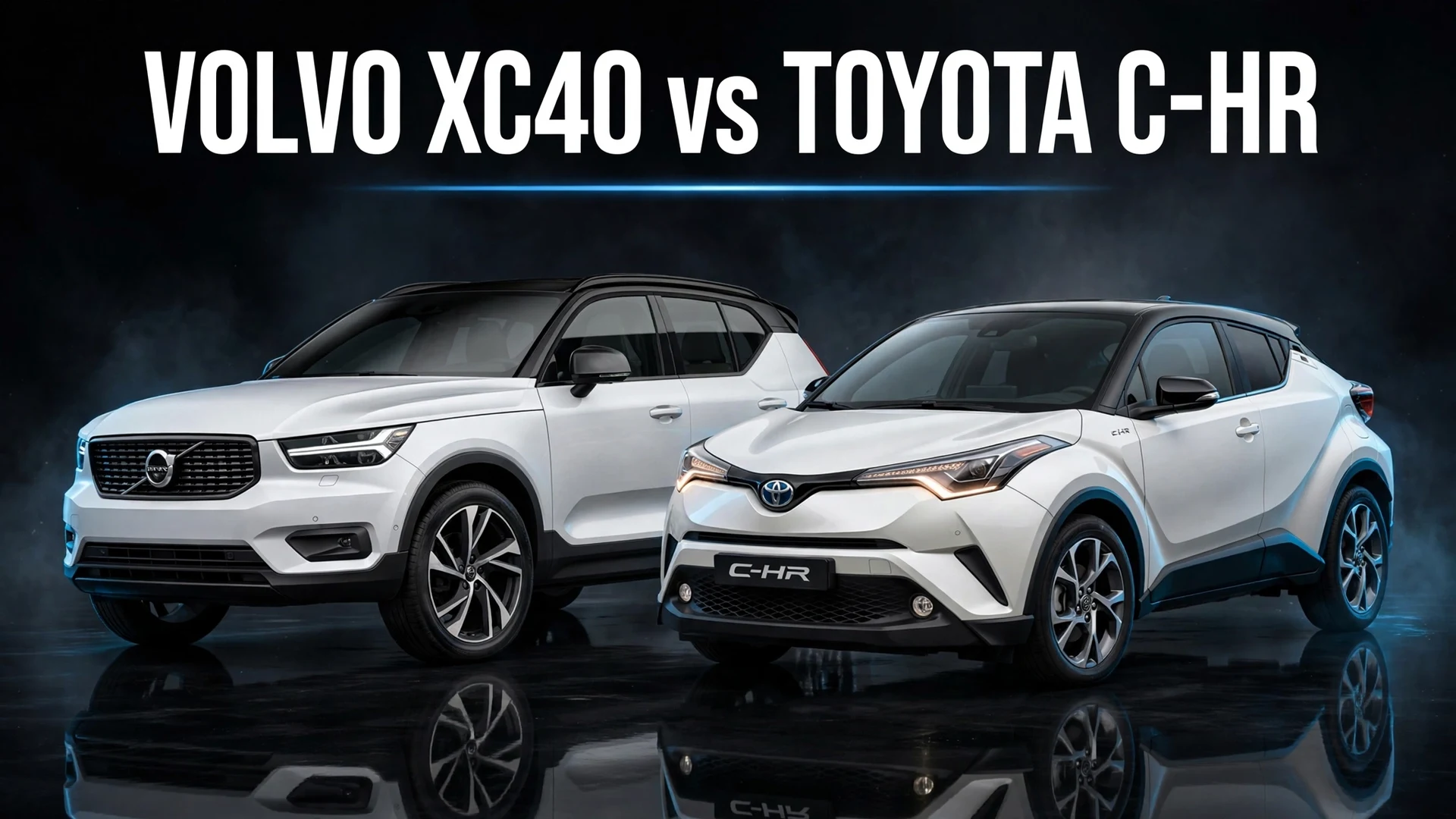
Volvo XC40 vs Toyota C-HR?

Shoppers cross-shopping the Volvo XC40 and Toyota C-HR in 2026 are in for a surprise: these two aren’t really rivals on paper anymore. The XC40 sticks with gas mild-hybrid power, while the C-HR just relaunched as a fully electric SUV — one of the more significant powertrain gaps you’ll find in a “compact SUV showdown.”
TL;DR
- The 2026 Volvo XC40 starts around $39,900–$41,195 and runs on a turbocharged 2.0L mild-hybrid engine, not a battery
- The 2026 Toyota C-HR relaunched as a fully electric SUV starting around $37,000–$38,450, with 338 hp and up to 287 miles of range
- Volvo’s electric equivalent is now a separate model, the EX40, not the XC40
- XC40 wins on interior materials, safety pedigree, and gas-engine simplicity
- C-HR wins on power, tech-forward EV features, and starting price
Volvo XC40 vs Toyota C-HR: The Short Answer
These are two different kinds of vehicles wearing similar “compact SUV” labels. The XC40 is a traditional gas mild-hybrid with Volvo’s signature safety and interior polish. The C-HR is now a dual-motor electric crossover with more power than most gas SUVs in its class. If you want a plug-in daily driver, the C-HR is the newer, quicker option. If you’d rather not think about charging at all, the XC40 keeps things simple.
I’ve tracked Volvo’s XC40/EX40 split and Toyota’s electrification rollout closely enough to know this comparison isn’t apples-to-apples anymore — and that matters more than trim-level nitpicking.
What Changed ?
The C-HR came back from a three-year hiatus as an EV, and that’s the headline. After a 2022 discontinuation, Toyota’s C-HR returned as a dual-motor, standard-AWD electric crossover with 338 net combined horsepower, a 74.7-kWh battery, and Toyota-estimated range up to 290 miles, according to Cars.com.
Meanwhile, Volvo split its XC40 lineup: the gas mild-hybrid keeps the XC40 name, while the fully electric version is now badged EX40 — a separate model entirely, per Volvo’s own U.S. site. That means a straight XC40-vs-C-HR comparison today is gas-hybrid vs. full EV, not EV vs. EV.
Pull quote: In 2026, comparing the XC40 to the C-HR means comparing a gas engine to a battery pack — not two versions of the same idea.
Specs at a Glance
| Feature | 2026 Volvo XC40 | 2026 Toyota C-HR |
|---|---|---|
| Powertrain | 2.0L turbo mild-hybrid (B4/B5) | Dual-motor, standard AWD, fully electric |
| Horsepower | 194 hp (B4) / 247 hp (B5) | 338 net hp |
| 0–60 mph | 8.1–6.1 sec depending on trim | ~5.0 seconds |
| Range/MPG | ~26 mpg combined (Ultra) | Up to 287 miles EPA-est. range |
| Starting MSRP | $39,900–$41,195 | $37,000–$38,450 |
| Cargo space | 20.1–20.4 cu ft | ~25.4 cu ft |
| Seating | 5 | 5 |
| Charging | N/A (gas) | NACS port, 10–80% in ~30 min DC fast |
The horsepower gap is the number that jumps out — Toyota’s electric C-HR nearly doubles Volvo’s base engine output, and its dual motors give it standard all-wheel drive without an upcharge.
Where the Volvo XC40 Pulls Ahead
It leads on interior refinement, familiarity, and Volvo’s safety reputation. The XC40 comes standard with Volvo City Safety, and its cabin uses genuine leather and wood trim even in the entry-level Core, per Volvo Cars Cincinnati’s rundown of hanges.
A few things Toyota doesn’t match:
- Adaptive cruise control and front park assist are now standard across the line
- Available 600-watt Harman Kardon sound system with 13 speakers
- No range anxiety or charging planning — just fill up and go
- A longer track record of Volvo’s safety-first engineering culture
Quick Tip: If you drive long distances without reliable charging access, or you just want zero learning curve, the XC40’s gas mild-hybrid setup removes one entire category of decision-making from ownership.
Where the Toyota C-HR Pulls Ahead
It leads on power, price, and efficiency for the electric-curious buyer. The C-HR’s dual-motor setup produces 338 hp and 323 lb-ft of torque, enough for a 0-60 sprint around five seconds — figures that outmuscle every XC40 trim, including the range-topping B5 Ultra.
Expert Insight: The XC40 asks you to pick an engine size. The C-HR asks you to pick a wheel size — 18-inch wheels net more range, 20-inch wheels look sharper but trim a few miles off the top.
Real-world scenario: A commuter with home charging access and a 40-mile round trip could run the C-HR for a fraction of the XC40’s fuel cost, while still having more power on tap for highway merges — provided they’re comfortable planning occasional road trips around DC fast chargers.
Pros and Cons by Buyer Type
The Charging-Averse Buyer
- ✅ Volvo XC40: gas mild-hybrid means no charging logistics, ever
- ❌ Toyota C-HR: requires home or public charging access to make sense
The Tech-Forward Commuter
- ✅ Toyota C-HR: more power, lower starting price, standard AWD, EV efficiency
- ❌ Volvo XC40: costs more to start and offers less power at every trim
The Interior/Safety-Focused Family Buyer
- ✅ Volvo XC40: standard City Safety, premium cabin materials, strong reliability ratings
- ❌ Toyota C-HR: safety ratings from NHTSA/IIHS aren’t yet published for the redesigned model
Alternatives Worth Considering
Choose the Volvo EX40 if you want Volvo’s safety and interior quality but in a fully electric package that actually competes with the C-HR on powertrain terms.
Choose the Toyota RAV4 or Corolla Cross Hybrid if you want Toyota’s proven hybrid formula without going fully electric — the C-HR’s old lane, now filled by other models in Toyota’s lineup.
FAQ
Is the 2026 Toyota C-HR a hybrid or fully electric? It’s fully electric. Toyota relaunched the C-HR for 2026 as a dual-motor EV after discontinuing the old gas-powered version in 2022.
Does the Volvo XC40 come in an electric version? Not under the XC40 name anymore. Volvo’s electric compact SUV is now sold separately as the EX40.
Which is more powerful, the XC40 or the C-HR? The C-HR, by a wide margin — its dual electric motors produce 338 net horsepower, compared to 194–247 hp across XC40 trims.
Which one costs less to start? The Toyota C-HR starts lower, around $37,000–$38,450, versus the Volvo XC40’s $39,900–$41,195 starting range (as of mid-2026).
How much range does the C-HR get on a full charge? Up to 287 miles on the SE trim’s 18-inch wheels, dropping slightly to around 273 miles on the XSE’s larger 20-inch wheels.
Key Takeaways
- The XC40 and C-HR are no longer comparable on powertrain terms — one’s gas, one’s electric
- Volvo moved its EV compact SUV to a new name, the EX40, leaving the XC40 as gas-only
- The C-HR’s 338 hp beats every XC40 trim, and it starts at a lower price
- XC40 still wins on interior materials, standard safety tech, and no-charging simplicity
- Buyers should decide on powertrain type first, then compare trims within that choice
Next Step
Decide whether you want a gas or electric compact SUV first — then compare the XC40 against the EX40, or the C-HR against similarly priced EVs, for an apples-to-apples matchup.