
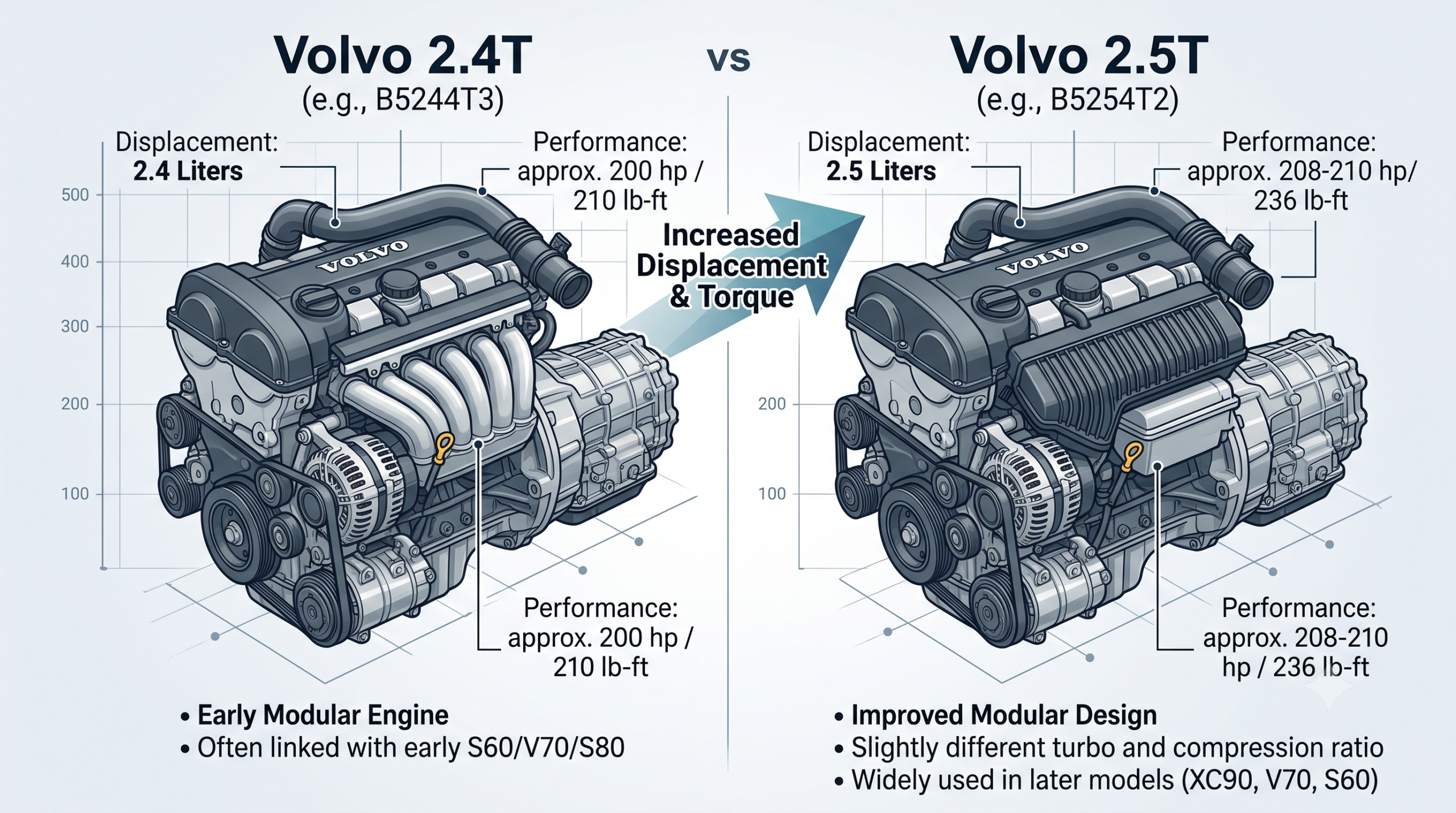
Volvo 2.4T vs 2.5T?

Shop for a used Volvo from the early 2000s and you’ll run into two similar-sounding engine badges: 2.4T and 2.5T. They look like a rounding error, but the difference actually comes down to a longer stroke, dual variable valve timing, and a real bump in low-end torque.
TL;DR
- The 2.4T is Volvo’s earlier low-pressure turbo five-cylinder, producing around 200 hp
- The 2.5T replaced it with a slightly longer stroke, adding displacement and dual VVT
- Power went up modestly, from roughly 200 hp to 210 hp, but torque saw a bigger jump
- Both use a small, low-inertia turbo tuned for early boost rather than top-end power, unlike the bigger-turbo T5
- The 2.5T is generally considered the better all-rounder, though the 2.4T is nearly as capable day to day
Volvo 2.4T vs 2.5T: The Short Answer
The 2.5T is the mild upgrade, not a different engine philosophy. Volvo stretched the 2.4T’s stroke by about 3mm to create the 2.5T, added dual variable valve timing, and picked up a meaningful torque increase at low RPM. If you’re choosing between two otherwise similar used Volvos, the 2.5T is the slightly newer, slightly stronger pick — but the 2.4T won’t leave you wanting in daily driving.
I’ve spent time in Volvo owner forums and technical archives tracking exactly what changed between these two badges, since Volvo’s own literature doesn’t spell it out clearly.
Why Two Nearly Identical Engines Exist
Volvo’s turbocharged inline-five came in two distinct tunes: a low-pressure turbo (badged 2.4T, then 2.5T) for smooth, everyday torque, and a high-pressure turbo (badged T5) for outright power. Forum consensus from longtime owners describes the low-pressure turbo as delivering effortless torque from low RPM, making for relaxed, confident cruising rather than peaky performance.
The 2.5T succeeded the 2.4T with a longer stroke that added roughly 100cc of displacement, along with dual VVT, which the 2.4T never received.
Pull quote: The 2.5T isn’t a new engine — it’s the 2.4T with a longer stroke and better breathing.
Specs at a Glance
| Feature | Volvo 2.4T | Volvo 2.5T |
|---|---|---|
| Displacement | 2.4L | ~2.5L (3mm longer stroke) |
| Horsepower | ~200 hp | ~208–210 hp @ 5,000 rpm |
| Torque | Lower peak, narrower band | 236 lb-ft @ 1,500–4,500 rpm |
| Valve timing | Single VVT | Dual VVT |
| Turbo type | Small, low-inertia, low-pressure | Small, low-inertia, low-pressure |
| Common platforms | S60, V70, XC70 (early 2000s) | S60, V70, XC70 (later 2000s) |
| Compared to T5 | Less peak power, smoother low-end | Less peak power, smoother low-end |
For context, the high-pressure T5 of the same era made around 247 hp with torque peaking higher in the rev range, at 2,400–5,200 rpm, versus the 2.5T’s earlier and broader 1,500–4,500 rpm torque band.
Where the 2.5T Pulls Ahead
It leads on torque delivery and refinement, not raw horsepower. The bump from roughly 210 lb-ft to 236 lb-ft of torque was the real headline improvement, according to longtime Volvo forum members who’ve owned both engines back to back.
A few things the 2.5T offers that the 2.4T doesn’t:
- Dual variable valve timing for smoother power delivery and better efficiency
- A noticeably stronger mid-range pull, useful for passing and hill climbs
- The newer of the two designs, meaning slightly fresher engineering by production date
Quick Tip: If you’re cross-shopping two similarly priced, similarly conditioned used Volvos, the 2.5T is the safer bet for long-term satisfaction — the extra torque is noticeable in everyday driving, not just on paper.
Where the 2.4T Still Holds Up
It leads on simplicity and proven reliability, with only a modest performance gap. Long-term owners who’ve driven both note the 2.4T has plenty of low-down pull for everyday needs, and question whether the 2.5T’s extra output justifies its price premium in some markets.
Expert Insight: Unless you’re chasing every last torque figure, a well-maintained 2.4T won’t feel like the “lesser” engine in daily use — it’s the same core design philosophy with slightly less refinement.
Real-world scenario: A commuter cross-shopping a 2003 V70 2.4T against a 2005 V70 2.5T at similar prices and mileage will notice the 2.5T pulls a bit harder in the mid-range, but both will comfortably handle daily commuting, highway merging, and moderate towing duties.
Pros and Cons by Buyer Type
The Budget-Conscious Used Buyer
- ✅ Volvo 2.4T: often priced lower, still plenty capable for daily driving
- ❌ Volvo 2.5T: sometimes carries a price premium for the torque bump
The Highway/Passing-Power Buyer
- ✅ Volvo 2.5T: stronger low-to-mid-range torque, smoother dual-VVT delivery
- ❌ Volvo 2.4T: adequate but noticeably less muscular in the mid-range
The DIY Maintenance Buyer
- ✅ Volvo 2.4T: simpler single-VVT design, slightly less to go wrong
- ❌ Volvo 2.5T: dual VVT adds a bit more complexity to diagnose
Alternatives Worth Considering
Choose the T5 if you want genuine top-end power and don’t mind more turbo lag around town — it’s the high-pressure sibling to both the 2.4T and 2.5T.
Choose the V70R (AWD) if you want the most capable version of this engine family, combining turbo power with all-wheel drive for year-round confidence.
FAQ
Is the 2.5T just a bored-out 2.4T? Not exactly bored out — it has a longer stroke, about 3mm more, which adds roughly 100cc of displacement along with dual variable valve timing that the 2.4T lacks.
How much more power does the 2.5T actually have? Around 208–210 hp versus roughly 200 hp for the 2.4T, but the more meaningful difference is torque, which climbs to 236 lb-ft on the 2.5T with a broader, lower-RPM band.
Is the 2.5T more reliable than the 2.4T? Both are considered durable engines by long-term owners, though some tuners prefer the 2.4T-era block for its thicker cylinder walls when modifying for higher boost.
Can you swap a 2.5T into a car originally built with a 2.4T? Yes, owners have done it, though it requires accounting for the 2.5T’s dual VVT system, different sensors, and connector differences versus the 2.4T harness.
Is the T5 worth choosing over either the 2.4T or 2.5T? If outright power matters most, yes — the T5 makes meaningfully more horsepower, though owners note the low-pressure 2.4T and 2.5T feel more effortless around town thanks to earlier turbo spool.
Key Takeaways
- The 2.5T is an evolution of the 2.4T, not a separate engine family
- The biggest real-world difference is torque, not horsepower
- Dual VVT arrived with the 2.5T and improved power delivery smoothness
- Both use a small, low-pressure turbo tuned for low-end pull over top-end power
- The T5’s high-pressure turbo remains the step up for buyers chasing raw performance
Next Step
Compare the specific model year and mileage of any 2.4T or 2.5T Volvo you’re considering — the engine difference matters less than the individual car’s maintenance history.