Volvo B4 vs D4?

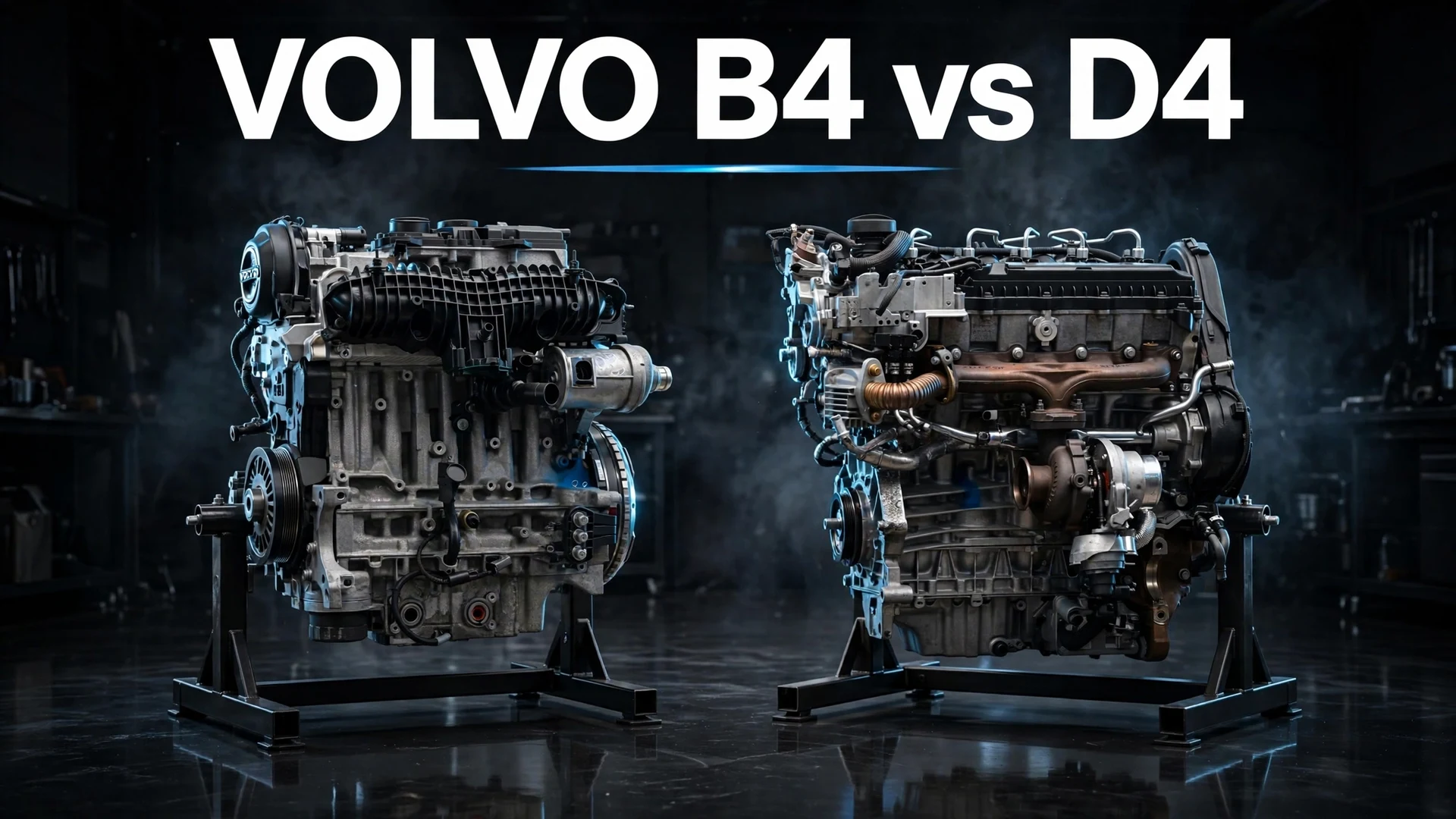
Cross-shopping a used Volvo and seeing both B4 and D4 badges on similar-looking cars? You’re not imagining the confusion — Volvo used “B4” for both a mild-hybrid diesel and a mild-hybrid petrol engine depending on the model and market, while D4 is the older, non-hybridized diesel it replaced.
TL;DR
- D4 is Volvo’s standard 2.0-litre diesel, without any mild-hybrid electrical assistance
- B4 replaced D4 as Volvo’s mild-hybrid engine badge — confusingly, B4 exists in both diesel and petrol form depending on the model
- The mild-hybrid system adds a 48-volt Integrated Starter Generator (ISG) and regenerative braking, not plug-in electric range
- Power gains are modest: roughly 7 extra hp and around 20 extra Nm of torque over the equivalent D4
- Real-world fuel economy differences between B4 and D4 are often small, and D4 diesel can still beat B4 on outright mpg
Volvo B4 vs D4: The Short Answer
B4 is the mild-hybrid successor to D4, but the two aren’t always the same fuel type. In most markets, Volvo’s B4 diesel directly replaced the D4 diesel, adding a 48-volt mild-hybrid system for smoother stop-start and slightly better efficiency. But Volvo also uses “B4” for a separate mild-hybrid petrol engine on certain models, like the XC40 — so always check whether a specific B4 listing is diesel or petrol before assuming it’s a direct D4 replacement.
I’ve pulled together UK press reviews and owner forum threads that specifically compare these two badges side by side, since Volvo’s own naming convention doesn’t make the distinction obvious.
What “B” Actually Means
Volvo’s B Series badge represents a standard 48-volt mild hybrid system, using an Integrated Starter Generator (ISG) to help the engine fire up faster and provide extra power under load, easing the engine’s burden to unlock better fuel economy and lower emissions. This is a self-charging mild hybrid, not a plug-in system — there’s no pure-electric driving mode.
Volvo positioned the diesel version of B4 as a like-for-like power upgrade over D4, while the mild-hybrid diesel adds 7bhp to the diesel engine compared to its previous D4 form, raising output to 197bhp with an additional 20Nm of torque.
Pull quote: B4 isn’t a new engine — it’s the same D4 diesel block with a 48-volt electrical assistant bolted on.
Specs at a Glance
| Feature | Volvo D4 (diesel, no hybrid) | Volvo B4 (diesel mild hybrid) |
|---|---|---|
| Engine | 2.0L diesel | 2.0L diesel + 48V ISG |
| Horsepower | ~190 hp | ~197 hp |
| Torque | ~400 Nm | ~420 Nm |
| 0-62 mph | Slightly slower | 8.3 seconds (XC60 B4) |
| WLTP economy | Up to 48 mpg | Up to 46.3 mpg |
| CO2 emissions | 129–135 g/km | 142 g/km |
| Plug-in capability | No | No (self-charging only) |
Interestingly, official WLTP figures on the XC60 actually favored the older D4 slightly on both fuel economy and emissions, despite the B4’s added hybrid hardware — a counterintuitive result that surprised more than one reviewer.
Where the B4 Pulls Ahead
It leads on refinement and low-speed driveability, not outright efficiency numbers. The mild-hybrid system provides extra torque from 0 rpm, giving the car a useful additional shove under acceleration and smoothing out Volvo’s occasionally jerky eight-speed transmission.
A few things the B4 offers that the D4 doesn’t:
- Smoother, quicker start-stop operation, since it doesn’t rely on the traditional starter motor
- Slightly stronger real-world acceleration thanks to instant electric torque fill
- A foundation technology Volvo used as groundwork for its broader electrification push
Quick Tip: If most of your driving is stop-and-go city traffic, the B4’s smoother restart behavior and low-end torque assist will likely feel more noticeable day to day than its modest power spec-sheet advantage suggests.
Where the D4 Still Makes Sense
It leads on outright fuel economy and, often, purchase price for the same-age used car. One detailed UK review found the D4 diesel returns up to 48mpg and emits between 129 and 135g/km of CO2 — genuinely better than the B4’s official figures in the same test.
Expert Insight: The B4’s hybrid hardware helps refinement more than it helps your fuel bill — if efficiency is your only priority, don’t assume “newer and hybrid” automatically beats the older D4.
Real-world scenario: A high-mileage motorway commuter chasing the lowest possible fuel costs might actually be better served by a well-maintained D4, while a driver doing mostly urban stop-and-go trips will likely appreciate the B4’s smoother low-speed manners more than the mpg difference matters.
Pros and Cons by Buyer Type
The Fuel-Economy-First Buyer
- ✅ Volvo D4: often slightly better real-world and official mpg figures
- ❌ Volvo B4: hybrid hardware doesn’t always translate to a genuine efficiency win
The City/Stop-and-Go Commuter
- ✅ Volvo B4: smoother restarts, useful low-end torque fill from the electric motor
- ❌ Volvo D4: fine, but lacks the B4’s added refinement at low speeds
The Used-Car Value Shopper
- ✅ Volvo D4: typically cheaper to buy, simpler mechanically, one less system to maintain
- ❌ Volvo B4: newer tech may hold resale value slightly better, per anecdotal owner reports
Alternatives Worth Considering
Choose the B5 if you want a more meaningful power step over D4/D5 — it offers noticeably higher horsepower alongside the same mild-hybrid benefits.
Choose the T8 Twin Engine if you actually want plug-in electric range — neither the B4 nor D4 offers pure-EV driving, but the T8 does.
FAQ
Is Volvo’s B4 engine diesel or petrol? It depends on the model — Volvo uses “B4” for both a mild-hybrid diesel (succeeding D4 on models like the XC60) and a separate mild-hybrid petrol engine on models like the XC40, so always confirm fuel type before buying.
Does the B4 offer a plug-in electric mode? No — it’s a self-charging mild hybrid with a 48-volt system, meaning the battery charges only through the engine and regenerative braking, with no pure-electric driving mode.
Is the B4 more fuel-efficient than the D4? Not necessarily — in at least one detailed comparison, the older D4 diesel returned slightly better official mpg and lower emissions than its B4 successor, despite the added hybrid hardware.
How much more power does the B4 have over the D4? Typically around 7 additional horsepower and roughly 20 Nm more torque, a modest but noticeable real-world difference, especially at low speeds.
Should I buy a used D4 or B4 Volvo? If pure fuel economy and lower purchase price matter most, the D4 remains competitive; if you want smoother low-speed driving manners and slightly newer technology, the B4 is the better pick.
Key Takeaways
- B4 replaced D4 as Volvo’s mild-hybrid engine badge, but B4 also exists in petrol form on other models
- The mild-hybrid system adds a 48V ISG and regenerative braking, not plug-in capability
- Power gains over D4 are modest — around 7 hp and 20 Nm more torque
- D4 can still out-perform B4 on official fuel economy figures in some comparisons
- Choose based on driving style: B4 for city refinement, D4 for outright efficiency
Next Step
Confirm the specific fuel type and model year before comparing any B4 to a D4 — the badge alone doesn’t guarantee you’re comparing diesel to diesel.