Volvo FH16 750 vs Scania R730?

Volvo FH16 750 vs Scania R730
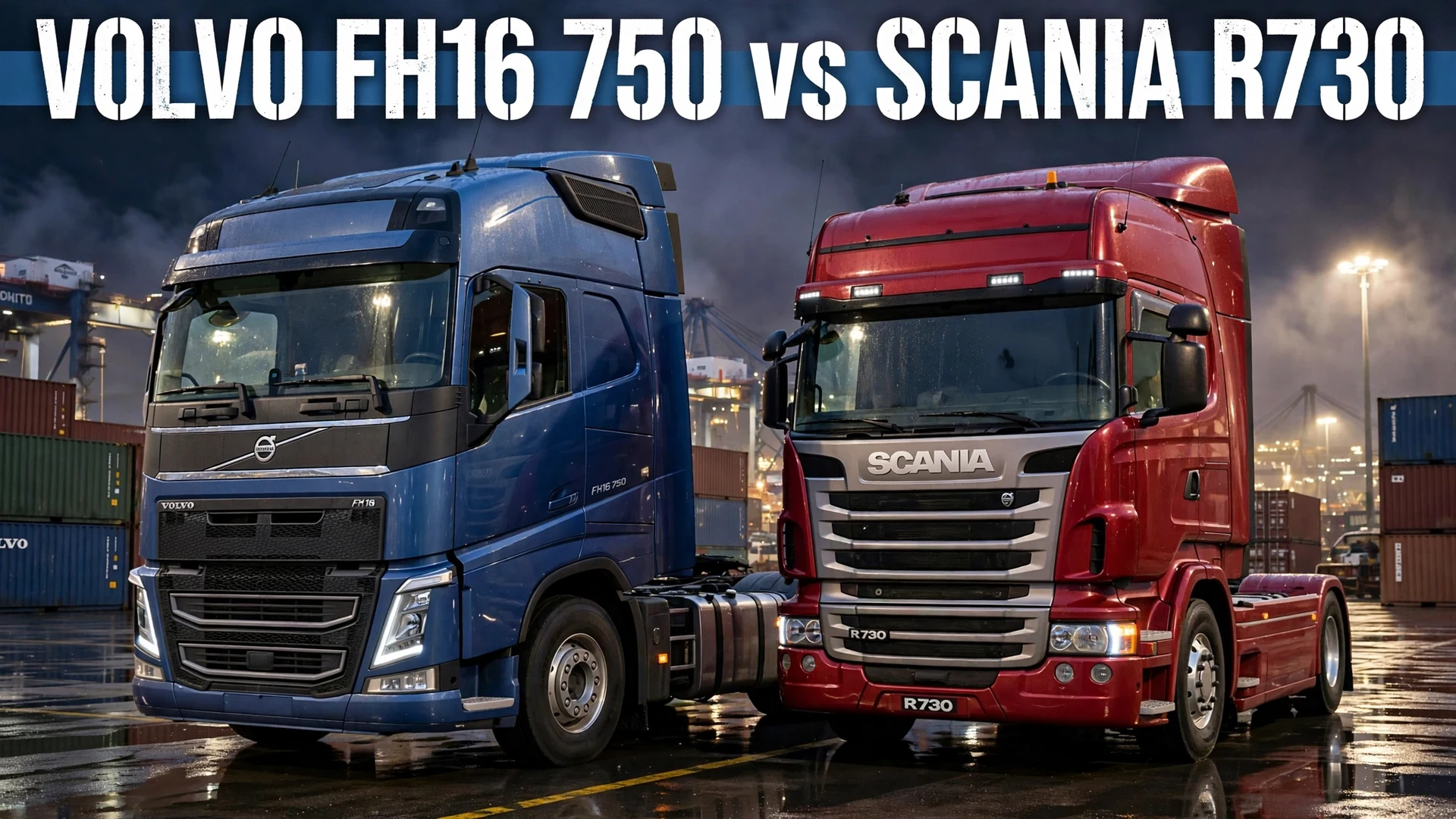
The Volvo FH16 750 and Scania R730 defined Europe’s horsepower war: Volvo’s 750 hp, 3,550 Nm inline-six against Scania’s 730 hp, 3,500 Nm V8. The Volvo wins on paper for power, torque and tested fuel economy; the Scania’s V8 pulls from lower revs and holds a cult following among heavy-haul operators. Neither is sold new in North America. Here are the verified specs, real road-test data, and which flagship suits which job.
Key Takeaways
- The FH16 750’s D16K750 makes 750 hp (552 kW) and 3,550 Nm from a 16.1-litre inline-six; the R730’s DC16 makes 730 hp (537 kW) and 3,500 Nm from a 16.4-litre V8.
- Commercial Motor road tests gave Volvo the fuel-economy edge: the FH16 700 averaged 7.81 mpg overall versus the R730’s 8.19/7.02 mpg across a two-day test (different days, different weather).
- Scania’s V8 delivers peak torque from just 1,000 rpm and proved itself in 80-220 tonne Australian road-train service.
- Neither truck is available new in the US or Canada; Scania stopped importing trucks to the US at the end of 1992.
- As of 2026 the war has moved on: Volvo’s FH16 780 (780 hp, 3,800 Nm) currently holds the most-powerful-production-truck title.
The Horsepower War, Briefly
Scania struck first in this round: the 730 hp V8 R730 launched in April 2010 and claimed the most-powerful-production-truck crown. Volvo answered on 9 September 2011 with the FH16 750 (750 hp, 3,550 Nm), presented to mark 25 years of Volvo’s 16-litre engine, which began in the 1987 Volvo F16 at 470 hp. The lineage runs 470 hp (1987), 520 hp (1993), 610 hp (2003), 700 hp (2009, when Volvo became the first maker to badge a series truck at 700 hp), then 750 hp.
The FH16 750 held the title for a decade until Scania’s 770 hp V8 (3,700 Nm) arrived in September 2020. Volvo retook it in 2024 with the FH16 780: a 17-litre D17 making 780 hp and 3,800 Nm, which Volvo calls Europe’s most powerful truck, with on-road tests showing 5% better fuel economy than the D16. Both trucks compared here were sold in Euro 5/EEV form at launch, with Euro 6 versions following in 2014.
Engine Philosophy: Inline-Six vs V8
Volvo’s D16K750 is a 16.1-litre inline-six: single overhead camshaft, four valves per cylinder, and a dual-stage turbocharger on the Euro 6 version. It makes 750 hp (552 kW) at 1,600-1,700 rpm and 3,550 Nm across 950-1,400 rpm. Volvo tuned it for high average speeds and efficient cruising, with pilot injection softening the engine note.
Scania’s DC16 730 is a 16.4-litre 90-degree V8 on a compacted graphite iron block, with XPI common-rail injection and a variable-geometry turbocharger. It makes 730 hp (537 kW) at 1,900 rpm and 3,500 Nm from 1,000-1,400 rpm. The V8 lugs from lower revs and holds gears on grades, which is why heavy-haul operators prize it: Australian reviewers found an 80-tonne B-triple combination “a walk in the park” for the R730.
The honest summary: Volvo optimized for efficient, fast cruising; Scania for low-rev pulling muscle. Twenty horsepower and 50 Nm separate them on paper, but the delivery feels different from the driver’s seat.
Head-to-Head Specifications
| Specification | Volvo FH16 750 | Scania R730 |
|---|---|---|
| Engine | D16K750, 16.1 L inline-six, single overhead cam | DC16 730, 16.4 L 90° V8, compacted graphite iron block |
| Max power | 750 hp (552 kW) at 1,600-1,700 rpm | 730 hp (537 kW) at 1,900 rpm |
| Max torque | 3,550 Nm at 950-1,400 rpm | 3,500 Nm at 1,000-1,400 rpm |
| Displacement | 16.1 litres | 16.4 litres |
| Transmission | I-Shift 12-speed automated; crawler-gear version available | Opticruise 14-speed automated (12 + 2 crawler gears) |
| Emissions | Euro 5/EEV at launch; Euro 6 from 2014 | Euro 5/EEV at launch; Euro 6 from 2014 |
| Documented max combination weight | Up to 325 tonnes GCW with crawler gears (factory rating) | Proven in 200+ tonne road-train service (e.g. 220-tonne Pilbara quad) |
| Cabs | Sleeper, Globetrotter, Globetrotter XL, Globetrotter XXL | Highline and Topline R-series cabs |
| New in North America | Not available | Not available |
Power and Torque Compared
Transmissions and Heavy-Haul Credentials
Both trucks use automated manuals with crawler gears for extreme work. Volvo’s I-Shift is a 12-speed splitter-and-range box; the crawler-gear version carries Volvo’s factory rating of up to 325 tonnes GCW. Scania’s Opticruise in the R730 is a 14-speed (12 + 2 crawler), and its reputation was earned in service: an 8×8 R730 converted to 10×8 in Western Australia’s Pilbara was configured to lead a quad road train of up to 220 tonnes of iron ore, running six and a half days a week.
Engine braking matters here too: Volvo’s VEB+ on the Euro 6 FH16 delivers up to 470 kW of braking effect at 2,200 rpm, cutting wear on the wheel brakes on long descents.
Fuel Economy: What Real Tests Found
The UK’s Commercial Motor magazine tested both trucks on its demanding route, and the results remain the best head-to-head data available. The R730 (November 2011) returned 8.19 mpg on day one but 7.02 mpg on day two, when 15-25 mph westerly winds, torrential rain and standing water hit the run; the severe-gradients section alone managed 5.96 mpg, while easy A-roads returned 7.84 mpg. The Volvo FH16 700 (October 2009) averaged 7.81 mpg overall, with 9 mpg on the easy A-roads/motorway section, more than 1.1 mpg better than the R730 there. The magazine gave Volvo the overall economy edge.
Three caveats: the Volvo tested was the 700 hp version, not the 750 (Volvo stated the 750’s consumption was unchanged); the tests ran two years apart in different weather, so this is not a lab comparison; and the R730’s worst figures came in genuinely extreme conditions. Even so, the direction is consistent: the inline-six sips less on steady highway work, while the V8’s advantage is pulling power under maximum load, not fuel bills.
Cab Comfort and Driver Life
Both cabs are genuine driver-retention tools. The FH16 runs up to the Globetrotter XXL with Volvo’s Dynamic Steering, and reviewers consistently praise its driving position, visibility and low noise, helped by the D16’s pilot injection softening the engine note. Scania’s R-series Highline and Topline cabs are the V8’s natural home, and the V8 badge carries real status: in Norway, V8s account for around 60% of Scania’s truck sales. The trade-off is character: the V8’s soundtrack is part of the purchase for many owner-drivers; fleet buyers tend to prefer the Volvo’s quieter cruising.
A practical shopping tip: Scania bakes the power figure into the badge (R730 = R cab, 730 hp), while Volvo’s FH16 badge needs the power suffix checked on the data plate.
Where You Can Actually Buy One
From the US or Canada, you cannot order either new. The FH16 sells across Europe, Asia/Pacific, the Middle East, Africa and South America; Volvo Trucks North America sells the VNL range instead. Scania has no new-truck presence in North America: Scania USA announced on 18 June 1992 it would discontinue importing heavy trucks effective 31 December 1992, and today its American operation covers industrial and marine engines only.
Which Flagship for Which Job?
Long-haul, high average speed: the Volvo FH16 750. The inline-six showed better fuel economy in independent testing, torque spans 950-1,400 rpm, and the I-Shift is tuned for fast cruising. Pick the Volvo for time-critical European long-haul or heavy timber work at speed.
Heavy-haul and extreme combinations: close, leaning Scania for character and Volvo for rated capacity. Volvo publishes a 325-tonne GCW rating with crawler gears; the R730 earned its legend in 80-220 tonne Australian road-train and Pilbara mining service, where low-rev V8 torque shines on grades.
Driver comfort: both excel, differently. The FH16 (Globetrotter XL/XXL) is the quieter, more refined long-distance tool; the R730’s Highline/Topline cab plus V8 soundtrack is the emotional choice that keeps owner-drivers loyal. Fleet buyers: Volvo. Owner-drivers buying with the heart: Scania.
Verdict
The Volvo FH16 750 wins on paper: 20 hp more, 50 Nm more, a wider torque band, and the better result in the only independent head-to-head testing we could verify. For efficiency, high average speed and the highest published heavy-haul rating, the Volvo is the rational choice.
But the Scania R730 was never about paper figures. Its V8 makes peak torque from 1,000 rpm, pulls relentlessly on grades, and carries a desirability that shows up in resale values and driver loyalty, especially in Australia and the Nordics. For extreme heavy-haul where pulling character counts, or for an owner-driver buying with heart as well as spreadsheet, the R730 is the one you will love.
Sources
- Volvo Trucks FH16 product brochure: D16K ratings, I-Shift, 325-tonne GCW rating (volvotrucks.com)
- Automotive World: FH16 Euro 6 launch, spring 2014 (automotiveworld.com)
- Trucks Planet: FH16 750 launch, 9 September 2011 (trucksplanet.com)
- Commercial Motor archive: FH16 750 unveiling and R730 road test, 2011 (archive.commercialmotor.com)
- Scania R730 6×4 chassis specification: DC16 730, 730 hp (537 kW), 3,500 Nm (scania.com)
- The Truth About Cars: R730 launch, 24 April 2010 (thetruthaboutcars.com)
- TradeTrucks Australia: R730 review and Opticruise details (tradetrucks.com.au)
- Transport Engineer: Scania 770 hp V8 range launch (transportengineer.org.uk)
- Trucking magazine: Scania 770S road test (truckingmag.co.uk)
- Volvo Trucks: FH16 780 D17 launch, 2024 (volvotrucks.ph)
- Fully Loaded: R730 10×8 Pilbara mining specification (fullyloaded.com.au)
- BigMackTrucks: Scania USA import discontinuation, announced 18 June 1992 (bigmacktrucks.com)
Frequently Asked Questions
Can I buy a Volvo FH16 750 or Scania R730 in the United States?
No. The FH16 is sold in Europe, Asia/Pacific, the Middle East, Africa and South America, but not North America. Scania stopped importing trucks to the US at the end of 1992 and has not returned. Importing a used example privately would require EPA and DOT compliance work that makes it impractical.
Which is more fuel efficient, the FH16 750 or the R730?
Commercial Motor road tests give Volvo the edge: the FH16 700 averaged 7.81 mpg overall (9 mpg on easy motorway sections) versus the R730’s 8.19 mpg on day one and 7.02 mpg on day two. The tests ran two years apart in different weather, and the R730’s worst figures came in severe wind and rain. Volvo stated the 750’s consumption was unchanged from the 700.
Is Volvo Trucks the same company as Volvo Cars?
No. Volvo Cars makes passenger vehicles and is a separate company. Volvo Trucks, which builds the FH16, is part of the Volvo Group alongside Mack Trucks, Renault Trucks and UD Trucks.
Why did Scania stop selling trucks in North America?
Scania USA announced on 18 June 1992 that it would discontinue importing heavy trucks, effective 31 December 1992, after a difficult attempt to establish the brand in the mid-1980s against entrenched domestic competition. Its US operation now supports industrial and marine engines only.
What is the most powerful production truck you can buy in 2026?
The Volvo FH16 780, launched in 2024 with a 17-litre D17 engine making 780 hp and 3,800 Nm, which Volvo describes as Europe’s most powerful truck. Scania’s current flagship is the 770 hp V8 (3,700 Nm) from 2020. The FH16 750 and R730 compared here are one generation back.
Which should I choose: the FH16 750 or the R730?
Choose the FH16 750 for fuel-efficient long-haul work, high average speeds and the highest published heavy-haul rating (325 tonnes GCW). Choose the R730 for low-rev V8 pulling character on extreme combinations and grades, or as an owner-driver who wants the segment’s most desirable badge. Neither is sold new in North America.