Volvo vs Kenworth vs Peterbilt?

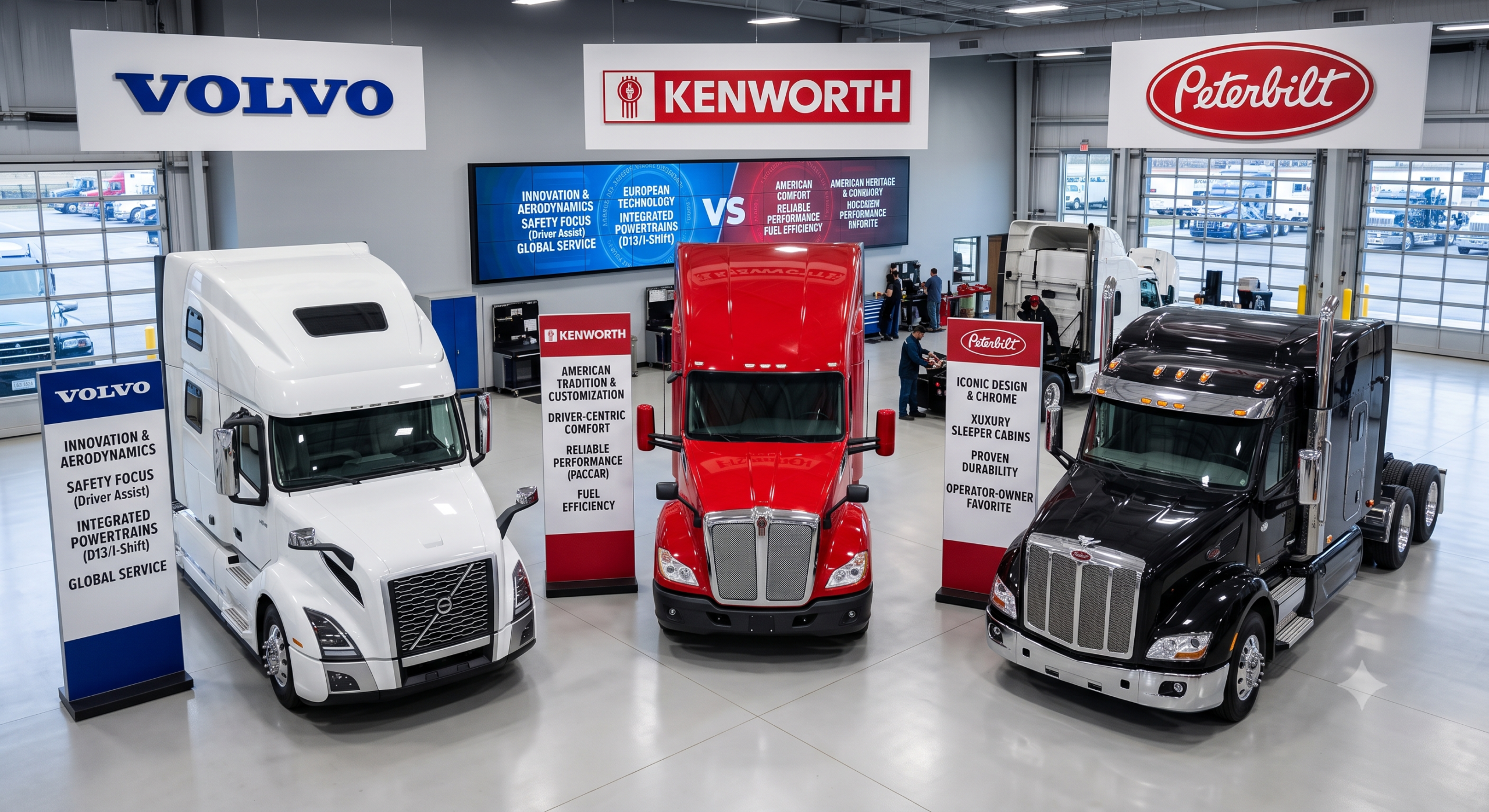
Quick answer: Volvo leads on driver safety tech and fuel efficiency, Kenworth balances classic long-hood comfort with durability, and Peterbilt wins on heritage, style, and that distinctive driving feel — but tends to cost more without necessarily beating the others on the fuel-economy scoreboard.
TL;DR
- Volvo (VNL series) emphasizes safety innovation, driver ergonomics, and fuel-saving technology like turbo compounding and the I-Shift automated transmission.
- Kenworth (T680, W900) is frequently voted the “best of both worlds” — classic styling plus genuine comfort, especially for taller drivers in sleeper configurations.
- Peterbilt (579, 389) trades some fuel-economy advantage for heritage styling and a driving feel owners describe as impossible to replicate elsewhere.
- Kenworth and Peterbilt are both owned by PACCAR and share engine options, so the real differences often come down to cab design and driver feel rather than mechanical fundamentals.
- Your best truck depends heavily on your route type — long-haul, regional, or short-haul — more than brand loyalty alone.
Volvo vs Kenworth vs Peterbilt: The Basics
These three trucks compete in the same Class 8 space but come from different corporate lineages. Volvo Trucks North America is part of the larger Volvo Group, the same company behind Volvo’s construction equipment and buses (and historically linked to Volvo Cars, though the two are now separate companies). Kenworth and Peterbilt are both owned by PACCAR, built in different factories — Kenworth in Chillicothe, Ohio, and Peterbilt in Denton, Texas — but sharing PACCAR’s in-house engines and many underlying components.
That shared ownership matters more than you’d think: depending on how a truck is specced, a Kenworth and a Peterbilt can end up mechanically similar under the skin, with the real differentiation coming down to cab design, dealer network, and driver feel rather than fundamentally different engineering.
Quick Tip: If you’re choosing based on parts and service access rather than driving feel alone, ask about dealer density in your actual routes — some drivers report Peterbilt-specific parts costing more or taking longer to source in certain regions.
Driver Comfort and Cab Design
Kenworth often wins this category outright, especially for the sleeper experience. One trucker survey found the Kenworth W900 repeatedly praised for cab comfort, with drivers specifically noting it’s “great for tall guys and by far the comfiest sleepers.” Kenworth’s Diamond VIT interiors add leather seating and heavy insulation that keeps noise and temperature swings down.
Peterbilt earns loyalty for a different reason — not raw comfort numbers, but a distinctive driving feel and heritage styling that owners describe almost emotionally. One trucker put it simply: “When I drove a Peterbilt for the first time, I instantly became a Peterbilt guy.”
Volvo takes a more ergonomics-and-safety-first approach, with world-class ergonomic seats, panoramic windshields, and a Dynamic Steering system designed specifically to reduce driver strain over long hauls.
Real-world scenario: A tall long-haul driver spending weeks at a time in the sleeper will likely gravitate toward the Kenworth’s cab dimensions and comfort reputation. A driver who wants their rig to feel like an extension of trucking heritage and doesn’t mind trading some efficiency for that experience often ends up loyal to Peterbilt.
Fuel Efficiency and Technology
Volvo consistently positions itself as the fuel-efficiency and safety-tech leader. Its D13 and D16 engines use turbo compounding technology specifically for extra efficiency, paired with the I-Shift automated transmission and lightweight aluminum/composite construction to cut weight and fuel burn. Volvo was also among the first manufacturers to introduce automatic emergency braking and lane-keeping assist in semi-trucks.
Kenworth counters with its own tech suite — TruckTech+ remote diagnostics, and optional AI-driven predictive cruise control that Kenworth claims can improve fuel efficiency by up to 6%. Peterbilt’s Driver Performance Assistant serves a similar role, helping drivers optimize fuel economy in real time.
Expert Insight: All three brands now offer genuinely competitive driver-assistance and remote diagnostics systems — the days of one brand having a clear technology monopoly are largely over. The differentiation has shifted toward how well that tech integrates with your specific fleet’s existing systems.
Comparison Table
| Category | Volvo (VNL) | Kenworth (T680/W900) | Peterbilt (579/389) |
|---|---|---|---|
| Known for | Safety tech, fuel efficiency | Comfort + durability balance | Heritage styling, driving feel |
| Engine options | Proprietary D13/D16 (turbo compounding) | PACCAR MX-11/MX-13, Cummins X15 | PACCAR MX-13, Cummins X15 |
| Best for | Long-haul, urban transport, safety-focused fleets | Long-haul drivers wanting comfort + toughness | Owner-operators who value style and feel |
| Sleeper comfort | Strong, especially Globetrotter cab | Frequently rated best-in-class, especially for tall drivers | Good, but secondary to styling |
| Fuel economy focus | High priority, dedicated tech | Strong, with predictive cruise tech | Present, but less the primary selling point |
| Ownership | Volvo Group | PACCAR | PACCAR |
Pros and Cons by Buyer Type
The Fleet Manager Prioritizing Uptime and Cost
- Volvo pros: Strong fuel efficiency reduces per-mile operating cost; robust safety tech can lower insurance and incident costs
- Volvo cons: Parts and service network may be less dense than PACCAR’s combined Kenworth/Peterbilt footprint in some regions
- Kenworth/Peterbilt pros: Shared PACCAR engine options mean broad parts availability across both brands
- Kenworth/Peterbilt cons: Premium specs and brand reputation often come with a higher upfront price tag
The Long-Haul Owner-Operator
- Kenworth pros: Frequently the top choice for sleeper comfort on multi-week hauls
- Kenworth cons: Historically priced higher than comparably specced Peterbilts in some builds
- Peterbilt pros: Distinctive driving feel and resale-friendly heritage appeal
- Peterbilt cons: Typically not the fuel-economy leader in this trio
The Safety and Tech-Focused Buyer
- Volvo pros: Early and consistent leader in active safety features like automatic emergency braking
- Volvo cons: Less of a “heritage” brand identity than Kenworth or Peterbilt among veteran drivers
- Kenworth/Peterbilt pros: Both now offer competitive ADAS suites and remote diagnostics
- Kenworth/Peterbilt cons: Safety tech innovation has historically been more associated with Volvo and Freightliner in industry discussions
Which Should You Choose?
Choose Volvo if fuel efficiency, active safety technology, and driver ergonomics are your top priorities, especially for long-haul or urban delivery routes where those savings compound.
Choose Kenworth if you want the strongest overall balance of comfort and durability, particularly if you’re a taller driver who’ll spend significant time in the sleeper.
Choose Peterbilt if heritage styling and a distinctive driving experience matter to you as much as the spec sheet — many owner-operators choose Peterbilt for reasons that go beyond pure economics.
Alternative to consider: If none of these three quite fit, Freightliner’s Cascadia remains the highest-volume choice in the US for a reason — strong fuel economy, low maintenance costs, and the widest dealer and parts network of any brand. Choose this if uptime and total cost of ownership matter more to you than brand loyalty or driving feel.
FAQ
Are Kenworth and Peterbilt actually different trucks, or just badges? They’re built in different factories (Kenworth in Chillicothe, Ohio; Peterbilt in Denton, Texas) with distinct cab designs and styling, but both are owned by PACCAR and often share engine options and underlying components. The real differences tend to show up in cab comfort, styling, and driver feel rather than core mechanicals.
Is Volvo a good choice for long-haul trucking? Yes. Volvo’s VNL series is a common recommendation for long-haul work specifically because of its fuel efficiency, driver ergonomics, and safety technology, and it appears consistently on long-haul shortlists alongside the Kenworth T680 and Peterbilt 579.
Which semi truck brand has the best resale value? Peterbilt and Kenworth are frequently cited as holding value well due to strong brand loyalty and demand, though this can vary significantly by model, spec, and market conditions at the time of resale.
Do Volvo trucks use the same engines as Kenworth and Peterbilt? No. Volvo uses its own proprietary D13 and D16 engines, while Kenworth and Peterbilt both offer PACCAR’s in-house engines (like the MX-13) as well as Cummins engine options, including the Cummins X15.
Which brand is best for short-haul or regional routes? For regional and short-haul work, trucks like the Kenworth T680 Next Gen, Freightliner Cascadia, Volvo VNR, and Peterbilt 567 are commonly recommended, since maneuverability and durability under frequent stop-and-go conditions matter more than long-haul sleeper comfort.
Key Takeaways
- Volvo leads on fuel efficiency and safety technology, making it a strong pick for cost-conscious, safety-focused fleets.
- Kenworth is frequently rated the best overall balance of comfort and durability, especially for sleeper cab use.
- Peterbilt trades some efficiency advantage for heritage styling and a distinctive driving feel many owner-operators value highly.
- Kenworth and Peterbilt share PACCAR ownership and engine options, so differences often come down to cab design rather than core mechanicals.
- Match your choice to your actual route type (long-haul, regional, short-haul) rather than brand reputation alone.
Ready to Start Shopping?
Whichever brand you’re leaning toward, spec out the truck against your actual routes and duty cycle before committing — the “best” truck is the one that fits your lanes, not just the one with the loudest fan base.