Volvo XC70 3.2 vs T6?

Two engines, one wagon, and a debate that’s kept Volvo forums busy for over a decade. If you’re shopping a used XC70, the 3.2 vs. T6 question is the first fork in the road — and it shapes everything from your monthly fuel bill to how the car feels on the on-ramp.
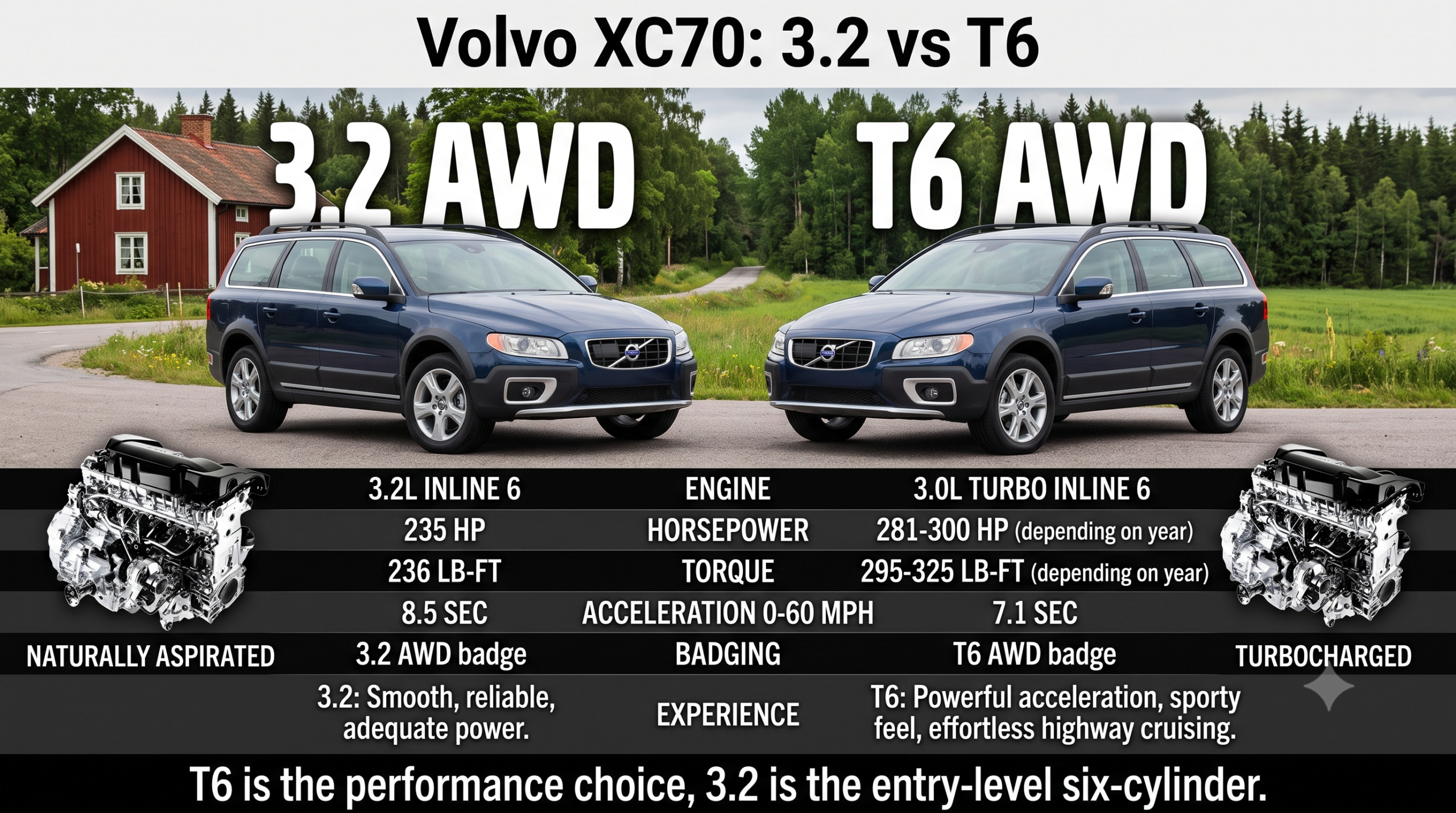
Quick answer: the 3.2 is the naturally aspirated 3.2-liter inline-6 with 235–240 horsepower, built for smooth, low-maintenance daily driving on regular gas. The T6 is the turbocharged 3.0-liter inline-6 with 281–300 horsepower, built for drivers who want real acceleration and don’t mind paying more for premium fuel and upkeep.
TL;DR
- The T6 makes roughly 60 more horsepower than the 3.2 and gets to 60 mph about two seconds faster.
- The 3.2 runs on regular unleaded; the T6 requires premium, adding real cost over time.
- Fuel economy is close on AWD models — the gap mostly shows up on FWD 3.2 trims, which get slightly better mpg.
- The T6 is AWD-only; the 3.2 was offered in both FWD and AWD depending on the model year.
- Owners are split on long-term reliability — some prefer the 3.2’s simplicity, others argue turbo maintenance concerns are overblown.
Volvo XC70 3.2 vs T6: The Core Difference
Both engines are inline-6 units, but they take completely different approaches to power. The 3.2 is a naturally aspirated 3.2-liter engine producing 235–240 horsepower depending on model year, while the T6 uses a turbocharged 3.0-liter block that pushed out 281 hp in earlier years and climbed to 300 hp in later ones.
That gap sounds modest on paper. In practice, it’s the difference between a wagon that feels adequate and one that feels genuinely quick. Edmunds clocked the 2013 T6 at 6.1 seconds to 60 mph, compared to a claimed 8.4 seconds for the 3.2 — a gap large enough to notice on every on-ramp.
Quick Tip: If you mostly drive in flat, low-traffic areas, the 3.2’s power deficit will bother you far less than it would in hilly terrain or dense city traffic where quick merges matter.
Power and Performance
The T6 wins decisively on raw performance. Owners who’ve driven both back-to-back consistently describe the 3.2 as noticeably slower and louder under acceleration, while the T6 feels smoother and doesn’t suffer from turbo lag once moving.
That said, “underpowered” doesn’t mean “unsafe” — several long-term 3.2 owners report the engine handles highway merging and passing just fine, especially for buyers who aren’t aggressive on the throttle. It’s a matter of preference more than a dealbreaker.
Real-world scenario: A driver doing mostly suburban errands and school runs will rarely miss the T6’s extra muscle. A driver who regularly merges onto fast-moving highways or tows a small trailer will likely find the 3.2 feels strained by comparison.
Fuel Economy and Running Costs
The 3.2 has a real, if modest, edge here — with one big asterisk. On the 2013 model year, the FWD 3.2 was EPA-rated at 19/25/21 mpg city/highway/combined, versus 17/23/20 for the T6 AWD. But once you add all-wheel drive to the 3.2, that gap nearly disappears — AWD 3.2 models return essentially the same mpg as the T6.
The bigger cost difference is fuel type. The 3.2 runs happily on regular 87-octane gas, while the T6 calls for premium. One owner’s math on a 15,000-mile annual driving habit put the extra fuel cost at roughly $500 a year for the higher-output engine.
Expert Insight: If you’re cross-shopping a FWD 3.2 against an AWD T6, you’re not just comparing engines — you’re comparing drivetrains too. Match trims apples-to-apples (AWD to AWD) before deciding fuel economy is a deciding factor.
Reliability and Long-Term Ownership
This is where opinions genuinely split, and it’s worth hearing both sides before you buy.
The case for the 3.2: It’s mechanically simpler with no turbocharger to eventually wear out, and some owners report it’s cheaper to insure and repair. One long-term owner logged 75,000 trouble-free miles on a 3.2 while averaging 26–29 mpg.
The case for the T6: Several owners argue the reliability gap is overstated, noting both engines were co-designed by Volvo and built by the same manufacturer used for Land Rover and Jaguar units. One owner who switched from a problem-plagued 3.2 (with unresolved oil-consumption issues) to a T6 called the difference “night and day” in a positive direction.
Quick Tip: Reliability on a used XC70 often comes down to how the individual car was maintained more than which engine it has. A well-documented service history should weigh more heavily than the badge on the trunk.
Comparison Table
| Category | XC70 3.2 | XC70 T6 |
|---|---|---|
| Engine | 3.2L naturally aspirated inline-6 | 3.0L turbocharged inline-6 |
| Horsepower | 235–240 hp | 281–300 hp |
| 0–60 mph | ~8.4 seconds | ~6.1 seconds |
| Drivetrain options | FWD or AWD (by model year) | AWD only |
| Fuel type | Regular (87 octane) | Premium recommended |
| EPA combined mpg (2013, comparable trims) | 21 (FWD) / 20 (AWD) | 20 (AWD) |
| Best for | Budget-conscious, low-maintenance driving | Drivers who want real acceleration |
Pros and Cons by Buyer Type
The Budget-Conscious Commuter
- 3.2 pros: Lower fuel costs, simpler engine, often cheaper purchase price used
- 3.2 cons: Noticeably slower, can feel strained under hard acceleration
- T6 pros: More confident merging and passing
- T6 cons: Premium fuel and typically a higher used purchase price
The Performance-Minded Daily Driver
- T6 pros: Genuinely quick for a wagon, smooth power delivery, no turbo lag once underway
- T6 cons: Higher running costs over time
- 3.2 pros: Still capable for daily use
- 3.2 cons: Feels noticeably less refined by comparison, according to multiple owner reports
The High-Mileage, Keep-It-Simple Buyer
- 3.2 pros: One less complex system (no turbo) to eventually service or replace
- 3.2 cons: Some model years reported oil-consumption complaints — check service records carefully
- T6 pros: Shares core engineering with the 3.2, so it’s not inherently less durable
- T6 cons: Turbo components add one more system that could eventually need attention
Which Should You Choose?
Choose the 3.2 if you want lower running costs, don’t need rapid acceleration, and plan to drive mostly around town or on flatter terrain.
Choose the T6 if you regularly merge onto fast highways, want the car to feel genuinely quick, and don’t mind paying a bit more for premium fuel and a likely higher purchase price.
Alternative to consider: If you’re shopping later model years, the T5 Drive-E (2015+) offers a turbocharged 2.0-liter four-cylinder with 240 hp and notably better fuel economy than either the 3.2 or T6. Choose this if you want strong power with better mpg and don’t need AWD.
FAQ
How much horsepower difference is there between the XC70 3.2 and T6? The gap is roughly 45–65 horsepower depending on model year, with the 3.2 producing 235–240 hp and the T6 producing 281–300 hp.
Does the XC70 3.2 require premium gas? No. The 3.2 is designed to run on regular 87-octane gasoline, while the T6 recommends premium fuel.
Is the XC70 T6 available with front-wheel drive? No. The T6 was offered as AWD-only, while the 3.2 was available in both front-wheel drive and all-wheel drive configurations depending on the model year.
Which engine is more reliable, the 3.2 or the T6? Owner opinions are genuinely mixed. Some prefer the 3.2’s mechanical simplicity, while others report no meaningful reliability difference between the two, since both engines share core engineering and manufacturing.
Is the T6 worth the extra cost? It depends on your priorities. If daily acceleration and highway confidence matter to you, many owners say yes. If you’re optimizing for lower running costs, the fuel economy and octane savings on the 3.2 add up over time.
Key Takeaways
- The T6 offers a meaningful performance advantage — about two seconds quicker to 60 mph than the 3.2.
- The 3.2 costs less to fuel, running on regular gas versus the T6’s premium requirement.
- Fuel economy is close once you compare AWD to AWD; the biggest mpg gap shows up against FWD 3.2 trims.
- Reliability opinions vary by owner more than by engine — a documented service history matters most.
- Later T5 Drive-E models offer a four-cylinder alternative worth considering if fuel economy is a priority.
Ready to Start Shopping?
Test drive both engines back-to-back if you can — the difference is easy to feel in person, and it’ll make the decision a lot easier than specs alone.