Volvo VNL 780 vs Freightliner Cascadia?

Pull into any truck stop from California to Pennsylvania, and you’ll see the same scene: rows of Cascadias parked nose-to-tail with Volvo VNLs. Drivers argue about which one’s better like it’s a sports rivalry—and both sides have real numbers to back them up.
TL;DR
- The VNL 780 was the flagship sleeper trim of Volvo’s previous-generation VNL lineup, before Volvo redesigned the VNL series in recent years with new naming
- The Cascadia is America’s best-selling Class 8 truck, built around Freightliner’s Detroit Integrated Powertrain
- Owner-operators generally describe the VNL as the more comfortable “driver’s truck”, citing quieter cabins and better ergonomics
- The Cascadia is generally described as the more predictable “business machine”, with faster parts turnaround and broader dealer network reach
- Real driver feedback is mixed on fuel economy—some report Cascadias with the DD15 beating VNLs, others report the opposite
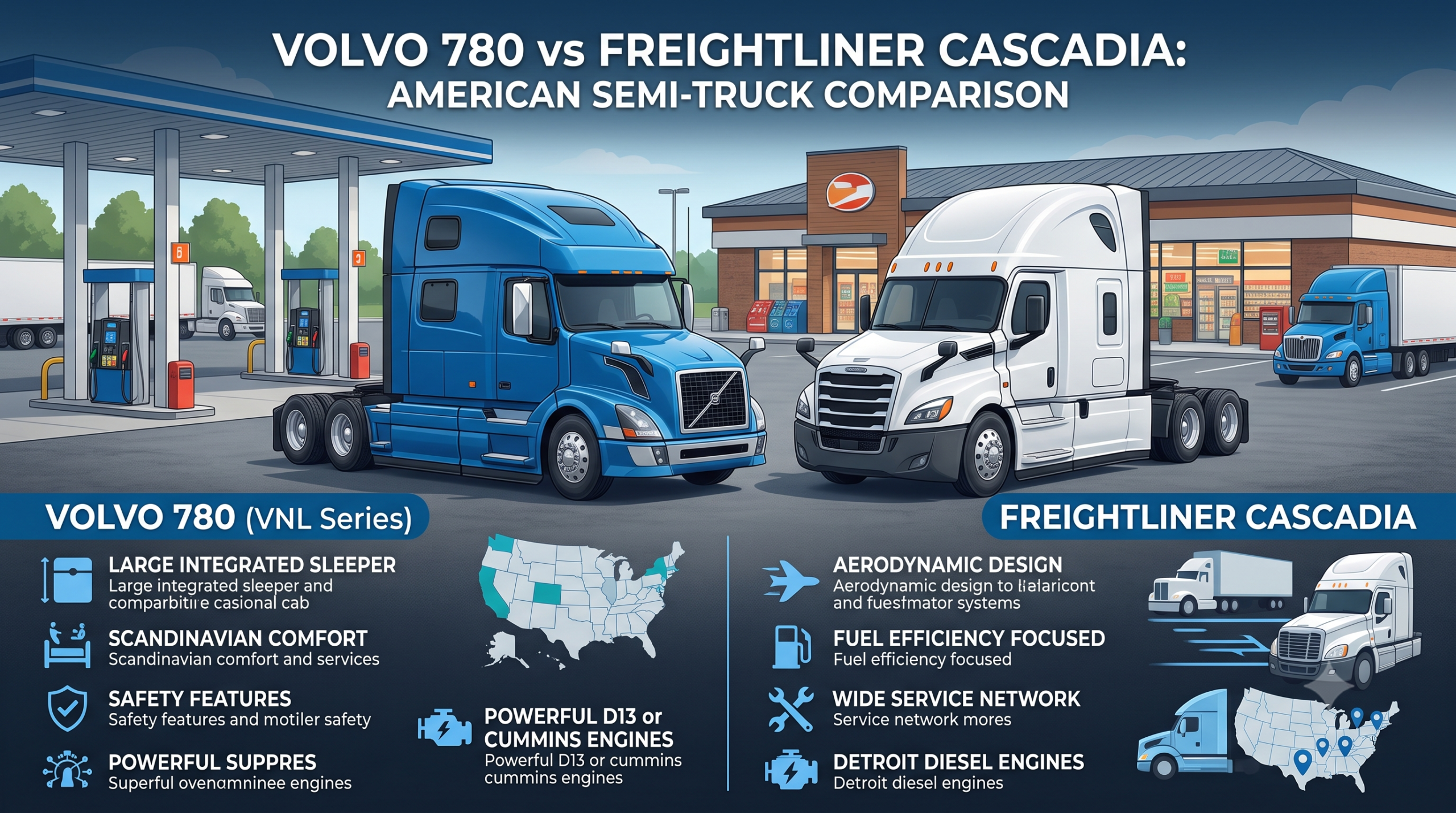
The core answer: the Volvo VNL 780 (the previous generation’s top sleeper trim) is generally regarded by drivers as the more comfortable, quieter, driver-focused truck, while the Freightliner Cascadia is generally regarded as the more predictable, faster-to-service “business machine” with a broader dealer network—meaning the right choice often comes down to whether you’re optimizing for driver comfort and retention or fleet uptime and parts availability.
Is the VNL 780 Still a Current Model?
This is worth clarifying before comparing specs, since Volvo has updated its lineup naming in recent years.
The VNL 780 was the flagship sleeper-cab trim in Volvo’s previous-generation VNL lineup (alongside trims like the 740, 760, and 860), but Volvo has since redesigned the VNL series with new trim naming. If you’re shopping new, confirm with a Volvo dealer whether you’re looking at a used previous-generation VNL 780 or Volvo’s current VNL lineup, since features and naming have changed.
Quick Tip: Most “VNL 780 vs. Cascadia” comparisons in the market today are really comparing a used or recent-model-year VNL 780 against a current or recent Cascadia—confirm exact model years before making a purchase decision.
How Do Comfort and Driving Experience Compare?
This is where driver opinion consistently favors one truck over the other.
According to fleet financing and trucking industry sources, the Volvo VNL is often perceived as having a slight edge in quietness, ride quality, and ergonomic design, with cabins engineered to reduce driver fatigue through features like Volvo Dynamic Steering and advanced seating. One driver reported that after switching to a VNL 860, their back pain dropped significantly, describing the cab as simply easier to live in.
Expert Insight: Owner-operator forum discussions consistently frame the tradeoff this way: the Cascadia offers more predictability and faster repairs when something breaks, while the VNL trades some of that repair-speed advantage for a noticeably more comfortable, fatigue-reducing cab—one Reddit trucker specifically noted that Freightliner “gets fixed faster,” while “Volvo feels nicer, but downtime hurts more when you’re waiting.”
VNL 780 vs. Cascadia: Side-by-Side
| Feature | Volvo VNL 780 | Freightliner Cascadia |
|---|---|---|
| Model status | Previous-generation flagship sleeper trim | Current, actively updated lineup |
| Cab comfort/quietness | Frequently praised by drivers | Solid, but generally rated below VNL by drivers |
| Dealer network | Smaller than Freightliner’s | Extensive, unmatched network across North America |
| Repair/parts turnaround | Reportedly slower in some driver reports | Generally faster, per driver feedback |
| Powertrain | Volvo engine + I-Shift transmission | Detroit Integrated Powertrain (DD13/DD15) |
| Fuel economy reputation | Strong, but mixed real-world driver reports | Strong, especially when properly spec’d |
| Safety tech | Volvo Active Driver Assist, Volvo Dynamic Steering | Detroit Assurance suite (Active Brake Assist, ACC, Lane Departure Warning) |
Pros and Cons by Buyer Type
Owner-Operators Prioritizing Driver Comfort
- ✅ Drivers consistently report reduced fatigue and back pain in VNL cabs, particularly larger sleeper configurations
- ✅ Volvo Dynamic Steering and quieter cabin design are frequently cited advantages
- ❌ Some drivers report longer wait times for Volvo-specific parts compared to Freightliner
Fleet Managers Prioritizing Uptime and Parts Access
- ✅ Freightliner’s extensive dealer and service network supports faster repair turnaround
- ✅ The Cascadia is widely regarded as a predictable, cost-effective workhorse at scale
- ❌ Cabin comfort and driver retention benefits may lag behind what a VNL fleet could offer
Fuel-Economy-Focused Buyers
- ✅ Both platforms can deliver strong fuel numbers when properly spec’d, according to driver and fleet reports
- ✅ Volvo’s Turbo Compound technology is cited as capable of saving up to 16% of fuel in certain configurations
- ❌ Real-world fuel economy varies significantly by driving habits, terrain, and load, per both trucking sources and drivers—don’t assume brand alone determines your MPG
Quick Tip: If driver retention is a business priority, consider that one fleet discussion specifically noted: “Our Cascadias get better fuel numbers, but the VNL drivers call in sick less”—a tradeoff worth weighing beyond pure fuel-cost math.
Real-World Scenario
Picture a fleet manager running long-haul regional routes with tight maintenance budgets and multiple service locations along common routes. The Cascadia’s broader dealer network and generally faster parts turnaround make it the lower-risk choice for minimizing downtime.
An owner-operator who spends extended stretches living in their sleeper cab, on the other hand, might prioritize the VNL’s quieter, more ergonomic cabin—accepting potentially longer waits for certain parts in exchange for daily comfort that reduces fatigue and back strain over hundreds of thousands of miles.
Which Should You Choose?
Choose the Cascadia if: you prioritize fast repairs, broad dealer access, and predictable fleet-wide maintenance costs.
Choose the VNL 780 (or current VNL equivalent) if: driver comfort, cabin quietness, and long-haul ergonomics are your top priorities, and you’re comfortable with potentially longer parts wait times.
Pull quote: One’s a driver’s truck. The other’s a business machine. There’s no universal winner—only the right fit for your lanes.
FAQ
Is the VNL 780 still available new? The VNL 780 was a trim in Volvo’s previous-generation VNL lineup; Volvo has since redesigned the VNL series with new trim naming, so confirm with a dealer whether you’re looking at a used previous-gen VNL 780 or Volvo’s current lineup.
Which truck has better fuel economy, the VNL or Cascadia? Driver reports are mixed—some report the Cascadia with the DD15 beating VNLs on fuel, while others report the opposite; real-world results depend heavily on spec, driving habits, terrain, and load.
Which is more reliable, Volvo or Freightliner? Driver forum feedback varies significantly by individual experience; some drivers report fewer issues with Volvo but slower parts availability, while others report more frequent issues with Freightliner units but faster repair turnaround.
Which has a bigger sleeper cab? This varies by specific trim and configuration on both brands—compare exact sleeper cab dimensions for the specific VNL and Cascadia trims you’re considering rather than assuming one brand is universally larger.
Which truck is better for driver retention? Anecdotal fleet feedback suggests VNL drivers report less fatigue-related absence, though this is based on informal fleet discussion rather than a controlled industry study.
Key Takeaways
- The VNL 780 was a previous-generation flagship trim—confirm current VNL naming and availability with a dealer
- The Cascadia is generally regarded as the more predictable, faster-to-service option
- The VNL is generally regarded as the more comfortable, driver-focused option
- Real-world fuel economy reports are mixed and depend heavily on spec and driving conditions
- The right choice depends on whether you prioritize driver comfort/retention or fleet uptime/parts access
What To Do Next
If possible, rent or test both trucks on your actual routes before committing—real-world fuel numbers, maintenance cycles, and driver feedback on your specific lanes will tell you more than any spec sheet comparison.